• The move to the new server is done. There are some software and database maintenance updates in process. This has us passing the hat around to help out. We appreciate any donations. Seriously, even a dollar helps. The payment page may be found here - https://www.audiokarma.org/support.html

Testing on Hickok 800 - 12AX7 vs ECC83 BIAS setting

ring

AK Subscriber
Subscriber
I couldn't find any discussion of this, so I'd appreciate your take:

Hickok 800 roll chart says 12AX7 wants a BIAS setting of 12, but the Hickok 800/800A euro tubes supplement says ECC83 wants BIAS at 7. No other settings differ. Should be no difference beyond the name, right?

As a 12AX7 this Telefunken gets 450|700 (of 1250 new)
Call it ECC83 and now it reads 1050|950 (of 1250 new)

Weathered Sylvania gets either 650|1050 or 950|1450
NOS looking Sylvania gets 1300|1275 or 1750|1725

Philips Miniwatt measures 550|600 or 750|850


12AU7 vs ECC82 listings show a similar issue (BIAS 24 vs 17), but the differences are smaller.

Gold Aero measures 1650|1600 or 1900|1850 (of 2200 new)

12AT7 vs ECC81 reverses the trend (BIAS 10 vs 13), but also changes the target value from 4400 to 3250. Haven't experimented with a 12AT7 yet to see if that balances out results.


Is Hickok trying to make euro tubes look good? Am I missing something? Any guidance on which chart is more useful?

Thank you
 
Register to hide this ad
Interesting!, I see what your saying with regards to the supplement. I'm not sure what the reason is why bias setting is different. Wondering if the "ENG" setting difference is an issue too?

Here's hoping some of the tube gurus stop by to explain/clarify

800

800 roll chart.png

800 Supplement

Screen Shot 2021-01-02 at 8.01.33 PM.png

:lurk:
 
This is confusing. I had an 800 but did not notice that. My TV7, a Hickok design, does not differentiate settings. I always tested these tubes like a 12AX7. An ECC83 is actually considered a premium 12AX7. Likewise, a 7025 is a premium tube, with important low noise characteristics (when new). Does the roll chart for 7025 specify measuring like an ECC83 ?

Usually, with Hickoks, when a tube is the "uprated" premium version, like a 7189 over a 6BQ5, the settings cause more stress during the testing. That makes the premium tube appear not as strong. For illustration, with a TV7, a new 6BQ5 will test near 100 over 50. The new testing 7189 will measure about 62 over 46. The 6BQ5 appears stronger, but we know the industrial strength 7189 really paseed the more strenuous, accurate test.

So, why would the 800 roll chart "handicap" the normal 12AX7 ? I know my other Hickoks do not differentiate these numbers for either versions. I will check this out further.
 
Well then, should the OP use the ECC83 settings ? The ECC83 results seem more in line with other Hickoks, but the bias number is lower than other Hickoks...
 
Last edited:
Thanks for all the responses!

So far as I know Tom is right and there should be no difference beyond name.

@Dswankey As I understand the specific English/Shunt setting is only for pass/fail testing, not for microhmo readings. For 12AX7/ECC83 the tiny difference 58/60 wouldn't mean nearly as much as the BIAS difference 12/7.

I agree with tubeactive that the ECC83 settings seem more in line with expectations. I need to run a couple of brand new tubes through for reference. Can never be truly sure of "NOS" tubes (or new, I suppose)

@tubeactive The roll in my 800 has identical test settings for 12AX7, 5751, 6681, 7025, 7729. The supplement shows identical settings for ECC83 and E83CC and ECC803. It would make sense if Hickok did test "premium" versions differently, but I haven't found examples so far.

ECC82, E82CC, ECC802 are biased at 17 in the supplement, but 12AU7, 6680, 6189, 7489 are all biased at 24 in the roll.
 
@Tom Bavis

Do you think it was a typo error re; BIAS settings on Hickok's end when they published the euro tube supplemental?

That would make sense, but it's even odder when all 3 dual-triode tubes are biased differently under euro-names. I could see one error being copied (ECC83 = E83CC for example), but making a similar error with ECC82 and ECC81...
 
Wonder if the BIAS setting differences has anything to do with different outlet voltages in US and Europe? :idea:

I use 12AX7 settings for all ECC83 tests. I have a Hickok 6000A.
 
Well, the tube tester setting charts were established by testing a batch of new tubes. There's really no other way to do it. Maybe Hickock used GEs for 12AX7 and Telefunkens for ECC83. Although the readout is in micromhos, the Hickock circuit bears no resemblance to an actual operating circuit - it has half-wave rectified AC voltage on the grid and plate; the meter reads the time-average of the resulting plate current. The Hickock circuit was simple (cheap to produce) and could give repeatable results that correlated somewhat with actual transconductance measurements, so it's become the standard. An AVO, Triplett 3444, a few others can duplicate the data sheet conditions and test values.
 
I'm really glad to see this thread as I also have a hickok 800, and all my hybrid bass amplifiers take the 12ax7 or ecc83 tube variants. So far, nobody appears to be clear regarding what bias setting, either 7 or 12, is correct relative to a gM of 1250 micromhos; which is the reference value on both the European tube supplement booklet and the included roll chart
 
I think I found the answer to this. In the European tube testing supplement, it states under Notations, Note 4: "Mutual Conductance Values are minimum. Discard tubes which read lower." So, with the Bias of 7 and English 60, the gM of 1250 is the minimum value for an ECC83 or 12AX7 variant to be acceptable. With the Bias setting at 12 and English 73 as specified in the original manual, the gM of 1250 represents an average "new" tube (English of 58 on the roll chart is used only with the good-replace scale).
 

Attachments

  • Model 800 European Tube Supplement Testing Notes.jpg
    Model 800 European Tube Supplement Testing Notes.jpg
    115.3 KB · Views: 10
Last edited:
I think I found the answer to this. In the European tube testing supplement, it states under Notations, Note 4: "Mutual Conductance Values are minimum. Discard tubes which read lower." So, with the Bias of 7 and English 60, the gM of 1250 is the minimum value for an ECC83 or 12AX7 variant to be acceptable. With the Bias setting at 12 and English 73 as specified in the original manual, the gM of 1250 represents an average "new" tube (English of 58 on the roll chart is used only with the good-replace scale).


Thank you for taking the time to read the fine print!
 
Ok guys, I got the hang of it and everything looks great and working great with my preamp tubes. Just having a little problem with the EL84 and what is suppose to be the equivalent being 6BQ5.

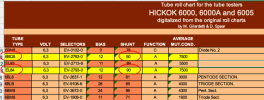
On the roller chart I get : 6BQ5 6.3 EV2793-0 12 90 A 7500 ( it is also the same settings for the beefy version 7189 tube)
On another site I get for the EL84 (foreign tube) 6.3 EV2793-0 12 50 A 7500 ( this really pegs the meter somewhat)

With the reference published at 7500 and setting on 15,000 red dot: I get around 3700-4000 and I have tried NOS Mullards, New JJ EL84 and GE with almost identical results. Moving the red dot to 6000, the needle can almost be pegged.

Question: I read on a few places that these tubes are is being treated differently. So what setting do you use for the 6BQ5 and the EL84 and when reading against the reference of 7500……….. What do you get?

I promise not to be a Pain in the @ss like some we see asking about replacing electronic components and can’t solder.

Thanks in advance.
 

Attachments

  • Screenshot 2025-05-11 at 1.03.29 PM.png
    Screenshot 2025-05-11 at 1.03.29 PM.png
    127.9 KB · Views: 3
I'd go with the non-pegged settings. Output tube tester readings are more relative (comparing tube to tube) than absolute. Your tester does not test the output tube at the voltages it will see in an amp. Measuring the idle bias current and plate voltage in an amp will better indicate the tube's strength.
 
Back
Top Bottom