
• The move to the new server is done. There are some software and database maintenance updates in process. This has us passing the hat around to help out. We appreciate any donations. Seriously, even a dollar helps. The payment page may be found here - https://www.audiokarma.org/support.html

Testing speaker protection circuit

c.coyle

Fighting the Dunning-Kruger effect.
I replaced the differential pair transistors in an amplifier and, when I tested offset (with no speakers connected, thank the stars), I got 38 volts at the speaker terminal on that channel. I went back and figured out that I had an open solder joint on one of the new trannys. That fixed the problem, and I can now dial it down to zero.

Here's the thing: The relay clicked in when I powered up, which is why I could see the 38V at the speaker terminals.

See the attached schematic. My plan is to put a 9V battery from either X to ground and see if the relay opens up. This seems like a good and safe way to test the circuit. Right or wrong?
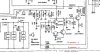
trm-750 relay circuit.jpg
 
Last edited:
Register to hide this ad
My plan is to put a 9V battery from either X to ground and see if the relay opens up.

Presumably the 9V battery would be "fighting" the power amplifiers' efforts to keep those X points at 0V. I believe the battery would lose the fight. My guess is that it would lose so badly that there wouldn't be enough DC at the X points to trigger the protection circuit even if it was working.

You probably want to apply some sort of test stimulus to the junction of R759 and R760. The stimulus could be the battery coupled via a series resistor of, let's say 120Kohms, or whatever you have in that neighborhood.

It might be easier to just probe with an ohmmeter between the R759/760 junction and ground. For that to be effective, the ohmmeter would need to be in a "diode test" mode (or else would need be of an old-school type that applies a voltage greater than a semiconductor junction's turn-on threshold).

Whichever method you use, try both polarity orientations. The protection circuit should trigger with either polarity.

Testing in this way doesn't cover R759 and R760 themselves, but it is wildly unlikely that they are at fault.

Cheers,

chazix
 
Back
Top Bottom