
• The move to the new server is done. There are some software and database maintenance updates in process. This has us passing the hat around to help out. We appreciate any donations. Seriously, even a dollar helps. The payment page may be found here - https://www.audiokarma.org/support.html

the 250th tube tester thread - help me choose

752 about half of TV7- looks like a no brainer?

For me, yes - again, according to your list.

If you really want to match tubes, only - repeat : only - a real bench test can give you consistent results.

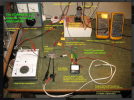
Like me, you can built one for the measurement / matching occasion, using regulated supplies, meters... Well, some equipment you need to achieve this as expected :

1701510229247.png

1701510271530.png

The prototype, in a more practical to use form...

1701510309943.png

The final bench version - still using external supplies and meters, but more quick and easy to use "at a flick of a switch".

- all I and U parameters are adjustable and readable - and these are true voltages like if the tube was operating normally, not pulses.
- direct reading of the true Gm.
- direct reading of grid N°1 leak current.
- qualification of the ringing, the microphonics, by ear and by measurement.
- possibilty of measuring gain or power output of a single tube under audio signals, by adding the required external elements.

1701510334390.png

It is still awaiting construction... To be honest, I barely need such so precise measurements, so the wooden version in picture 3 is enough, if necessary - at least for the moment !

Again, @sancho22 : if you don't need - or barely need - to go that far in tube qualification, the Hickok 752 / 752a would be the best / easiest all-around tube tester to go - according to your list.

I sold my 752a to a friend who needed a good tube tester, for no other reason that I have my 539C and 600 that covers the functionalities of the 752a, so I could let it go (and I know it's in good hands now !), otherwise I would have kept it.

But it's me, OK ?

T
 
or just stuff it in the amp its supposed to go in and make sure it does what it ought to do. If its weak enough to matter you'll know it pretty quick. I've got a pair of absolutely whipped 6CA7 tubes around here somewhere. They bias up just fine, but they make about 5 watts before falling apart. Good tubes in the same amp make an honest 40. Have a set of somewhat tired but not useless RCA 6bq5 that make 11 watts, where a good strong set will make closer to 14 in the same amp. Not weak enough to retire them since they sound fine.
This is what I do and let my test equipment (Audio Precision System One) tell me the rest.
 
Yes, I checked and the Amplitrex has a manual mode, where the user is prompted at each steps of the test cycle.
So you can wait as long as you want in static emission, so current flow through the tube, actually warming up the plates.
Then the user can decide to carry on and go to the gm test. It's a nice feature.
I remember reading a "continuous mode" with the Utracer with an hardware mod.
 
If you wanted a tv7, another thing you could do is buy a cheap clean one and send it straight to Dan Nelson. Someone on ebay might say it's restored, but who knows how well?
Dan Nelson will make sure it's perfect. The total bill for mine was around $500 a couple years ago, but mine needed a lot of repairs including a new meter.
 
I was in the same boat as you and ended up buying both MaxiMatcher testers. I was considering the Amplitrex but I understand that the tester has not been upgraded since its release. The software is cumbersome and has some bugs.

The MaxiMatchers are pretty good but limited in the tubes they can test. For home enthusiasts, i think they are perfect. They do one thing the Amplitrex does not and that is measure gain. Be aware that the Maximatchers are built every few months so if they are sold out, you might have to wait for the next production batch.
 
Yes, I checked and the Amplitrex has a manual mode, where the user is prompted at each steps of the test cycle.
So you can wait as long as you want in static emission, so current flow through the tube, actually warming up the plates.
Then the user can decide to carry on and go to the gm test. It's a nice feature.
I remember reading a "continuous mode" with the Utracer with an hardware mod.
Yes, I`ve found that some older used (Tele, Mullard, Amprex, etc.) small signal tubes tend to often test slightly better by letting them warm up for a longer time before running the test again, and can be more revealing for the end of performance testing final microphonic test wearing headphones tapping the tube with my fingernail.
 
I was in the same boat as you and ended up buying both MaxiMatcher testers. I was considering the Amplitrex but I understand that the tester has not been upgraded since its release. The software is cumbersome and has some bugs.

The MaxiMatchers are pretty good but limited in the tubes they can test. For home enthusiasts, i think they are perfect. They do one thing the Amplitrex does not and that is measure gain. Be aware that the Maximatchers are built every few months so if they are sold out, you might have to wait for the next production batch.
I also have the Maximatcher (with socket adaptors for 6BQ5, 7027, 7591), bought in the early 2000s over a decade before my purchase of my Amplitrex.
If there are any so called bugs in the tester`s firmware in the AT-1000, I`ve not encountered any tube testing issues after testing well over a 1000 audio tubes of my tube based audio equipment friends and my used (good pulls) and new tubes, small signal, power output and rectifiers.
 
They do one thing the Amplitrex does not and that is measure gain.
I might be a little rusty, but is not the "Gm rating" of a tube not an indication of it`s amplification merit, in which my AT-1000 provides along with the other current state of the tube under test indicates, and also H to K leakage, plus gas based current, as well, at the end of the tube`s test.

That the simple 2 switch position test display indicator Maximatcher fails to provide either indication plus the pentode based power tube under test`s screen current value.

Also I have not felt the need, in my use of the AT-1000, to connect mine to a computer via it`s USB port to a laptop/printer with it`s provided CD installed software, so if the bugs that are claimed reside in that area of use, it hasn`t affected my 7 yr. use, so far.
I have found the AT-1000, to be a quick, no brain setup/operate and provides accurate full tube under test, merits information tube tester, albeit a pricy purchase for my non commercial selling of tubes, even running the tester (testing all my tubes) for 3 full days, after receiving it.
 
Back
Top Bottom