

I’ve been doing some serious listening to the ADC Astrion for several months now. It’s risen to the top of my favorite list. I wanted to share how the cartridge was packaged and how ADC presented it. This is from 1981 and it’s kind of over the top. ADC (post Pritchard) was making a statement that the Astrion was no ordinary cartridge.
The cartridge is in a dark blue box with "ADC" on the top and "ASTRION" printed vertically along the right edge of each side. Inside the box are two dark blue velvet pouches. One is a bill-fold style envelope that holds the instruction manual and frequency response graphs, screw driver and stylus brush, and a stylus alignment card.

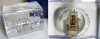
The larger pouch contains the cartridge which is inside a heavy Lucite hinged box with "ASTRION" carved on the inside top. Opening the box you see the cartridge resting in a carved out well. The top of the cartridge has an etched serial number.
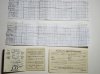
There are two frequency response graphs, a registration card and a booklet that is signed by the tester that verifies that the cartridge is performing to the stated specifications and the record that was used in the listening test. The printout of the graphs shows no peaks and is essentially flat all the way to 20k Hz.
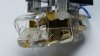
The cartridge uses the original XLM induced magnet design but everything else is built from the ground up. It's a hand-made cartridge using low resonance materials (polycarbonate) in both the both the body and stylus grip. The low resonance material is supposed to isolate the stylus vibrations from the tonearm to dampen any resonance peaks. The suspension is much stiffer than the XLM with a compliance of 35 (down from 50) but it has increased tracking ability by reducing the stylus mass by 50%.
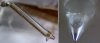
The sapphire cantilever has a higher stiffness to mass ratio than standard aluminum cantilevers and a resonance frequency above 25kHz. I've seen a reference that BSR contracted with a Japanese company (Namiki?) to manufacture the cantilever, low mass hyperelliptical stylus and polycarbonate materials for the body.
I did find one published technical test on the Astrion. The report found it met all specifications and also verified the ruler flat frequency response. The cartridge passed all tracking tests (Shure III, IV test records) up to level 4 but found a slight hint of distortion on the level 5 tests. The listening evaluation states that it is a neutral sounding cartridge with no emphasis in any frequency with a result of producing music "one can enjoy for hours on end without being reminded that it originates on the record".
To my ears, it's a fine sounding cartridge. It has an "airy" high end with no hint of strain, solid tight bass (not boomy) and a clean mid range.
There isn't much information on this cartridge, but I did find some interesting information about Peter Pritchard and what BSR did when they bought ADC from him. Peter Pritchard was a staunch believer that the key to producing a low tracking, low distortion cartridge was high compliance. The last ADC cartridge designed by Pritchard was the XLM in 1971. The XLM had a compliance of 50 and tracked at 0.6 grams. It was ADC's premium cartridge until BSR took over in 1975. The main problem with Pritchard's design was that it was compatible with only a few low mass tone arms. With mid-to-high mass arms, inertia issues caused tracking problems with all but the flattest records and the resonance peaked in the audible frequency range. When BSR bought ADC, they also bought the rights to Pritchard's patents and in 1976 redesigned the XLM with mk II, mkIII and "improved" versions.. These versions included a stiffer compliance, increased tracking force, reduced stylus mass and advance stylus tip shapes. These "improvements" made the XLM compatible with practically all arms, eliminated the warped record problem while still maintaining its high tracking ability. These changes did not sit well with Pritchard and in 1976, he founded the Sonus Company with the intent of resurrecting his original high compliance induced magnet design. However, due to a law suit filed by BSR for patent infringement in 1985, Pritchard was force to shut down operations.
The cartridge is in a dark blue box with "ADC" on the top and "ASTRION" printed vertically along the right edge of each side. Inside the box are two dark blue velvet pouches. One is a bill-fold style envelope that holds the instruction manual and frequency response graphs, screw driver and stylus brush, and a stylus alignment card.
The larger pouch contains the cartridge which is inside a heavy Lucite hinged box with "ASTRION" carved on the inside top. Opening the box you see the cartridge resting in a carved out well. The top of the cartridge has an etched serial number.
There are two frequency response graphs, a registration card and a booklet that is signed by the tester that verifies that the cartridge is performing to the stated specifications and the record that was used in the listening test. The printout of the graphs shows no peaks and is essentially flat all the way to 20k Hz.
The cartridge uses the original XLM induced magnet design but everything else is built from the ground up. It's a hand-made cartridge using low resonance materials (polycarbonate) in both the both the body and stylus grip. The low resonance material is supposed to isolate the stylus vibrations from the tonearm to dampen any resonance peaks. The suspension is much stiffer than the XLM with a compliance of 35 (down from 50) but it has increased tracking ability by reducing the stylus mass by 50%.
The sapphire cantilever has a higher stiffness to mass ratio than standard aluminum cantilevers and a resonance frequency above 25kHz. I've seen a reference that BSR contracted with a Japanese company (Namiki?) to manufacture the cantilever, low mass hyperelliptical stylus and polycarbonate materials for the body.
I did find one published technical test on the Astrion. The report found it met all specifications and also verified the ruler flat frequency response. The cartridge passed all tracking tests (Shure III, IV test records) up to level 4 but found a slight hint of distortion on the level 5 tests. The listening evaluation states that it is a neutral sounding cartridge with no emphasis in any frequency with a result of producing music "one can enjoy for hours on end without being reminded that it originates on the record".
To my ears, it's a fine sounding cartridge. It has an "airy" high end with no hint of strain, solid tight bass (not boomy) and a clean mid range.
There isn't much information on this cartridge, but I did find some interesting information about Peter Pritchard and what BSR did when they bought ADC from him. Peter Pritchard was a staunch believer that the key to producing a low tracking, low distortion cartridge was high compliance. The last ADC cartridge designed by Pritchard was the XLM in 1971. The XLM had a compliance of 50 and tracked at 0.6 grams. It was ADC's premium cartridge until BSR took over in 1975. The main problem with Pritchard's design was that it was compatible with only a few low mass tone arms. With mid-to-high mass arms, inertia issues caused tracking problems with all but the flattest records and the resonance peaked in the audible frequency range. When BSR bought ADC, they also bought the rights to Pritchard's patents and in 1976 redesigned the XLM with mk II, mkIII and "improved" versions.. These versions included a stiffer compliance, increased tracking force, reduced stylus mass and advance stylus tip shapes. These "improvements" made the XLM compatible with practically all arms, eliminated the warped record problem while still maintaining its high tracking ability. These changes did not sit well with Pritchard and in 1976, he founded the Sonus Company with the intent of resurrecting his original high compliance induced magnet design. However, due to a law suit filed by BSR for patent infringement in 1985, Pritchard was force to shut down operations.
Last edited:


 That's one of the reasons for multi TT's here
