• The move to the new server is done. There are some software and database maintenance updates in process. This has us passing the hat around to help out. We appreciate any donations. Seriously, even a dollar helps. The payment page may be found here - https://www.audiokarma.org/support.html

The biggest and baddest Pre Amplifiers of all time?

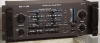
I had no idea Crown made anything like that! Looks very Revox inspired style wise, love it. How does it sound?
My impression of it is that it is the cleanest sound of any preamp I have used in the last 15 years. I would say the ARC SP-3A would be the most musical. This holds with Crown sound quality in their electronics. I need to hook it up to my tube amps and give it a listen again as that is my new reference.

Look up the EQ-2 and the amps to get an idea of this series. The preamp sold for 2500 in 1980 with a phono module. Additional modules were at least a few hundred. Difficult thing about it is that inputs are ¼" phone jacks, but since I had a Crown amp in 1974, I have always had proper interconnects. Don't want adapters.
 
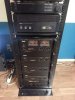
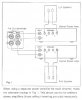
I really love the Yamaha C-80 & C-85 pre-amps (which are the same). I personally use a C-80 as the core of my system. The things that I like the best about it are it's inverted pre-outs, and that it has a VERY low output impedance (47 ohms). The inverted pre-outs allow amps to be bridged that wouldn't otherwise be able to be bridged. I use my C-80 to bridge each of my Yamaha P2200 & P2201 amps for about 700wpc into each of my JBL L150 and L100T speakers. Those amps would normally be doing about ~220wpc into 8-ohms in stereo. I also use the inverted pre-outs to invert one of the channels on my Yamaha M-2 and Yamaha P3500 which I do run in Stereo, which gives them a bit of extra mileage and that does help quite a bit since the P3500 is powering subs at the moment and is being pushed to it's limits. The low output impedance helps greatly with being able to run the 6 amps, which might be a bit much for other pre-amps.

6amps.jpg
c80invertBridge.jpg
c80invert.jpg
 
Here's another one to consider.
momentum_preamp_3.jpg
 
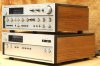
Sony TAE-8450. Companion to the TOTL TAN-8550 VFET power amp. Fantastic build quality. Incredible flexibility including MC phono (one of the very first) and separate level controls for each input. And the cool as hell PPM meters.

I bought a non working one here on bartertown a few years ago along with the matching amp. Got them both working and recapped. They sound wonderful.

http://www.thevintageknob.org/sony-TAE-8450.html

s-l1600.jpg
 
Last edited:
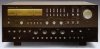
Although perhaps not within world-record striking distance, the Luxman C1000 seems to me to be unusually big and heavy for a preamplifier. Tim de Paravicini designed it during his years with Luxman to have a multitude of features, as Luxman desired. However, he managed to make it a superb-sounding unit, especially when minimal use is made of the plethora of knobs and controls. The phono and line stages are excellent, and were highly regarded in the day.
 
A second one I own (not working) The Sony TA-E88, a truly dual mono pre amp with entirely separate amplification for each channel with 2 separate power transformers. 2 phono inputs and again, variable cartridge loading. Definitely not as rare as the JVC however still worth a mention.
I've always wanted one of these. These, to me, are the coolest looking preamps ever...
 
Sony TAE-8450. Companion to the TOTL TAN-8550 VFET power amp. Fantastic build quality. Incredible flexibility including MC phono (one of the very first) and separate level controls for each input. And the cool as hell PPM meters.

I bought a non working one here on bartertown a few years ago along with the matching amp. Got them both working and recapped. They sound wonderful.

http://www.thevintageknob.org/sony-TAE-8450.html

View attachment 1174453

Incredible, ppm meters on a hifi pre amp, that is serious. How does it sound? Based on looks alone i'd love to own one of these.
 
I had the Pioneer Spec One and the Sansui BA3000 pictured above. To my ears, both were mediocre, lacking clarity, transparency, "musicality". May have been all the knobs and switches the signal had to pass through, all the separate lengths of wire (or traces) used to connect everything, and the pounds of solder. But both looked sensational.

Out of curiosity what do you feel sounds better than those two? The Spec I can understand, as beautiful as it looks, internally it really doesn't come close to some of the other really high end jap pre amps, but the Sansui I assumed would be up with some of the best sound wise.
 
Which begs the question: what do you do with them? Anyone worried about clipping their preamp?

Looking at some of this stuff I do wonder whether it was intended for use in a mastering studio environment just as much as home hifi? Taking my JVC for example, they called it the Laboratory series and in some japanese sales literature there is mention of it being designed for a professional environment, the addition of rack ears to some of this stuff further supports this. Would love for someone to shed some more light on this topic, I can only imagine this stuff was crazy expensive new and didn't sell in huge numbers in comparison to even the totl integrated amps or receivers, and thats why there aren't many turning up.
 
Looking at some of this stuff I do wonder whether it was intended for use in a mastering studio environment just as much as home hifi?
Even at that, one would monitor levels using the recording console, not playback preamp.

They probably would impress The Beaver though. “Gee whiz, Wally!”
 
Even at that, one would monitor levels using the recording console, not playback preamp.

They probably would impress The Beaver though. “Gee whiz, Wally!”

True, there must have been some reasoning behind it. it's pity the geniuses who designed this stuff aren't around anymore/aren't on any forums to answer these questions.
 
Looking at some of this stuff I do wonder whether it was intended for use in a mastering studio environment just as much as home hifi? The addition of rack ears to some of this stuff further supports this.
It was a design conceit of the time: to make home gear look more "serious". Some may have been used in studios but not for critical mastering, it was used to see what things would sound like to the consumer on his home system. I had a preamp that not only had rack ears, it had rack handles. Totally unnecessary, it weighed less than 10 pounds, hardly a serious lift — the handles were decoration, for that "pro" look.
 
True, there must have been some reasoning behind it. it's pity the geniuses who designed this stuff aren't around anymore/aren't on any forums to answer these questions.
I think that was more of a marketing function. :)

Just as you see with McIntosh today. Mac enthusiasts love their BFMs on amps, preamps, phone music players, turntables(!), clocks(?), towels(?), etc. Their website splash screen is one giant meter. I'm genuinely surprised the $1500 light box doesn't have one.

bfm.jpg
 
It may not be the biggest or baddest, but the most flexible would be a Mcintosh C-40.

I'm going to push the envelope, its been a good day to day.

For Biggest how about a two piece Mcintosh C-1100 Stereo tube pre-amp with a D-1100 Digital supplementing pre-amp used with a MX 160 in the Stereo bypass mode.

Then I guess you could have 3 MC 2k for the front channels and 4 MC 1.25 K for the surrrounds. Then you should add a MEN 220 to correct the speakers in the BY Pass mode. That would mean the preamp size would be 17.5 inches wide and 34" tall with feet. The amps would be 158 1/8 inches tall with feet. in one stack. Opp's, I for got the ceiling speaker amps. ,maybe two MC 452's. Whats that, another 15 or 16 inches? Gets ridiculous after a while.

Of course if you used efficient Klipsch speakers you could get buy with a MC 207 and a MC 205. or 3 MC 303s and a MC 302 with JBL DD series. Maybe you like tubes, 11 MC 2301.s How tall is that? It's fun being superfluous . The problem would be where to find 3 XR 290's, 4 XRT 28's and the 4 ML-4c to be used as ceiling speakers with the big amps. . Wouldn't need any sub woofers. All the speakers can reproduce 20HZ.

I wonder how much Magico wants for their dual 18" subs with the 4 or 6000 watt amps. You would at least need 2? Lets see 12 front 12 inch woofers, thats 432 pi sq inches + 8 side and rear 10 inch woofers, 200 pi sq inches + 16 more 12 inch ceiling woofers woofers 576 pi sq inches. for a total of 1208 pi sq inches. 1208 divide by 81= close to 15 18 inch woofers. Lets say for argument sake the magico cones moves 1/2 again as far as a Mac woofer so that would mean 10 18 inch woofer or 5 of those big Magico subs, ouch. Oh!And Klipsch doesn't make a speaker that will reach 30 hz let alone 16 hz. at any level. JBL Does. Their Dual 18 inch sub cones move over two inches. But you would need more 2K amps.for each box. I suppose you could get buy with 4 of the JBL boxes.

Lets face it 3 611's and 2 302's sounds like much better option and for get the ceiling un less you need a MC 205 for your must have ceiling speakers.
 
Last edited:
Back
Top Bottom