• The move to the new server is done. There are some software and database maintenance updates in process. This has us passing the hat around to help out. We appreciate any donations. Seriously, even a dollar helps. The payment page may be found here - https://www.audiokarma.org/support.html

The False Claim that You Should Only Use Deoxit F5 on Pots

you mean the straw with enuf force to wash dried cat vomit off a carpet? can expend the entire can in the time an MP5 machine gun can empty a clip? THAT one?
Yup. That's the one!:rflmao:
BTW, I've fired an MP5 in full auto. It expends a 30 round magazine PDQ.
 
I've used Fader Lube. No problems.

The idea is not to flood the pot with any solvent made by any company. If the contacts are so bad that you need to flood the thing, you need a new pot.
 

I have now had extensive further discussions with the manufacturers and contained in this article are, I hope, the answers to these questions. Hopefully this one can now be ‘put to bed’. Here is a summary of the questions and concerns:

1. D5 lists many uses on the side of the can but it does not list ‘potentiometers’. The implication is that this product should not be used on potentiometers.

2. F5 specifically mentions potentiometers on the can. The implication is that only this (DeOxit) product should be used on potentiometers.

3. D5 contains mineral spirits. These are harmful to carbon tracks. F5 does not contain mineral spirits. The implication is that here is more proof that this is the one to use for potentiometers. All three of these implications are false. Summary TL/DR

• Neither D5 or F5 are harmful to carbon track potentiometers.

• Both D5 and F5 use mineral spirits as a flushing agent, in exactly the same proportions, i.e. 75%

• D5 will work on all carbon track potentiometers regardless of if the problem is surface contamination or oxidisation of the metal wiper.

• F5 was formulated for conductive plastic faders/pots. The lubrication is important in these components.
F5 will not help with oxidized metal parts as it contains no deoxidization chemical.

• In the latest packaging, DeOxit D5 has ‘potentiometers’ on the list of uses on the side of the can. Here is the full explanation. Since the earliest days of electronics the search has been on for a solvent which would clean switch contacts, potentiometers and suchlike. For decades the ‘go to’ solution was Freon. It flushed away contaminants and evaporated rapidly. However, as we now know Freon is very environmentally damaging and is banned in most countries. The search was then on to find an alternative. For some time MEK (Methyl Ethyl Ketone) was used as an organic solvent but this is still fairly damaging and attacks many plastics. Mineral spirits were then used as the ‘least worst’ option (environmentally). There are many different formulations and strength of ‘mineral spirits’ – it is a catch-all term. DeOxit D5 uses mineral spirits as the flushing agent. A ‘flushing agent’ is the chemical which washes away surface contaminants mostly via mechanical action. DeOxit D5 uses one of the milder formulations and strengths of OMS (Odourless Mineral Spirits). The sole purpose of the mineral spirits in D-Series products is to flush (wash) away surface contaminants. Despite ongoing myths to the contrary, mineral spirits do not attack or ‘eat’ carbon. In addition to the mineral spirit flushing agent, D-Series products also contains an anti-oxidisation formulation, the effect of which will now be explained. A potentiometer consists of two surfaces in contact with each other. Commonly this is a metal ‘wiper’ and a carbon track. The mineral spirits in D-Series will wash away surface contaminants (dust, grease, dirt etc.). Many other solvent sprays will do the same of course, even alcohol will do this. but sometimes the metal wiper contact is oxidised. In this case no amount of solvent spray will improve the potentiometer. The deoxidisation chemicals in all D-Series sprays will remove the oxidation from the metal surfaces. It is this dual action which makes it so effective on potentiometers. Aside: I have many times tried isopropyl alcohol and other solvent sprays on pots. It seems to work about 50% of the time. The other 50% of the time it does not work. If I then use D5 on the same pot, it is completely fixed. In these instances, I believe the metal contact was oxidised and required the deoxidisation chemicals in D5 to cure it – alcohol and many other sprays have no effect on oxidisation. There are 3 products in the D-Series. Here is what each one does.

1. DeOxit D5 – as described above. A mineral spirits ‘flush’ to remove contaminants. Then a powerful deoxidiser to remove oxidation from the metal wiper. Downside - you can overspray and as it doesn’t evaporate it needs mopping up.

2. DeOxit DN5 – if you don’t need a flushing action this product delivers the deoxidiser via a fast evaporation solvent. Good for more precise delivery of the deoxidation element and no residual liquid.

3. DeOxit D100S This is 100% deoxidation product with no solvent delivery chemical. FADER F5 Product This product was specially formulated for linear conductive plastic film slider potentiometers. E.g. Faders on mixing desks. It contains the same percentage mineral spirits (75%) as D5. It also has a lubricant to aid fader travel. This product can also be used on potentiometers. However, if the potentiometer is faulty due to metal oxidisation on the wiper, then a better product would be the D-series (e.g. D5). Very Old/Valuable Potentiometers. With very old and worn potentiometers it might not be advisable to use any spray with a flushing action as the mechanical action of this may under rare circumstances further loosen any material, Instead use DN5 for accurate delivery. Summary TL/DR

• Neither D5 or F5 are harmful to carbon track potentiometers.

• Both D5 and F5 use mineral spirits as a flushing agent, in exactly the same proportions, i.e. 75%

• D5 will work on all carbon track potentiometers regardless of if the problem is surface contamination or oxidisation of the metal wiper.

• F5 was formulated for conductive plastic faders/pots. The lubrication is important in these components. F5 will not help with oxidized metal parts as it contains no deoxidization chemical.

• In the latest packaging, DeOxit D5 has ‘potentiometers’ on the list of uses. I hope this provides a full explanation and draws a line under this topic.

Thank you. Thank you. Thank you. Your report covers the products well with helpful dos and don’t .
 
Acetic acid has a distinctive odor, like vinegar.
It looks like Napha is the primary cleaner. The proprietary compounds are for lubrication and rust prevention. :idea:

The important take-home lesson: use only as much as needed. Do not flood the components or surfaces! Wipe off any excess.
 
Last edited:
I've used Fader Lube. No problems.

The idea is not to flood the pot with any solvent made by any company. If the contacts are so bad that you need to flood the thing, you need a new pot.
I use a 25ml squeeze bottle of Deoxit F100L Fader Lube- has a long needle to apply it with so you can get into tight spaces..works great on switches, pots, and faders. The small bottle has lasted for five years so far, and it is now down to 1/3 full.
 
Isn't Naptha what dry cleaners use?
I think thats perchloroethylene, same stuff in Electra-Motive cleaner. Nice for washing carbon brush gunk out of motors and the like but its nasty stuff and not so friendly with some plastics.

Naptha is the go-juice in Zippo fluid or Coleman lantern fuel.
 
I think thats perchloroethylene, same stuff in Electra-Motive cleaner. Nice for washing carbon brush gunk out of motors and the like but its nasty stuff and not so friendly with some plastics.

Naptha is the go-juice in Zippo fluid or Coleman lantern fuel.
Naphtha is a solvent for polystyrene, most other plastics not.
 
This I do know. If someone brings me an old stereo, amp, radio, etc. with scratchy pots being the only problem. That one can of D5 pays for itself two times over on the first fix bench fee. Customer is happy, I am happy. win win for everyone. If they ask me how I fixed it I simply tell them that the connection between the transmodulator and the audio control panel recognizer was loose and needed redone ;)
 
This I do know. If someone brings me an old stereo, amp, radio, etc. with scratchy pots being the only problem. That one can of D5 pays for itself two times over on the first fix bench fee. Customer is happy, I am happy. win win for everyone. If they ask me how I fixed it I simply tell them that the connection between the transmodulator and the audio control panel recognizer was loose and needed redone ;)
Jim McShane has often said that DeOxit solves many connectivity issues, especially with old tube equipment. It's always worth trying all connections and contacts initially before diving deeper into the unit.

A nice post by Jim on Audio Asylum:

____________________
I have been deluged lately with people asking about issues with their tube gear that they have decided, for whatever reason, must be the tubes. Occasionally, it is, but at least 75% of the time, in my experience, it is not. So, I wanted to make a few points and pass along a few tips to help people.

1. The #1 cause of noise problems with tubes is poor contact between the tube pins and the socket. There are a wide variety of possible causes: dirty pins and sockets (in the case of a noisy new tube, the socket is the PRIME suspect), socket contacts that have been stretched out or worn out and don't make good contact, or in a few cases, bad solder joints on the socket itself.

Tube sockets—even really good ones—are not sophisticated, high-reliability connectors. You won't see them in critical applications because they are simply not reliable enough.

Do yourself a favor - clean the tube pins and sockets whenever you change tubes. A bottle of DeOxit D5 and a handful of good old-fashioned pipe cleaners works great for octals and other large pin sockets; for the miniatures, D5 and the little tiny dental brushes for cleaning between your teeth (another drug store item), do a solid job. BTW, D5 is good to 400F - so don't lose sleep over it because of something you read on the "Hi-Fi Hysteria" forum. And it doesn't gum up, either. Spray some in a paper cup and let it evaporate - you'll be able to see for yourself.

Sometimes, you swap a tube, and the new tube is okay. So the tube you removed must be bad, right? NO! Sometimes, the scraping action of removing and reinstalling a tube in that socket is enough to restore contact temporarily—and fool you into thinking you have a bad tube! KEEP YOUR SOCKETS CLEAN!!

If you are putting new production tubes into sockets in vintage/older gear, remember that most modern tubes have slightly smaller pins than the original old stock tubes. So you may have to re-tension (or, worst case, even replace) the original sockets that can't make good contact with the smaller pins.

Honest, only a few percent of the tubes I return for noise are bad. Most go on to play fine in another socket.

2. Those metal cans around tubes are shields, and they prevent external fields from inducing noise in a tube. Do you really think a manufacturer would spend the money to put them on there unless they were worth it? Will the tube run a bit warmer with them in place? Possibly, but be smart about removing shields!

3. Want to use KT-120s in your amp? It's more than just a heater current increase that is an issue. I have now had a couple of cases where excessive grid circuit resistance causes unstable bias. The KT-120 has a grid circuit resistance maximum of 51K Ohms. If your amp is above that, there is a risk in using the KT-120. Just like the EH and Tung-Sol 7591As, some KT-120s will be okay with excess resistance—but some will not.

4. Don't fry those expensive new power tubes! If your amp has an adjustable bias, turn the bias current DOWN significantly before plugging in new tubes. The bias that was correct for the older worn tubes may not be for the fresh new ones. And it doesn't take much of an overcurrent event to damage a tube or shorten its life. Adjust the bias UP to the spec - and be sure the amp is thoroughly warmed - not just the tubes but the internal parts. In my experience, the whole amp should be warm, which takes at least half an hour.

Keep one last thing in mind - often, you see a voltage "spec" on a schematic at the control grid of a tube. DO NOT TRY TO SET THE VOLTAGE AT THE GRID TO THAT SPEC! The negative voltage at the tube grid should be whatever value is required to set the tube's cathode current to spec. If the tube is passing the correct amount of current and the voltage at the grid is -20 volts, then the hell with the "spec" of -22.5 volts or whatever it is. Making the grid voltage more negative concerning the tube's cathode is the equivalent of stepping down harder on a garden hose to restrict the water flow. And if you let up the pressure on the hose and more water flows - that's the same thing that happens if the tube grid is less negative!!

5. Most tube testers do not test power or other high voltage/high current tubes at a high enough voltage to be meaningful. Matching of current is pretty much out of the question for all but the few "lab grade" testers that can apply high voltages at reasonable current levels to the tube. What your tube tester says with 150 volts on the plate will differ significantly from what my rig says at 465 volts! Our old pal Steve Melkisethian (proprietor of Angela Instruments) used to say he didn't even CARE what your tube tester said! It's a little harsh - sure, but not all that unreasonable, either. Remember - a tube's test results depend on the conditions under which it is tested!

6. Other components besides the tubes can make your matched tubes seem less well-matched. Power tubes may be matched for transconductance, but it is imperative that if you need matched tubes, they are matched for current - some say plate current, and I say CATHODE current. Why cathode current? Because between the cathode and ground of many (most?) power tubes, you will find a resistor in the circuit - low value, 10 Ohms is common - and that resistor's purpose is to make it possible for you to measure the voltage across that resistor and use Ohm's Law to calculate the current. Measuring the current with an ammeter requires breaking into the circuit and inserting the current meter. But with a voltmeter we don't have to break into the circuit, we can measure the voltage across the resistor and know the current flow through it. For instance, if you read .5 volts across a 10-ohm resistor, you can compute the current flow by dividing the voltage by the resistance. .5 volts divided by 10 Ohms = .05 amps, 50 milliamps.

But keep in mind that not only the plate current but also the screen current flows through the tube cathode to the ground (triodes have no screens, so this doesn't apply). We'll ignore situations where the grid is driven positively and current flows through it.

So that 50 ma. Did you just read the above in our example? The plate and screen current are combined (unless the tube is a triode). That combined current causes the voltage across the resistor. By knowing the total current—cathode current—and the voltage across the tube from plate to cathode, we can easily calculate the total power dissipation of the tube. That's important since too much dissipation (measured in watts) is a tube killer.

Why would the readings be different on "matched tubes"?

a. The tubes are never perfectly matched - some tolerance exists
b. The screen and plate voltages are slightly different at the different tubes due to varying resistances in the output transformers' primary windings.
c. The cathode resistors never have precisely the same value.
d. Etc.

Or some combination of the above...

7. Variance in the brightness of the tube heater is normal and not an issue. If you use tubes, you must learn to differentiate between the orange glow of the tube heater located right in the center of the tube and the reddish glow of the large metal internal tube plate. The picture below shows one of a set of tubes with a reddish-orange tube plate. That is a problem for sure!


red_plating_power_tube.jpg


Now, look at the picture below. It shows some variance in the brightness/glow of the tube heaters both at the top and bottom of the internal tube structure. This is entirely normal and the result of small variances in production. It is nothing to be concerned about at all.


tube_heater_glow_variation.jpg
The amount that the heater protrudes outside the cathode sleeve varies from tube to tube, and if one protrudes more than the other at the top, it will be brighter. It can also happen at the bottom of the tube; it depends on whether the heater is protruding more (like at the top). Don't worry! It is not a malfunction and is no reason for concern at all.

I just wanted to share a few things that maybe will help people struggling to understand why they had "problems" with their tubes. One of the points mentioned above is almost always the case!
 
Last edited:
I find it unlikely that deoxit would be able to revert oxides back to metal or anything near that. Most likely all it provides is an oxidation resistant coating on the contact surface.
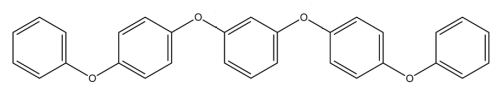
Large molecular weight fatty acids like oleic acid, do dissolve certain oxides but only at boiling temperatures. It might be that some contact cleaners contain oleic acid in their composition but not for dissolving oxides, just to form a long lasting film on the contacting surfaces. On the other hand, polyphenylethers are well known oily substances that are very stable against oxidation, and if they have sufficiently large molecular weight they have a very low vapor pressure, so they do not evaporate. This is a key in long lasting contact lubrication. Most of deoxit composition is just refined solvents. Some contact cleaner manufacturers indeed use polyphenylethers in their contact cleaners for example MG contact cleaner. An example of a polyphenyl ether is this molecule:
1729049996669.png
This is very simiar to Santovac-5. It is possible to derive a very large family of compounds from this by bindng specific groups on some of the free corners of the rings, and this may improve the contact preserving action of this base polyphenyl ether. My speculation is that deoxit is the result of a large search for the best derivatives of polyphenylethers that worked the best for preserving the contact conductivity.
 
Jim McShane has often said that DeOxit solves many connectivity issues, especially with old tube equipment. It's always worth trying all connections and contacts initially before diving deeper into the unit.

A nice post by Jim on Audio Asylum:

____________________
I have been deluged lately with people asking about issues with their tube gear that they have decided, for whatever reason, must be the tubes. Occasionally, it is, but at least 75% of the time, in my experience, it is not. So, I wanted to make a few points and pass along a few tips to help people.

1. The #1 cause of noise problems with tubes is poor contact between the tube pins and the socket. There are a wide variety of possible causes: dirty pins and sockets (in the case of a noisy new tube, the socket is the PRIME suspect), socket contacts that have been stretched out or worn out and don't make good contact, or in a few cases, bad solder joints on the socket itself.

Tube sockets—even really good ones—are not sophisticated, high-reliability connectors. You won't see them in critical applications because they are simply not reliable enough.

Do yourself a favor - clean the tube pins and sockets whenever you change tubes. A bottle of DeOxit D5 and a handful of good old-fashioned pipe cleaners works great for octals and other large pin sockets; for the miniatures, D5 and the little tiny dental brushes for cleaning between your teeth (another drug store item), do a solid job. BTW, D5 is good to 400F - so don't lose sleep over it because of something you read on the "Hi-Fi Hysteria" forum. And it doesn't gum up, either. Spray some in a paper cup and let it evaporate - you'll be able to see for yourself.

Sometimes, you swap a tube, and the new tube is okay. So the tube you removed must be bad, right? NO! Sometimes, the scraping action of removing and reinstalling a tube in that socket is enough to restore contact temporarily—and fool you into thinking you have a bad tube! KEEP YOUR SOCKETS CLEAN!!

If you are putting new production tubes into sockets in vintage/older gear, remember that most modern tubes have slightly smaller pins than the original old stock tubes. So you may have to re-tension (or, worst case, even replace) the original sockets that can't make good contact with the smaller pins.

Honest, only a few percent of the tubes I return for noise are bad. Most go on to play fine in another socket.

2. Those metal cans around tubes are shields, and they prevent external fields from inducing noise in a tube. Do you really think a manufacturer would spend the money to put them on there unless they were worth it? Will the tube run a bit warmer with them in place? Possibly, but be smart about removing shields!

3. Want to use KT-120s in your amp? It's more than just a heater current increase that is an issue. I have now had a couple of cases where excessive grid circuit resistance causes unstable bias. The KT-120 has a grid circuit resistance maximum of 51K Ohms. If your amp is above that, there is a risk in using the KT-120. Just like the EH and Tung-Sol 7591As, some KT-120s will be okay with excess resistance—but some will not.

4. Don't fry those expensive new power tubes! If your amp has an adjustable bias, turn the bias current DOWN significantly before plugging in new tubes. The bias that was correct for the older worn tubes may not be for the fresh new ones. And it doesn't take much of an overcurrent event to damage a tube or shorten its life. Adjust the bias UP to the spec - and be sure the amp is thoroughly warmed - not just the tubes but the internal parts. In my experience, the whole amp should be warm, which takes at least half an hour.

Keep one last thing in mind - often, you see a voltage "spec" on a schematic at the control grid of a tube. DO NOT TRY TO SET THE VOLTAGE AT THE GRID TO THAT SPEC! The negative voltage at the tube grid should be whatever value is required to set the tube's cathode current to spec. If the tube is passing the correct amount of current and the voltage at the grid is -20 volts, then the hell with the "spec" of -22.5 volts or whatever it is. Making the grid voltage more negative concerning the tube's cathode is the equivalent of stepping down harder on a garden hose to restrict the water flow. And if you let up the pressure on the hose and more water flows - that's the same thing that happens if the tube grid is less negative!!

5. Most tube testers do not test power or other high voltage/high current tubes at a high enough voltage to be meaningful. Matching of current is pretty much out of the question for all but the few "lab grade" testers that can apply high voltages at reasonable current levels to the tube. What your tube tester says with 150 volts on the plate will differ significantly from what my rig says at 465 volts! Our old pal Steve Melkisethian (proprietor of Angela Instruments) used to say he didn't even CARE what your tube tester said! It's a little harsh - sure, but not all that unreasonable, either. Remember - a tube's test results depend on the conditions under which it is tested!

6. Other components besides the tubes can make your matched tubes seem less well-matched. Power tubes may be matched for transconductance, but it is imperative that if you need matched tubes, they are matched for current - some say plate current, and I say CATHODE current. Why cathode current? Because between the cathode and ground of many (most?) power tubes, you will find a resistor in the circuit - low value, 10 Ohms is common - and that resistor's purpose is to make it possible for you to measure the voltage across that resistor and use Ohm's Law to calculate the current. Measuring the current with an ammeter requires breaking into the circuit and inserting the current meter. But with a voltmeter we don't have to break into the circuit, we can measure the voltage across the resistor and know the current flow through it. For instance, if you read .5 volts across a 10-ohm resistor, you can compute the current flow by dividing the voltage by the resistance. .5 volts divided by 10 Ohms = .05 amps, 50 milliamps.

But keep in mind that not only the plate current but also the screen current flows through the tube cathode to the ground (triodes have no screens, so this doesn't apply). We'll ignore situations where the grid is driven positively and current flows through it.

So that 50 ma. Did you just read the above in our example? The plate and screen current are combined (unless the tube is a triode). That combined current causes the voltage across the resistor. By knowing the total current—cathode current—and the voltage across the tube from plate to cathode, we can easily calculate the total power dissipation of the tube. That's important since too much dissipation (measured in watts) is a tube killer.

Why would the readings be different on "matched tubes"?

a. The tubes are never perfectly matched - some tolerance exists
b. The screen and plate voltages are slightly different at the different tubes due to varying resistances in the output transformers' primary windings.
c. The cathode resistors never have precisely the same value.
d. Etc.

Or some combination of the above...

7. Variance in the brightness of the tube heater is normal and not an issue. If you use tubes, you must learn to differentiate between the orange glow of the tube heater located right in the center of the tube and the reddish glow of the large metal internal tube plate. The picture below shows one of a set of tubes with a reddish-orange tube plate. That is a problem for sure!


red_plating_power_tube.jpg


Now, look at the picture below. It shows some variance in the brightness/glow of the tube heaters both at the top and bottom of the internal tube structure. This is entirely normal and the result of small variances in production. It is nothing to be concerned about at all.


tube_heater_glow_variation.jpg
The amount that the heater protrudes outside the cathode sleeve varies from tube to tube, and if one protrudes more than the other at the top, it will be brighter. It can also happen at the bottom of the tube; it depends on whether the heater is protruding more (like at the top). Don't worry! It is not a malfunction and is no reason for concern at all.

I just wanted to share a few things that maybe will help people struggling to understand why they had "problems" with their tubes. One of the points mentioned above is almost always the case!
Yes. I always try the easy stuff first.
 
I think thats perchloroethylene, same stuff in Electra-Motive cleaner. Nice for washing carbon brush gunk out of motors and the like but its nasty stuff and not so friendly with some plastics.

Naptha is the go-juice in Zippo fluid or Coleman lantern fuel.
VM&P Naptha, aka
Varnish Makers and Painters Naptha as well as all the other stuff you guys mentioned such as white gas and Coleman stove and lantern fuel, Zippo lighter fluid and Ronsonol lighter fluid.
 
Back
Top Bottom