• Please note that there are a few updates and clarifications made in the Audiokarma Rules, mostly relating to advertising and the addition of the new "Paying it Forward" & "Giving back" forums in the AudioKarma Audio Marketplace section.

The Fisher TFM-300 Tuner: Worth Restoring?

artsybob

AK Subscriber
Subscriber
My uncle has an old Fisher TFM-300 tuner lying around and I was wondering if these early (mostly) solid-state units were worth fixing up. It's got the 6AL5 and 6CW4 "Golden Synchrode" front end. I know the can caps and all the filter caps underneath the chassis need replacing, but I'm wondering if all those tiny caps on the top need replacing too. Is this a nice tuner or is it a curious piece of audio gear when technology was transitioning between tube and solid state? Thanks!
 
Register to hide this ad
All those tiny caps on the IF Strip and the MPX board you can usually leave alone, unless it won't work after replacing the filter caps underneath. Then you'll need to be able to align the Front end (which is from a 500c) the IF Strip, and possibly the mpx. The TFM-300 and the TX300 were functionally the equaivalent of a 600-T in separate cabinets and was the top of the consumer tuners for FISHER until the TFM 1000 came along. As to your last question it's a bit of both.
 
Most of the capacitors on the IF board and many on the multiplex board are disc ceramic. Those are ok. There are a few electrolytics. I'd replace all of them. Not expensive at all. The 4µF can be replaced with 4.7µF. The others are all 10µF.

The unit is definitely worth fixing up as long as it is cosmetically clean.
 
I've been listening to a restored TFM-300 and it is one of the quietest tuners I have ever heard. My local classical station, KBAQ, is noisy as hell on many tuners because their HD radio broadcast causes IBOC noise. No problem on the TFM-300. Stereo imaging is good but not up to my Scott 310E, but the 310E is awfully hard to beat.
 
Last edited:
You might be able to tweak the multiplex adjustments. There is no reason that the stereo imaging should not be as good as any other tuner. Connect a scope to test point 401 on the multiplex board, tune in a stereo station, and adjust all 4 coils for maximum at 19 kHz and 38 kHz.

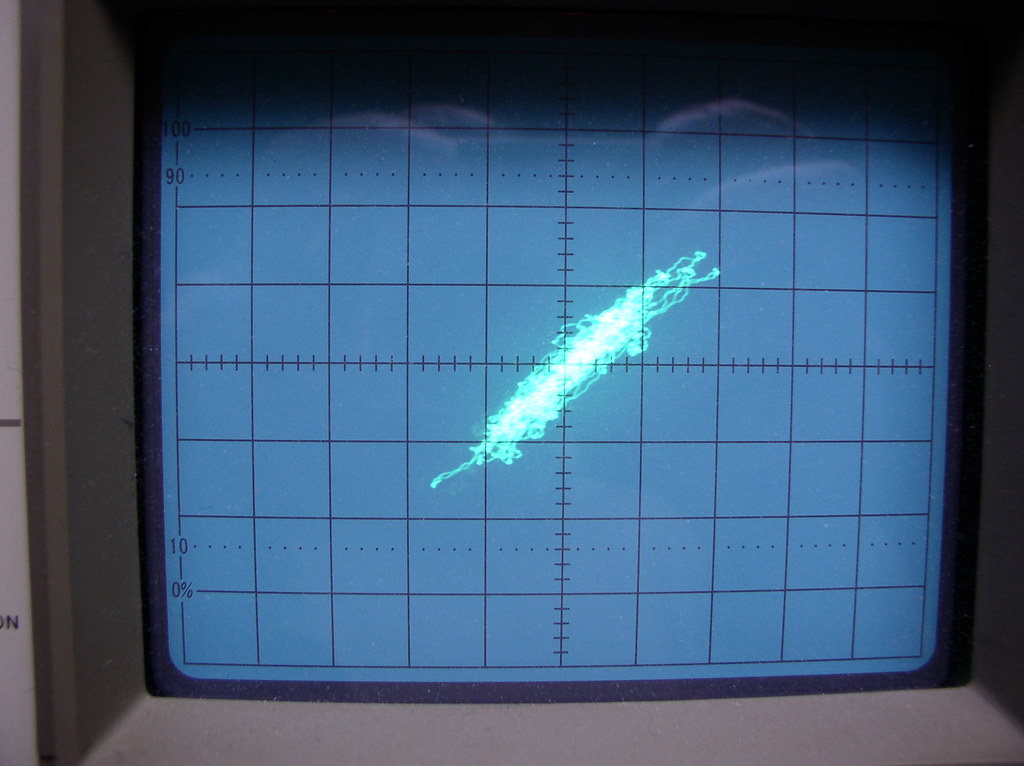
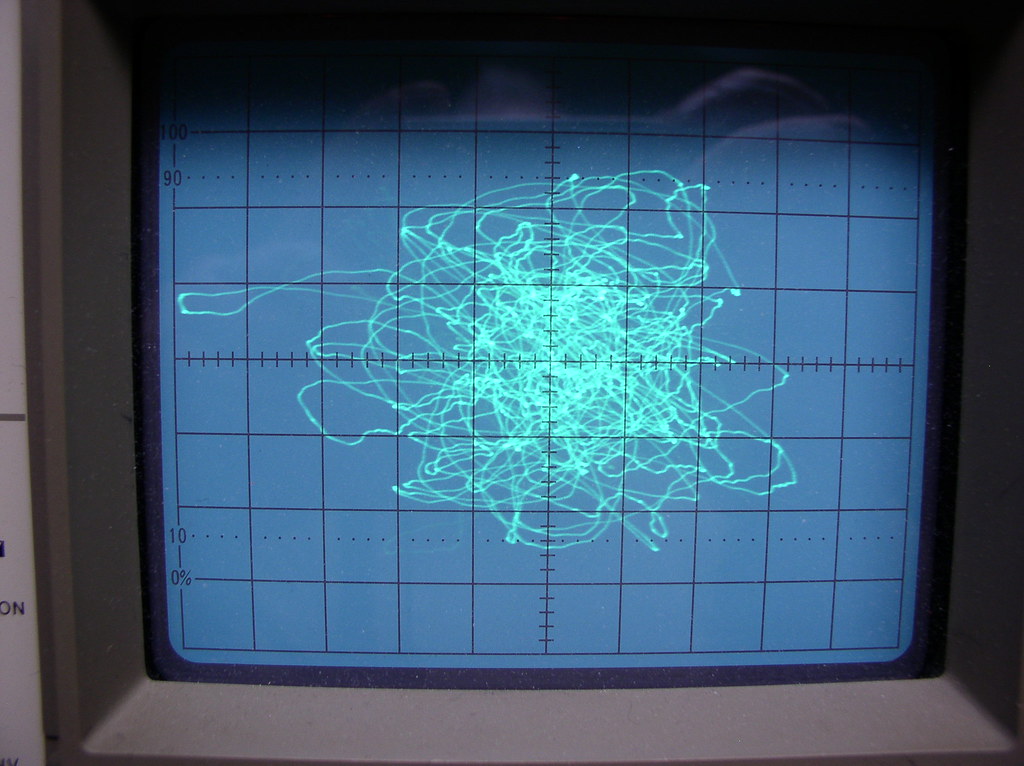
Next, connect a 2 channel scope to left and right audio anywhere in the audio section, even the output terminals. Tune in a classical station playing orchestral music. Put the scope in X-Y mode and adjust the separation control for the largest fuzzball on the scope. Don't go too far or there will be a phase reversal. Start with the control adjusted for no separation, turn to max, and don't go beyond.

I recently did a 600-T rebuild (TFM-300 is the tuner portion) and tested one of the multiplex ICs in place of the discrete decoder and there was no visible difference in separation.

Photos show slight separation and maximum separation (Beethovens brain on drugs).

1440
13728021904_7ea663c7a8_b.jpg


1441
13727611295_d1f2a4bca1_b.jpg
 
Back
Top Bottom