• The move to the new server is done. There are some software and database maintenance updates in process. This has us passing the hat around to help out. We appreciate any donations. Seriously, even a dollar helps. The payment page may be found here - https://www.audiokarma.org/support.html

The official Fairchild 412 registry thread!

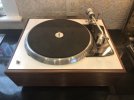
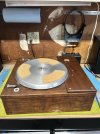
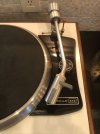
412 double speed with speed selector knob? (the 412-2 is a very different external design, never saw while researching, the 412 with the design from the 412-1 but with a 33/45 knob selector, there's no other picture on the internet of this particular configuration (Image is from E Bay right now for sell)

Maybe this is a DIY modification? not an original model with this feature?
--412.jpeg-412.jpeg412.jpeg
 
Last edited:
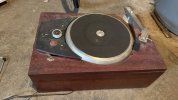
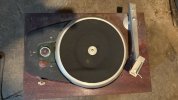
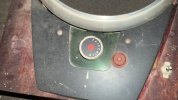
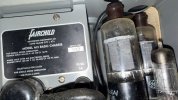
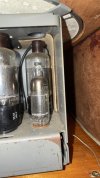
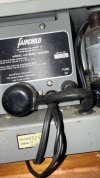
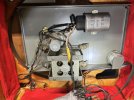
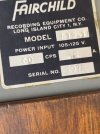
Reviving this thread to post about the Fairchild 412-4 I recently found in my mother's basement. It was part of my grandfather's set-up. Serial number on the 412 Chassis is 1553. Serial number on the 412-ED is 202. (Is there a SN for the complete set up (the 412-4) or is it just the SNs for the two parts? That's all I found.) It turns on, but doesn't spin (although I'm genuinely unsure if there's something else I need to do to get it to start spinning other than turn it on). I haven't figured out how to check the status of the belt or anything yet. (I'm new to the world of vintage turntables.) It has a Gray 212 tonearm, that looks like it would need some work (if it could be fixed). Any thoughts on how hard this would be to get working would be appreciated. Also, is there a way to use this turntable in a stereo setup, or is is strictly mono only?
IMG_9963.jpegIMG_9964.jpegIMG_9965.jpegIMG_9966.jpegIMG_9989.jpeg
 

Attachments

  • IMG_9971.jpeg
    IMG_9971.jpeg
    104.8 KB · Views: 3
  • IMG_9969.jpeg
    IMG_9969.jpeg
    96.5 KB · Views: 3
  • IMG_9968.jpeg
    IMG_9968.jpeg
    94 KB · Views: 2
  • IMG_9967.jpeg
    IMG_9967.jpeg
    102.1 KB · Views: 2
Reviving this thread to post about the Fairchild 412-4 I recently found in my mother's basement. It was part of my grandfather's set-up. Serial number on the 412 Chassis is 1553. Serial number on the 412-ED is 202. (Is there a SN for the complete set up (the 412-4) or is it just the SNs for the two parts? That's all I found.) It turns on, but doesn't spin (although I'm genuinely unsure if there's something else I need to do to get it to start spinning other than turn it on). I haven't figured out how to check the status of the belt or anything yet. (I'm new to the world of vintage turntables.) It has a Gray 212 tonearm, that looks like it would need some work (if it could be fixed). Any thoughts on how hard this would be to get working would be appreciated. Also, is there a way to use this turntable in a stereo setup, or is is strictly mono only?
View attachment 3551590View attachment 3551591View attachment 3551592View attachment 3551593View attachment 3551604

Congrats, that’s an extremely rare and expensive turntable :trebon: Take some time and read through this thread and do a bit of research…..

VR
Andy
 
Congrats, that’s an extremely rare and expensive turntable :trebon: Take some time and read through this thread and do a bit of research…..

VR
Andy
Thanks! I read through the thread and tried to get the manual from vinyl engine, but new registrations are closed at the moment. I'm honestly a little lost as to how to begin, although it sounds like this might be something that I could do some work on myself, if I can find a good guide. (As opposed to the McIntosh and Scott pieces I found that are clearly out of my wheelhouse.)
 
Thanks! I read through the thread and tried to get the manual from vinyl engine, but new registrations are closed at the moment. I'm honestly a little lost as to how to begin, although it sounds like this might be something that I could do some work on myself, if I can find a good guide. (As opposed to the McIntosh and Scott pieces I found that are clearly out of my wheelhouse.)
Congratulations on your 412-4.Sams has a photofact set 413 folder 8 I probably have it somewhere but @Tom Bavis would be your best bet to get one. I let my membership slide on vinyl engine so it no longer works .Radio museum also has the photofact but it's 7 pages I was able to download the schematic plus the front page but not anymore as there's a limit unless you pay for a subscription.posting the schematic here for the Ed unit would be unreadable.
 
Reviving this thread to post about the Fairchild 412-4 I recently found in my mother's basement. It was part of my grandfather's set-up. Serial number on the 412 Chassis is 1553. Serial number on the 412-ED is 202. (Is there a SN for the complete set up (the 412-4) or is it just the SNs for the two parts? That's all I found.) It turns on, but doesn't spin (although I'm genuinely unsure if there's something else I need to do to get it to start spinning other than turn it on). I haven't figured out how to check the status of the belt or anything yet. (I'm new to the world of vintage turntables.) It has a Gray 212 tonearm, that looks like it would need some work (if it could be fixed). Any thoughts on how hard this would be to get working would be appreciated. Also, is there a way to use this turntable in a stereo setup, or is is strictly mono only?
View attachment 3551590View attachment 3551591View attachment 3551592View attachment 3551593View attachment 3551604
Wow! I think that's the highest serial number I've seen for the electronic drive unit (and the 412-1 with the ED mounted), though it still has the paper prototype-style tag. That tracks with my best guess that Fairchild made about 100 ED drive units. There was no serial number for the combined unit that I've ever seen, since they were designed to be a modular add-on.

I'm sure it's turned into something sticky and nasty, but that's also the most intact original mat I've ever seen on a 412. That table sat quietly for a long, long time. Good luck getting it running! What cartridge is on that Gray tonearm? Do you have the rest of your grandfather's stereo system? What you have sitting there was, from the various publications of the time that I've seen, the most expensive turntable available for any sort of reasonable home audiophile use in the 1958/59 time frame. The ED drive unit doubled the cost of the already expensive Fairchild 412-1, and the factory base was another (though comparatively small) expense.

The ED drive unit is like every other tube amplifier out there from the late 50s. Make sure you go over it carefully before running it for any length of time, the electrolytic capacitors at a bare minimum are long past their expiration date.
 
Congratulations on your 412-4.Sams has a photofact set 413 folder 8 I probably have it somewhere but @Tom Bavis would be your best bet to get one. I let my membership slide on vinyl engine so it no longer works .Radio museum also has the photofact but it's 7 pages I was able to download the schematic plus the front page but not anymore as there's a limit unless you pay for a subscription.posting the schematic here for the Ed unit would be unreadable.
I have a copy of it around here somewhere.
 
Looks like a typical 2-speed unit, with the smaller cover plate.
And the lovely SA-12 tonearm, which I suspect was a Ramond Lowey design like much of Fairchild's audio equipment, though I've never seen a direct attribution.
 
412 double speed with speed selector knob? (the 412-2 is a very different external design, never saw while researching, the 412 with the design from the 412-1 but with a 33/45 knob selector, there's no other picture on the internet of this particular configuration (Image is from E Bay right now for sell)

Maybe this is a DIY modification? not an original model with this feature?
View attachment 3334986View attachment 3334987View attachment 3334988
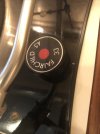
Standard 412-2 on the factory pinth, using the narrow "butterfly" belt cover, as previously noted. I'm sure you're aware that the center puck on the turntable is a pop-up 45 adapter. The oil in them has a tendency to turn to glue over the decades, so they can be very hard to move until cleaned out. All 412s had the pop-up 45 adapter, even the single speed 412-1 models.
 
IMG_5024.jpeg

IMG_5049.jpegF118423A-29EA-4E80-A0FE-F84A9A23098E.jpeg

Greetings everyone. Just bought this Fairchild 412-1 inexpensively without many pictures and a generic description. It was only after it arrived and I removed the armboard that I discovered it was a 412-1 model.

The bummer is that it’s only one speed at 33 1/3pm. Is there a speed box or external switching system that can manipulate the speed to at least both 33 1/3 and 45 rpm? I bought this to restore and could possibly DIY this speed box myself. However, thought I’d check to see if anything was already available out there. I found one on eBay but uses 9-pin connector - this table’s power cord is hardwired in without a connector.

Thanks.
 
View attachment 3834282

View attachment 3834283View attachment 3834284

Greetings everyone. Just bought this Fairchild 412-1 inexpensively without many pictures and a generic description. It was only after it arrived and I removed the armboard that I discovered it was a 412-1 model.

The bummer is that it’s only one speed at 33 1/3pm. Is there a speed box or external switching system that can manipulate the speed to at least both 33 1/3 and 45 rpm? I bought this to restore and could possibly DIY this speed box myself. However, thought I’d check to see if anything was already available out there. I found one on eBay but uses 9-pin connector - this table’s power cord is hardwired in without a connector.

Thanks.
There is a modern solid-state drive unit available that duplicates the functionality of the 412-ED, one version has the octal plug to duplicate the 412-ED connection, another from the same seller is designed for any table using a similar Papst motor and is hardwired. The second version would be required for your shallow chassis turntable.
 
Last edited:
There is a modern solid-state drive unit available that duplicates the functionality of the 412-ED, one version has the octal plug to duplicate the 412-ED connection, another from the same seller is designed for any table using a similar Papst motor and is hardwired. The second version would be required for your shallow chassis turntable.
Thanks. Yes, I think the same seller has a different connection, which is what I needed. He confirmed it should work after showing him the close-ups of the wiring from the Papst motor to the Sprague. Turns out he’s about an hour-and-a-half down the freeway from me. The Fairchild mechanically seems to be in really good shape.
 
View attachment 3834282

View attachment 3834283View attachment 3834284

Greetings everyone. Just bought this Fairchild 412-1 inexpensively without many pictures and a generic description. It was only after it arrived and I removed the armboard that I discovered it was a 412-1 model.

The bummer is that it’s only one speed at 33 1/3pm. Is there a speed box or external switching system that can manipulate the speed to at least both 33 1/3 and 45 rpm? I bought this to restore and could possibly DIY this speed box myself. However, thought I’d check to see if anything was already available out there. I found one on eBay but uses 9-pin connector - this table’s power cord is hardwired in without a connector.

Thanks.
Also, it’s worth noting that this is a 412-1A. The “A” stamping is fairly light and ran out of the side of the model number box. There were four generations of the 412, rather surprising for a turntable that may have had 15,000 total examples produced.
412 Basic Chassis and 412-1 were the same deep chassis model, just with different labeling. The earliest 412 Basic Chassis models had a pulley idler system that was a bit unstable and was quickly redesigned.
412-1A kept the Papst motor but cut the deep box chassis down to an inverted tray, with no octal connection or mounting provision for the 412-ED module.
412-1B went back to the old General Industries “Death Cube” motor previously used in the very short lived 411.

I think the 412-2 had a separate serial number sequence, there seem to have been very few made, and I’ve never been able to gather much data on them.
 
Also, it’s worth noting that this is a 412-1A. The “A” stamping is fairly light and ran out of the side of the model number box. There were four generations of the 412, rather surprising for a turntable that may have had 15,000 total examples produced.
412 Basic Chassis and 412-1 were the same deep chassis model, just with different labeling. The earliest 412 Basic Chassis models had a pulley idler system that was a bit unstable and was quickly redesigned.
412-1A kept the Papst motor but cut the deep box chassis down to an inverted tray, with no octal connection or mounting provision for the 412-ED module.
412-1B went back to the old General Industries “Death Cube” motor previously used in the very short lived 411.

I think the 412-2 had a separate serial number sequence, there seem to have been very few made, and I’ve never been able to gather much data on them.
Great catch! I hadn’t noticed the A stamp running out of the box.

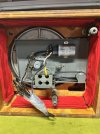
I was going into this thinking of doing a whole new plinth and using this as a template. I still might. However, looking underneath this plinth makes me think this is beyond any homebrew back in the day with the red cloth dampening and the two suspension springs (one looks like it’s missing on the top left corner). Maybe these were for feet? Anyway, the plinth top is not as Swiss cheese as I thought before getting it, so maybe I should preserve this somehow?

I assume the cork glued to the platter was for both dampening and leveling it with the raised armboard. I’m not a fan of cork so I’m inclined to remove the pie slices on the platter and construct my own armboard. I feel this construction has almost as much history as the Fairchild chassis itself.

IMG_5033.jpeg
 
Last edited:
That’s some kind of homebrew. There were plenty of people who had the tools and skills to make quality furniture at home. The bases sold by the factory had slanted walnut sides and white Formica tops. Early examples used plywood under the Formica, later versions had particle board. The base was an add-on, the basic drive unit was sold independently for installation in a countertop, console, or whatever base was desired.
 
Back
Top Bottom