• The move to the new server is done. There are some software and database maintenance updates in process. This has us passing the hat around to help out. We appreciate any donations. Seriously, even a dollar helps. The payment page may be found here - https://www.audiokarma.org/support.html

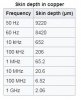
The "skin effect" at audio frequencies?

Artie

Super Member
I'm under the impression that the skin effect isn't really much of a factor at audio frequencies. But I'm not sure about that. At least, not for very short distances. I'm gathering the parts to build an A/B speaker selector, and am thinking of using solid 12 or 14 AWG romex. The max internal distance shouldn't exceed 2 or 3 inches. Do you think this would have any sonic impact?

Thanks all.
Artie
 
Register to hide this ad
I'm under the impression that the skin effect isn't really much of a factor at audio frequencies. But I'm not sure about that. At least, not for very short distances. I'm gathering the parts to build an A/B speaker selector, and am thinking of using solid 12 or 14 AWG romex. The max internal distance shouldn't exceed 2 or 3 inches. Do you think this would have any sonic impact?

Thanks all.
Artie

I thinkt that's perfect for the inside of the unit.
You can nicely route the wires, the bends will stay where you put them.
No movement inside the unit, so solid is OK.
I care not for any audio effects at this level.
 
Thanks Dingman. That's what I was thinking. Using solid core will make it a bit easier to build.
 
Considering most amps use much smaller internal wiring than you plan on using, your 12 or 14 gage wiring is overkill.

Also, there is no significance to conductor length for skin effect. Long or short wires, it does not really matter.
 
I would be using 12 or 14 simply because that's what I have laying around. Also, I'm thinking that due to its greater circumference, it has more "skin", so to speak.
 
I'm going to say yes. When I first built my amp I used some decent quality interconnect cable to connect the RCA inputs to the board. I eventually ripped it all out and replaced it with 18g solid twisted pair and it made a significant difference. For such short runs I wouldn't use anything bigger than 16g. The impedance to low frequencies at that length is totally insignificant, but a hulking piece of 12g starts acting like an inductor at 20KHz. The work around is 2 runs of smaller gauge wire. I built my speaker cables out of 2 triple runs of 16g and they are much clearer that my 2 single runs of 12g.
 
I'm going to say yes. When I first built my amp I used some decent quality interconnect cable to connect the RCA inputs to the board. I eventually ripped it all out and replaced it with 18g solid twisted pair and it made a significant difference. For such short runs I wouldn't use anything bigger than 16g. The impedance to low frequencies at that length is totally insignificant, but a hulking piece of 12g starts acting like an inductor at 20KHz. The work around is 2 runs of smaller gauge wire. I built my speaker cables out of 2 triple runs of 16g and they are much clearer that my 2 single runs of 12g.

Well, you have direct experience, I can't argue with that. I agree on the overkill but I also put some 14ga in an amp recently.
But the dual runs is interesting... never thought of that.
 
Audioholics did the calculations and proofed them with measurements.

They established skin effect caused something like -0.1dB at 20kHz using 12ga solid wire. Is -0.1dB change at 20kHz audible when you're playing music (or even a pure tone for that matter)?

I have my opinion. Each can form their own.
 
Well, you have direct experience, I can't argue with that. I agree on the overkill but I also put some 14ga in an amp recently.
But the dual runs is interesting... never thought of that.

To further elaborate on my reasoning...

All wires have resistance, inductance, and capacitance. Given the option, I prefer higher capacitance to higher inductance. More runs gets you higher capacitance, which doesn't much effect high frequencies because it's easily overcome by being charged by the amp throughout the bass and mid-range. The inductance is harder to overcome by high frequencies because the have much less energy, and that becomes a factor when skin effect begins to break down.
 
Audioholics did the calculations and proofed them with measurements.

They established skin effect caused something like -0.1dB at 20kHz using 12ga solid wire. Is -0.1dB change at 20kHz audible when you're playing music (or even a pure tone for that matter)?

I have my opinion. Each can form their own.

What's the length of wire that measurement applies to?
 
What's the length of wire that measurement applies to?

10ft.

But, I misspoke about the numbers; that's what you get from trying to go from memory.

What they measured on 10ft of 12ga solid wire @ 20kHz using an unlikely case of 2 ohms @ 20kHz load was -0.142dB total. However, -0.14dB of that was due to the losses from DC resistance. Skin effect itself was only -0.002dB of the total loss.

So, the result of skin effect itself was actually orders of magnitude less than I'd previously related.

The entirety of the article is on Audioholics if you Google that and skin effect together.
 
Skin effect is typical in microwave circuitry, Gigahertz, not in the audio range of 20-20,000Hz .
But this has come up before - believe as thou wilt.

The article says:
While Skin Effect is a real world problem in high frequency applications such as RF Power and Transmission,
it is negligible at audio frequencies as I will demonstrate in this article based on fundamental engineering and scientific principles.
https://www.audioholics.com/audio-video-cables/skin-effect-relevance-in-speaker-cables
 
Skin effect is typical in microwave circuitry, Gigahertz, not in the audio range of 20-20,000Hz .
But this has come up before - believe as thou wilt.

The article says:
While Skin Effect is a real world problem in high frequency applications such as RF Power and Transmission,
it is negligible at audio frequencies as I will demonstrate in this article based on fundamental engineering and scientific principles.
https://www.audioholics.com/audio-video-cables/skin-effect-relevance-in-speaker-cables

Thank for providing the actual link to the information I'd described in the previous posts.
 
Great info guys. This is why I asked here. It will be no problem for me to do several twisted strands of a smaller gauge. (Just to be safe.)
 
Back
Top Bottom