• The move to the new server is done. There are some software and database maintenance updates in process. This has us passing the hat around to help out. We appreciate any donations. Seriously, even a dollar helps. The payment page may be found here - https://www.audiokarma.org/support.html

This made me "laugh out loud"

Squonk07

Someday you'll understand
I was bored this evening, and--elated to have finally found the tool I needed to unscrew the posts holding together my Insignia NS-B2111's--I fetched some "dampening material" (cotton batting...because of my family business I have access to lots of the stuff) and shoved it inside. It worked pretty well, so I decided on a whim to dissect a pair of old Sony bookshelf speakers I had lying around to see how well they dampen the insides of their cases.

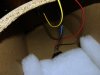
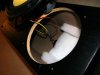
The pictures below show what just made me chuckle. Once you get past the plastic basket for the woofer (you'll have to take my word for it on account of my lousy camera), one must ask why they even bothered with that tiny quantity of material they put in there. If I'm way off base here, please let me know. Everything I've ever read and been told tells me that this is certainly laughable. At any rate, I'm about to shove an entire bale of batting in there to see if it does anything.

attachment.php


attachment.php
 

Attachments

  • Inside 1.jpg
    Inside 1.jpg
    102.8 KB · Views: 412
  • Inside 2.jpg
    Inside 2.jpg
    111.9 KB · Views: 413
Register to hide this ad
As good as homemade! Seriously, that's about on par with the Bostons I got that were refoamed with T-shirts sted actual foam.
 
Actually the amount of damping depends on the individual speaker design, some need and use more than others.
 
Can you guess what this is...Notice amount of dampening.. Very critical to the speaker design...
 

Attachments

  • NS1000M Stuffing.JPG
    NS1000M Stuffing.JPG
    51.1 KB · Views: 238
Can you guess what this is...Notice amount of dampening.. Very critical to the speaker design...

I don't want to break up the fun, but the mouse-over contains rather sensitive information that might help us in answering the question. :D
 
I know.I put it there .had to give you a hint..:smoke: These speakers are older than both of you..Just trying to help you out...
 
My guess would be that Sony wanted a "boomier sound" that would appeal to the masses and also give the appearance of better bass response than they are actually capable of producing, hence the minimal material. Just a guess though.
 
I know.I put it there .had to give you a hint..:smoke: These speakers are older than both of you..Just trying to help you out...

Good lookin' out for us. :yes: When I searched for the model number, I saw that the woofer is 11". Unless it was much more common in its time, this is a somewhat non-standard size (certainly in today's terms). I'm not sure what the surrounds were made of, but if they were foam, I wonder how difficult it would be to find replacements today.
 
Bass reflex speakers, if that is what those Sony's are, do not require as much damping material as a sealed design and in fact if too much is used, will restrict the amount of bass that can be produced.

Most designs I've seen place one sheet of damping material on one long side; (possibly) a portion on the rear panel; and either the top or the bottom panel.....and that's it. Much more than that and the material would start interfering with the soundwaves that need to exit the port.

The fact the Sony has the batting directly behind the woofer means that while this is probably a lower-price point speaker, the designer at least wanted to prevent a reflected wave directly from behind the woofer, which would be really noticeable and not very pleasant. In fact my Realistic Nova has all its damping material (much more than the Sony) located only in the bottom half of the enclosure & is completely surrounding its 11" woofer - this speaker has no boominess whatsoever.

It's higher-quality acoustic-suspension enclosures that are usually fully stuffed with damping material from top to bottom. Partly to generate that clean sound so many people like (like me!) but also, due to a quirk in the law of thermodynamics, if fully stuffed the woofer "thinks" it is installed in a larger enclosure which in turn allows the cone to move further with less power. I can't remember the exact percentage, but stuffing* can increase the effective internal volume by up to @20%. This means the enclosure itself can be made smaller for the same amount of bass output vs. a larger enclosure with less damping material.

* "stuffing" in this context means placing damping material into an enclosure until no more of it will fit - it doesn't mean literally cramming material into an enclosure by stomping, using fists or similar actions. :D
 
Bass reflex speakers, if that is what those Sony's are, do not require as much damping material as a sealed design and in fact if too much is used, will restrict the amount of bass that can be produced.

Most designs I've seen place one sheet of damping material on one long side; (possibly) a portion on the rear panel; and either the top or the bottom panel.....and that's it. Much more than that and the material would start interfering with the soundwaves that need to exit the port.

The fact the Sony has the batting directly behind the woofer means that while this is probably a lower-price point speaker, the designer at least wanted to prevent a reflected wave directly from behind the woofer, which would be really noticeable and not very pleasant. In fact my Realistic Nova has all its damping material (much more than the Sony) located only in the bottom half of the enclosure & is completely surrounding its 11" woofer - this speaker has no boominess whatsoever.

It's higher-quality acoustic-suspension enclosures that are usually fully stuffed with damping material from top to bottom. Partly to generate that clean sound so many people like (like me!) but also, due to a quirk in the law of thermodynamics, if fully stuffed the woofer "thinks" it is installed in a larger enclosure which in turn allows the cone to move further with less power. I can't remember the exact percentage, but stuffing* can increase the effective internal volume by up to @20%. This means the enclosure itself can be made smaller for the same amount of bass output vs. a larger enclosure with less damping material.

* "stuffing" in this context means placing damping material into an enclosure until no more of it will fit - it doesn't mean literally cramming material into an enclosure by stomping, using fists or similar actions. :D

This design in practice: Acoustic research AR6. :yes:
 
The complete opposite to the previous owner of my Goodmans Magnums.

One sounded a bit dead, but when I undid the last woofer bolt, it shot out at me. They'd stuffed it so full of rockwool that it seemed like a solid mass, pushing on the woofer's magnet.
 
So what was the outcome of putting more batting in the Insignia NS-B2111? Did it tame the chestiness problem they have?
 
Bass reflex speakers, if that is what those Sony's are, do not require as much damping material as a sealed design and in fact if too much is used, will restrict the amount of bass that can be produced.

Most designs I've seen place one sheet of damping material on one long side; (possibly) a portion on the rear panel; and either the top or the bottom panel.....and that's it. Much more than that and the material would start interfering with the soundwaves that need to exit the port.

The fact the Sony has the batting directly behind the woofer means that while this is probably a lower-price point speaker, the designer at least wanted to prevent a reflected wave directly from behind the woofer, which would be really noticeable and not very pleasant. In fact my Realistic Nova has all its damping material (much more than the Sony) located only in the bottom half of the enclosure & is completely surrounding its 11" woofer - this speaker has no boominess whatsoever.

It's higher-quality acoustic-suspension enclosures that are usually fully stuffed with damping material from top to bottom. Partly to generate that clean sound so many people like (like me!) but also, due to a quirk in the law of thermodynamics, if fully stuffed the woofer "thinks" it is installed in a larger enclosure which in turn allows the cone to move further with less power. I can't remember the exact percentage, but stuffing* can increase the effective internal volume by up to @20%. This means the enclosure itself can be made smaller for the same amount of bass output vs. a larger enclosure with less damping material.

* "stuffing" in this context means placing damping material into an enclosure until no more of it will fit - it doesn't mean literally cramming material into an enclosure by stomping, using fists or similar actions. :D

I appreciate the response and explanation of theory. I also tend to agree with you on sound preference; even when a given speaker has ports, I usually stop these up any way I can (socks work wonders).

Incidentally, these Sonys are not ported speakers, but of the acoustic suspension variety. This is why the lack of damping material surprised me so much. I expected at least a thin layer of material covering the entire inner surface of the enclosure. As it was, I wasted no time stopping up the whole thing with material in imitation of the usual treatment afforded acoustic suspension-type speakers. Unfortunately, though I noticed tighter bass, the absence in volume thereof further exacerbated the extremely hot midrange these speakers put out. I imagine this is due to a poor XO, but I wouldn't even begin to understand how to build my own (at least not yet--I'm still learning here :yes:).

These were indeed my first set of speakers (purchased a while ago, though perhaps not to some of the regulars here...2004 or thereabouts), and they weren't exactly expensive. Nor was I ever completely satisfied with them, which at least suggests I have somewhat discriminating ears.

That was before I knew any better. I wish I had known about AK back then. :D
 
So what was the outcome of putting more batting in the Insignia NS-B2111? Did it tame the chestiness problem they have?

Somewhat. Come to think of it, that's a pretty good way to describe the sound I was trying to rectify. The overall result was rather subtle, though I'm anxious to try the technique on another set of these I have in a smaller room and with a receiver that seems to suit them better. Overall, the weak points (read: resonant) of the cab are the top and bottom, so I concentrated on these. Surprisingly, the egg crate foam is entirely absent from these places, so I filled in pretty much everything I could. I ended up pretty much sacrificing the use of the port, but since I keep it stopped up with a sock, anyway, this wasn't of too much concern.

The bass is tighter, if quieter (larger rooms will almost certainly demand use of a subwoofer), and some of the sloppiness in the other frequency ranges went away. The midrange notch is still there (a modified XO or else some doping agent painted around the edge of the woofer is the only known solution to this), but it's no more noticeable than usual. Output efficiency was somewhat reduced, but that is to be expected, what with reduced cabinet resonance and further truncation of the port. Overall, I was pleased with the results of what was a ten minute modification pretty much anybody could do.
 
Good lookin' out for us. When I searched for the model number, I saw that the woofer is 11". Unless it was much more common in its time, this is a somewhat non-standard size (certainly in today's terms). I'm not sure what the surrounds were made of, but if they were foam, I wonder how difficult it would be to find replacements today.
Better do a little more "homework" there college boy..30 cm = 12"
woofers
http://www.thevintageknob.org/YAMAHA/NS1000/NS1000-specs.html
http://www.thevintageknob.org/YAMAHA/NS1000/NS1000.html
:smoke:
 
Hey, Squonk, thanks for the feedback on the Insignia mod. Before I permanently decide to let mine go, I should try playing with batting and the ports. I don't need another project on my hands, but I can't resist the urge to experiment and I've got tons of fiberglass on hand (the "reduced itch" kind, thank goodness).

I never commented on what originated this thread -- the postage stamp-sized batting in the Sony speakers. I did get a good laugh out of that too. I'm skeptical that this tiny bit of fiber does much of anything. If it was egg crate I think it would do more. I think filling those sony cabinets with fiberfil or fiberglass would make a nice difference.

I had a pair of Boston Acoustics CR7 bookshelfs pass through my place recently. They were way too tubby sounding and when I opened them I found a sizable chunk of fiberfil behind the woofer but nothing elsewhere in the cabinet. So I put even more fiber behind the woofer and filled the rest of the cabinet as much as I could, while leaving room around the inside mouth of the vent. The difference was unmistakable and made a huge improvement. They went from being lame speakers that were no better than the Insignias, to being quite refined and enjoyable.

By the way, I'm a fellow Genesis fan. Trick Of The Tail was my first album.
 
Last edited:
Back
Top Bottom