• The move to the new server is done. There are some software and database maintenance updates in process. This has us passing the hat around to help out. We appreciate any donations. Seriously, even a dollar helps. The payment page may be found here - https://www.audiokarma.org/support.html

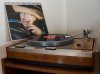
Thorens TD-125

Replacement for my totally irrelevant Denon-content post a while ago. I play in both camps. My TD-125 has been with me 36 years at this point. It was totally trashed during a fire at the house some years ago, but it got a full restoration (full board rebuild etc.) and is sounding lovely. There have a been a few different arms over the years - currently sporting a Fidelity Research FR-24 MkII.
_DSC5539.jpeg
 
The tables do fairly well where the floors are suspended, too.
The talk is that the Thorens tables suffer footfalls but as you state the 125 does a very good job of isolating this issue. It is the lighter tables that suffer.

The 125/6 have very heavy suspended top chassis with the arm and platter. The 160s and others of that ilk have a lightweight suspended lower chassis for the arm and platter and footfalls have enough energy to impart significant movement in that system. The heavy higher mass of the 125/6 suspended section keeps these footfalls from causing much movement.
 
The talk is that the Thorens tables suffer footfalls but as you state the 125 does a very good job of isolating this issue. It is the lighter tables that suffer.

The 125/6 have very heavy suspended top chassis with the arm and platter. The 160s and others of that ilk have a lightweight suspended lower chassis for the arm and platter and footfalls have enough energy to impart significant movement in that system. The heavy higher mass of the 125/6 suspended section keeps these footfalls from causing much movement.
You can dance madly in the room with my TD-125 and it pays no attention whatsoever. It all really comes down to suspension tuning.
 
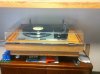
Show & tell? I'm game! That's my slightly modified 125:

E94GrQR.jpg


I use these for scratching when I DJ at the disco club on weekends (neah, I don't):

gxQJLA5.jpg
 
That really is a pretty big plinth for a 125. 12" SME on there I see? Nice!

Yes it is quite a big plinth. The turntable was for sale without arm and as I had a 3012 gathering dust it seemed like a good idea :cool: I’ve modified the plinth slightly to raise the deck an inch or so as I felt it was buried too deep in the plinth.
 
Not much actually. I thought adding mass would fix a speed fluctuation issue, but since then I've rebuilt the PCB so it's perfect now. It's still cool though and it was dynamically balanced like a tire and had a cost attached to it, so I've left it as is.
 
I have a TD125 with the standard TP25 arm. I also paid 20 bucks for mine, but that was about 10 or more years ago and it was in rough shape. I have a thread on here about the restoration and minor modifications I did.

I live in an apartment in a converted barn. It has bouncy floors. (Actually, one can feel the entire structure move around with high wind gusts. Rather disconcerting!) My cartridge and tonearm compliance/mass match isn't ideal. My 125 is very sensitive to footfalls. I've tried adjusting the suspension but the only thing that's helped was jamming some cardboard between the plinth and the suspended part to render the suspension essentially inactive. I don't have any rumble or acoustic feedback issues, so perhaps there's still some decoupling because the cardboard isn't a very stiff connection across the springs.

 
I had an almost identical problem with my 125. I solved it by building this:

https://www.diyaudio.com/community/threads/seismic-turntable-platform-stops-a-train.250727/
That is an outstanding engineered solution! I don’t think I’m going to go to the same amount of effort because I have another turntable that is 100% immune to the footfall and house shaking issues. My “daily driver” is a B&O TX2 that lives right next to the Thorens. I can’t get the B&O to skip and it’ll track the most warped record flawlessly. The B&O approach is ultra low tonearm mass and high compliance, with the cartridge specifically engineered for the arm and table system. I think the low mass approach makes a lot of sense when thinking about relatively large displacement motion such as footfalls and warped discs. I have fine line styli on both, a SoundSmith SMMC-2 on the B&O and a Shure with Jico SAS on the Thorens. They both sound great though definitely different. Some records are better sonically on one, some on the other. The B&O’s ease of use and immunity from footfalls gives it the nod most of the time.
 
I have a TD125 with the standard TP25 arm. I also paid 20 bucks for mine, but that was about 10 or more years ago and it was in rough shape. I have a thread on here about the restoration and minor modifications I did.

I live in an apartment in a converted barn. It has bouncy floors. (Actually, one can feel the entire structure move around with high wind gusts. Rather disconcerting!) My cartridge and tonearm compliance/mass match isn't ideal. My 125 is very sensitive to footfalls. I've tried adjusting the suspension but the only thing that's helped was jamming some cardboard between the plinth and the suspended part to render the suspension essentially inactive. I don't have any rumble or acoustic feedback issues, so perhaps there's still some decoupling because the cardboard isn't a very stiff connection across the springs.
I run my 125 suspension "full range" rather than "captive" as originally designed. I levelled it by adding mass to get equal compression on all of the springs. Once I'd done this the footfall issues vanished like they'd never been present.
 
I run my 125 suspension "full range" rather than "captive" as originally designed. I levelled it by adding mass to get equal compression on all of the springs. Once I'd done this the footfall issues vanished like they'd never been present.

What do you mean by “full range?”
 
The construction prevents motor vibrations or other mechanical disturbances from being transmitted to the pickup. It was not designed to avoid footfall vibrations from the record player.
To get rid of footfall vibrations, wall mounting should be preferred.

See picture:

td125sub.png
 
What do you mean by “full range?”
The suspension on the 125 is "captive" in that the degree of compression of each spring is variable depending upon the levelling adjustment. Mine is set up using added mass in various places to get the desired equal compression and "bounce". This seems to have eliminated the footfall issues (which under careful observation proved to be largely in the horizontal rather than vertical plane). Worked for me anyway - no footfall issues on a 111 year old hardwood floor.
 
The suspension on the 125 is "captive" in that the degree of compression of each spring is variable depending upon the levelling adjustment. Mine is set up using added mass in various places to get the desired equal compression and "bounce". This seems to have eliminated the footfall issues (which under careful observation proved to be largely in the horizontal rather than vertical plane). Worked for me anyway - no footfall issues on a 111 year old hardwood floor.
Does that mean that you removed the bump stops? Are your spring adjusters screwed all the way in one way or another? It's been a long time since I studied mechanical vibrations and resonance, but allowing more travel and reducing the natural frequency (adding mass) is an interesting area to experiment with.
 
Doesn’t always work.
In my case the walls shook and vibrated too. I had to resort to a full-blown engineered solution to deal with the problem.
Does that mean that you removed the bump stops? Are your spring adjusters screwed all the way in one way or another? It's been a long time since I studied mechanical vibrations and resonance, but allowing more travel and reducing the natural frequency (adding mass) is an interesting area to experiment with.
Yes, removed the bump stops entirely. Mass (surprisingly small amounts needed) was added in places on the top plate with it outside the plinth until I got identical measured compression of the three springs. The adjusters are just screwed so that they're equal and the top deck is level. The whole idea came up during extensive discussions a number of years ago with the late-and-much-missed Marc Morin. The end result was to reduce the frequency of the "bounce" to just over 2hz which is in the range Marc's study had shown to be ideal. Before the changes a 4 lb Jack Russell trotting across the room caused a skip - now one can do anything up to a room full of people dancing and no reaction.
 
Last edited:
Yes, removed the bump stops entirely.

Bump stops had nothing to do with my problem. I do agree though that tuning the suspension to around 1-2 Hz is the right thing to do. The advantage to my engineered solution is that it will work with ALL turntables, whether suspended or not.
 
Back
Top Bottom