
• The move to the new server is done. There are some software and database maintenance updates in process. This has us passing the hat around to help out. We appreciate any donations. Seriously, even a dollar helps. The payment page may be found here - https://www.audiokarma.org/support.html

Thorens TD-16x: mod or keep it stock?

p.robustini

Active Member
I've been playing a while with my Thorens TD-165.
I added damping material to the inside of the plinth walls, to the bottom of the faceplate, and lately even to the bottom of the sub-chassis (also around the bearing well) - using a combination of adhesive tar sheets and white tac.
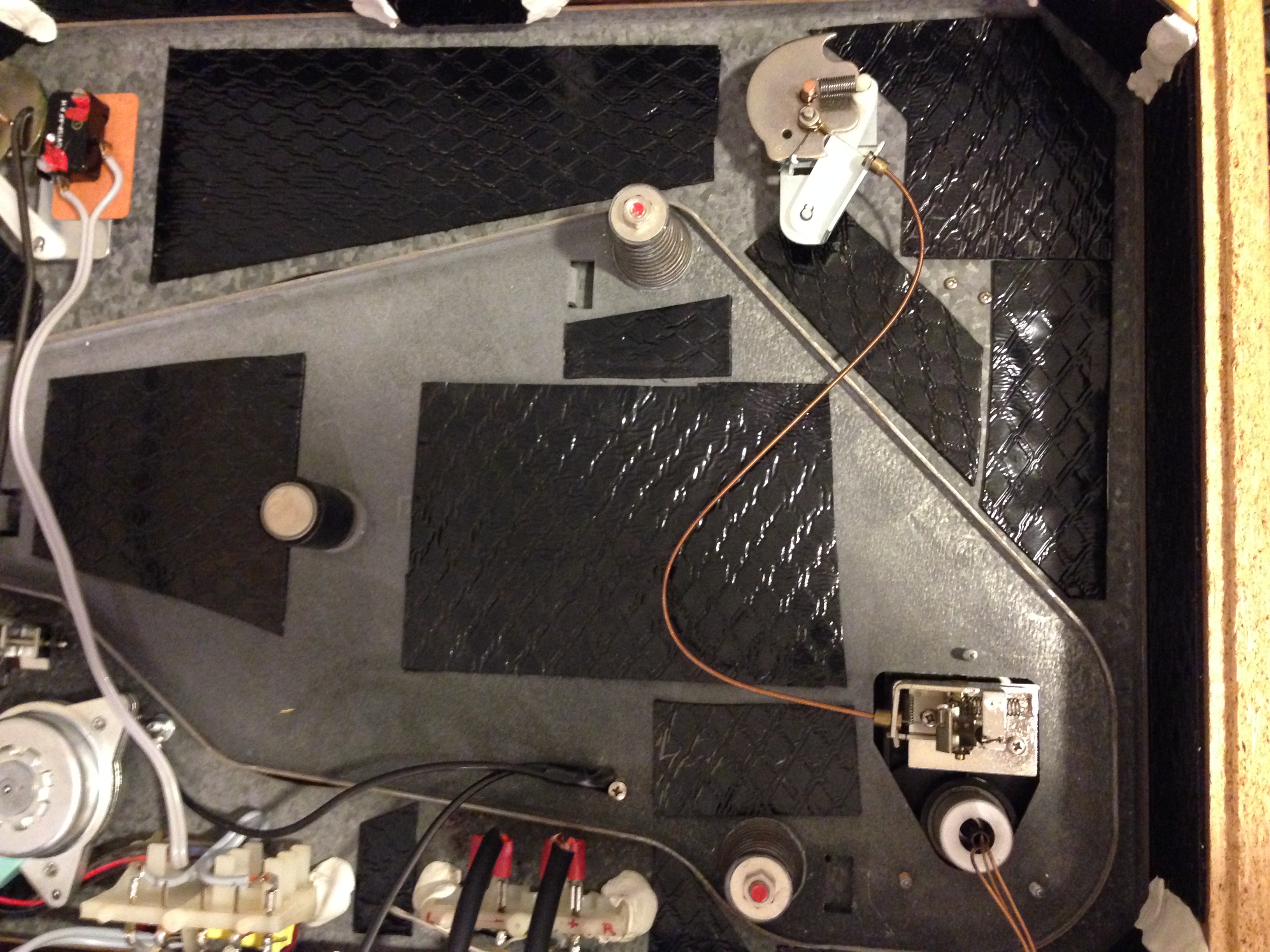
17898578566_e88f2de9b1_o.jpg


I have been replacing the cables, using both microphone and video coaxial cables.
I know someone does not like the idea of replacing the stock cables if they are fine: they were designed for that TT, with proper length/capacitance.
Some believe dampening the plinth may change the resonance of the TT and thus deaden the sound.
I have done my usual "mods" with a TD-160, too. I went to the extent of installing Belden 1505F cables.

Now I've come across a stock TD-160 with cables in good conditions. I'm thinking of leaving it almost as it is, maybe just partially dampening the subchassis and the bearing well - maybe I will ad some adhesive tar sheet to the faceplate's underside. But I want to keep the stock cables and compare the sound to the dampened TD-160 before I decide which one to sell.
I'm starting to like the idea of keeping the TT as stock as possible, at least for a while...

What is your opinion and/or experience about this?
 
Register to hide this ad
Unless you have proper test equipment, why not check the Table make sure it is up to original as you can be. Up grade your cartridge and or tone arm and sit back and enjoy the music. If thats not enough, save your time and energy and money and buy a proven more up to date turntable. Unless you are hearing rumble or changes in pitch why not enjoy yourself. Resonant sounds are more likely to be from the tone arm and cartridge combination, than the turntable. Maybe you need a pre-amp with adjustable loading to get the sound right as the final upgrade.
 
The TD-160 Super was a 160 II that was upgraded by Thorens using many of the suggestions of those TD-160 owners that found adding sound deadening, a solid bottom instead of the pressboard, a thicker base and other upgrades to make a very competitive table that is well above the stock 160 tables. Check the upgrades on theanalogdept and follow them if you want. If the manufacturer is going to make the upgrades and the table is well respected, it can't be all bad.

But if you want to keep a stock 160, that is fine, too.
 
The TD-160 Super is certainly a good point.
What was the dampening material they used? It looks like felt in the pictures. isn't it?

Twiiii, thanks for the contribution. To be precise, it's not that I'm not satisfied with my Thorens tables. I'm just wondering if I went too far with my dampening and cable replacements.
I currently have at home 2 TD-165s and 2 TD-160s. One TD-165 is sold, the other will be available soon and I have to decide what TD-160 to keep for me.
I figure I'll have the time to do some comparisons between the dampened/recabled one and the stock one before one of them goes.
I certainly don't feel the TD-160 needs to be replaced with a better table in my system. Unless I could afford TTs by Origin Live, Michell, Clearaudio or the likes... ;-)
 
The recabling of a turntable is not really an issue. What is the issue is the capacitance of the cable used. For some turntables this value is known and for some cartridges their desired capacitive load is also known, allowing one to tune the system to the manufacturer's recommendations. Without known values, it does not matter as long as the cables used are a low capacitance cable, allowing loading to fine tune the system. There are capacitive loading plugs available on the market, (DB systems).

I've read that damping can be overdone on a table and when it comes to a platter mat on a TD-160 Super, it very definitely can. Testing a Platter Matter (thick heavy rubber like), Marcof Glass Mat (felt covered glass I guess), the Thorens mat and a Herbies Mat, the first two sounded like the material they were made from, heavy and boomy or crisp and brittle. Teh Thorens mat sucked and was only listened to once. The Herbies was clean and clear as I would want it to sound. The same as the Platter Matter can happen if too much sound deadening material is used. But you have to get rid of that bottom thin sheet and use a proper 1/2 to 3/4" chunk of plywood for a bottom plate.

The 160 Super modification is a pdf on VE. The damping material is a bitumin containing cardboard material.
 
The recabling of a turntable is not really an issue.
......................................
...................................
The 160 Super modification is a pdf on VE. The damping material is a bitumin containing cardboard material.

Thanks a lot, Blue Shadow!
Very informative contribution.
I also read a thread on VE where Steve of theanalogdept announced a change in his approach to dampening = motor board and subchassis - no plinth + thicker MDF board.
As for mats, I had a major sound improvement after I bought a 5 mm Funk Firm Achromat!
There's a firm near Rome that can get you a 5 mm or 3 mm chunk of PVC laser cut as a TT mat with a perfect hole in the middle - it is very similar to the Funk Firm but less expensive. I strongly suggest the Achromat; as second but very close option a PVC mat; otherwise a simple 3 mm felt mat is the cheaper option.
Herbie's: silicon foam - FF Achromat: foamed vinyl/acrylic - PVC: foamed vinyl.
 
Coming in late by I concur that a properly modified TD-160 will beat a stock one. I did some of the mods to mine TD 160 in a serial fashion to hear and evaluate them.
The damping mods make a significant improvement.

Just make damping mods in similar fashion with the TD 160 Super and follow the lead presented at the site "the analog department".

As for TT wires, I think that better wire helps. Better means low capacitance, good conductors properly shielded, and terminated with quality RCA connectors. Some MM cartridges (like vintage Shure and Ortofon) actually like higher capacitance loads. If you use a cartridge like this you can just increase the overall capacitance at the phono stage with parallel load plugs.

cheers, Bob
 
On dampening the bottom surface of the motor plate:
I would avoid to put anything between the motor plate and the subchassis - that would narrow the space available for the suspension system.
But apparently many do that. Even the latest version of theanalogdept mods retain a complete motor plate dampening. The TD-160 Super also has some dampening material that appear to be between motor plate and subchassis.
dessous-160-super-001-3ad36a8_zps576ce749.jpg

Am I missing something?
 
Back
Top Bottom