• The move to the new server is done. There are some software and database maintenance updates in process. This has us passing the hat around to help out. We appreciate any donations. Seriously, even a dollar helps. The payment page may be found here - https://www.audiokarma.org/support.html

Thorens TD124 mk II: where to start

Pavlov

Active Member
Hi guys, it has been quite a long time...

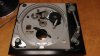
I thought I was finished with my set-up, but recently I stumbled this Thorens TD124 for a very reasonable sum and I just couldn't resist myself. However it seems - as with yachts - that the purchase of these is the easiest and less-costly part. To be honest I have no clue where to start to bring it back to its glory.
I bought it from the granddaughter of the original owner, and apparently it was still in use by the previous owner less than 3 years ago. (then in his 90s)
The seller insisted that the stroboscope went on when she tried it, but the platter spinned very slowly. I haven't tried to power it on myself - too scared.

But where do I start from here:
- firstly, does anybody has a clue about the age of the machine? It's a mark II, so after 1966, with serial n. 84587.
- do I try to turn it on and see if it still working - or do I look for a professional first to get it serviced? - I have minimal technical background... is it possible to do it yourself?
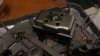
- cosmetically it seems to be in perfect shape and everything seems to be very clean (I haven't cleaned it myself and the seller claimed it hasn't been looked at since her grandfather died), and it looks as if no parts are missing (please correct me if I'm mistaken);
- I assume I need another (new?) arm to get the best out of the table. I have an unused Grado Reference Master which I'd love to match it with. Which tonearm should I look for?`
- I'm also not sure which platter I have? I read that there are different versions, some of which are non-ferocious and can take MC carts. Do I have to worry that my Grado (moving iron - I believe) will be affected by this?
- Do the 'mushrooms' also need to be replaced after all this time? Are these the original 'mushrooms', because they look not so bad tbho, I expected rubber to be in worse condition after 50+ years;
- What is the thing on left on the back? I assume it is a stand for a dust cleaner. Any idea if I can just remove it, and how?
- Do I need a different plinth? This one seems to be very flimsy, and not at all consistent with the build quality of the machine. I'm thinking about making my own in concrete. At least I'll need a new armboard if I change arms, am I wrong in thinking the current armboard is from ebony wood?

Sorry for all the chaotic questions, but I'm very excited and would love to get this thing running again :).
 

Attachments

  • IMAG0797.jpg
    IMAG0797.jpg
    49.4 KB · Views: 151
  • IMAG0805.jpg
    IMAG0805.jpg
    58.1 KB · Views: 146
  • IMAG0803.jpg
    IMAG0803.jpg
    50.7 KB · Views: 143
  • IMAG0807.jpg
    IMAG0807.jpg
    62 KB · Views: 148
  • IMAG0818.jpg
    IMAG0818.jpg
    79.7 KB · Views: 146
  • IMAG0819.jpg
    IMAG0819.jpg
    49.4 KB · Views: 144
  • IMAG0841.jpg
    IMAG0841.jpg
    19.2 KB · Views: 142
Register to hide this ad
If l were you I'd power it up and check the functions
But
Make sure the spindle well is immaculately clean and there is oil in there (light machine oil) about 2/3 full and lightly oil the spindle before you insert it.
Give it a little time to settle
The thing on the back would have probably held a dust bug.
Speed issue may be just a new belt required
 
Move the ball bearing in the end of the shaft in different directions with your fingertip to see if there are impact deformations or rough spots. Look down into the hole to see if there's any wear or a dimple on the bottom plate. If there is, don't worry, just note that it's there. Swab old oil out, put new in.

The "wedding cake" pulley should be pulled and make sure there is lube in that hole. I use the Zoom Spout stuff from the hardware store, but any light non-veg oil will be sufficient for all spots. Too much and it'll be everywhere. I'd put a few drops on both ends of the motor shaft, there are sintered bronze bearings and felt washers in there that should not be dry. I like a micro-drop on the idler wheel hub shaft as well, with a little hand-spin and wipe dry.

Put oil in the platter hole, rub a little on the shaft, then lower it in straight and gentle. When it hits the oil, spin it and it will slowly drop. May take a while, that's good.

Don't underestimate that arm, try it. Make sure it moves freely in all directions, carefully, don't oil.

You can try a magnet on the platter.

I made a heavy plinth, very crude heavy mahogany box lined with MDF, and sat my 135 (same drive, different platform) directly on it. Works very well, no mushrooms or adjusters. No noise hits the needle. If you want a fancy-looking plinth they are available, I just wanted one that worked so I could experiment with the drive. It works so well I'm not messin' with it.

Turn it on, run the motor for a while to see how much it heats up. If a lot, and if it's noisy, it may benefit from an alignment. Run the drive for a while, you may need a belt.

If you're in the southwest let me know, maybe I can help directly.
 
There's something wrong with the belt. Doesn't look like it is on correctly or twisted. Also the belt looks pretty glazed. Could use a new one.
 
Yours is actually the cast-iron platter, as was used on the MK1. Maybe it is an early example, and Thorens were trying to use up their existing stock. I had read that some MKIIs were produced with them. I'm not sure if your moving iron cartridge will have an issue. Some say that they get away with using their moving coils on the cast-iron platter, with use of a second platter mat, while others have had expensive cartridges destroyed.
 
you cant go wrong with a new belt but avoid the cheapies, they are too stretchy. Next make sure the motor pulley and the next pulley are in line, using a straight edge. loosen the motor shaft grub screws to raise and lower the motor pulley, then fit belt.
Lube motor, wait awhile then turn motor on and touch the top of each of the 3 motor mounts to feel the vibration level, then touch the chassis near each one to see if motor vibration is leaking thru the springs and rubbers, new motor rubbers may be in order .Rock the idler wheel to see if it needs a new bush.
Now you know what mechanical bits often fail. eventually the power switch will give trouble, get someone to swap with a long arm microswitch and the donuts, but many run these tables without the donuts, I do.
 
If the seller said it was in recent use, I wouldn't change anything related to alignments. I'd only change the platter oil and rewet the other normally oiled areas. There's a diagram on the net somewhere that'll show you where if it's not obvious.
Fix the belt and see how it lines up before you move pulleys.
Plenty of stuff to read on the TD124...read it so you know what to look for.
Keep in mind it's built like a truck and is a very straightforward design, which means you can look at it and figure it out if you take the time.
Take it slow...it takes time to figure it all out.

Also...I use both a Grado Ref and Stmnt Sonata1 with no problems on my table.

Make sure the table is level (don't trust the bubble). Make sure the armboard is level.

Great table! Rock solid speed control.
 
it makes sense to check motor pulley height before fitting a new belt because when the motor rubbers age and collapse a bit then the motor will sit lower in the plinth with its pulley. It is well worth doing these simple checks before before putting the platter back because its easy to drop the platter in but messy and not so easy to lift it out because there is a belt problem. I've been maintaining my td121 for 30years. They are not set and forget in the same way as a technics direct drive, but every few years ,I clean and lube the many moving parts because the belt will shed rubber and gum up the works.. and lube dries out. There are some very expensive parts for these now and given care they can last another 40-50 years.
Wonderful machines with unique sound. Don't sit around idleri
 
Wow wow wow ....it's fantastic nos or restored?
wub.gif
 
Congratulations on a fine table! I would lube it up, replace the belt and give it a trial run to see where it sits. Then make a list for the items that should be replaced like isolation mushrooms and motor mounts. Consider the spring motor isolation system at least, as that is the way I would look at. Inspect the spindle bearing, consider a new thrust plate, and perhaps end cap. If things aren't worn out, these can be pretty inexpensive to refurbish.

Regards
Mister Pig
 
A few words about the main bearing on my 121(a 10mm version with no removable end cap). About 20 years ago i had the table fully stripped down and measured some shaft wear and oval shaping of the top bush (I couldn't measure the bottom bush). This wear ,i figured was from previous running not level. So i thought if i get some new bushes and slightly reposition them to fit a new, unworn part of the shaft then all would be as good as new. A local machinist had some sintered bronze rod and said he would make a high tolerance fit. All was well I thought until the next inspection after 2 years that showed extreme shaft scoring where the new bushes were. Where am i going with all this?
Sintered bronze is made from compressed powder, it is porous,it is filled with lubricant that moves in and out of the pores and is more or less self lubing. Normal cutting tools will clog these lube holes.Just buy the right bushes from Germany and with the correct oil (not singer sewing machine oil, too thin) , you will have the correct tolerance for your main bearing.
 
Ok thanks for all the info, the table seems to be very well taken care for / very little used.
There is no scratch to be seen and the platters seem perfectly flat (the ingenious 'braking' system works like a charm - the mechanics of this thing are just fascinating).
I'll oil it this weekend and just try to start it I guess - then I know where I'm at.
But first I have a lot of reading up to do :).

I'm also reading some good things about the tonearm, so maybe I'll keep it after all !
 
Last edited:
Hi all, just an update on the Thorens and to share my enthousiasm.:jump: (and yes - brag)

I went for a professional to clean and oil the motor properly, which is running extremely smoothly now. It was described as VERY DRY.
The capacitors were mostly gone and have been replaced (the capacitor across the switch was bad and this caused the stroboscope to light on, even when the table is on '0'). The pulleys seem to be in line with each other.

I oiled the platter and installed some new mushrooms I ordered online (however most of you seem to be running them without). I'm waiting on a new belt and an anti-skate weight I ordered.
The idler wheel also seem to be in perfect unwarped shape.

So I went for it, installed and aligned a denon dl110 cartridge on the tonearm (however without anti-skating), leveled the table and powered it up, and ... it works!

To be more exact, it works very well!! I first played an original blue note record from '66 - just because it looks so cool on the Thorens :rockon: - and I'm very pleased with what I'm hearing!!! Very good sounding and no idler wheel to be heard imho.

It's crazy to think that this machine was built +50 years ago and is spinning as good as ever with a minimum amount of oil and a couple of capacitors!! Looking at the wear and tear I can't imagine this table has seen much use so far. I don't see any reason to replace anything at the moment.

The only thing about the motor is that it just can't seem to get to 33 rpm in the beginning but after a minute or two it is spot on. I've read that the motor needs 10 minutes to warm up (hence the fantastic 'hinge') but is it normal for it to be slow the first minute or so? It also takes 10 seconds to get to speed atm, but I have a strong suspicion that a new belt will fix this.

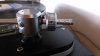
And then the arm. It runs pretty smoothly in all directions (not perfect), but the rubber near the counterweight is degrading, is this replaceable? I'm so far not unhappy with the arm, so maybe I want to make the best of the table as I bought it and keep it as original as possible (since this is already pretty good it seems:naughty:)
 

Attachments

  • IMAG0922.jpg
    IMAG0922.jpg
    43.6 KB · Views: 37
  • IMAG0928.jpg
    IMAG0928.jpg
    53.1 KB · Views: 37
  • IMAG0941.jpg
    IMAG0941.jpg
    39.8 KB · Views: 37
The sagging of the rubber coupling to the rear counterweight is common. It is possible to fix it the DIY way and I've done it twice, but some years ago. Google around for discussions of the best fix. Great to hear that your table is working well. It should give you years of good service.
 
Re the td124/121/185 etc. Motor. It is total overkill for the job and causes excessive vibration, ultimately into the plinth. Thorens upgraded the spring/ rubber motor mounts to double rubbers and longer shafts undoubtedly to further reduce motor vibration into the plinth. When anyone says there motor is running smoothly , this can only mean relative to an earlier state. In no way can the td124 motor be described as smooth on aturntable ,it is more powerful than a lot of sewing machine motors.
 
The only thing about the motor is that it just can't seem to get to 33 rpm in the beginning but after a minute or two it is spot on. I've read that the motor needs 10 minutes to warm up (hence the fantastic 'hinge') but is it normal for it to be slow the first minute or so? It also takes 10 seconds to get to speed atm, but I have a strong suspicion that a new belt will fix this.

It's not the motor. If you check a properly serviced motor with a tachometer while not under load, you'll see it comes right up to speed immediately and stays there.
The platter coming up to speed slowly is normal, as the Thoren's user's manual states. I think it takes time for the spindle oil to warm up and lose some of it's viscosity. Thoren's even stated ambient temperature will affect the time it takes for the platter speed to stabilize. Slower in the winter to stabilize, quicker in the summer. Rock solid all day long after that. I believe it was designed for broadcast use and meant to spin all day long.

Motor. It is total overkill for the job and causes excessive vibration
If the motor was overkill, I doubt ambient temperature and spindle oil viscosity would affect the motor's ability to drive the platter as what the user's manual described as normal.
It's been my experience that an underpowered motor under stress gets hotter, hums and vibrates even more. That the Thoren's E50 motor does none of these things implies to me it is well matched to the task.
In fact, Thoren's increased the coil size on the very first E50 motors and eventually switched to the Pabst motor. The implication there is that the original E50 motor was in their opinion underpowered.

My TD-124 has the original mounts without the (MKII) extensions and springs. The only things replaced were the rubber motor mounts. It runs quiet and smooth enough that I cannot detect any rumble or howl during playback. My E50 motor has the larger coils, similar in size to the coils sold by AudioSilente.
The motor suspension can be described as "hanging". The rubber bumpers absorb vibration and isolate motor vibrations very well from the chassis.
When anyone says there motor is running smoothly , this can only mean relative to an earlier state. In no way can the td124 motor be described as smooth on aturntable ,it is more powerful than a lot of sewing machine motors.

It's a fifty year old motor, of course it will need cleaning and lubrication.

"Relative to an earlier state" is obvious when you're talking about a "before and after" service situation.
I don't care about the Pabst motor upgrade or sewing machine motors, time has apparently proven the Thorens E50 motor matched well to the chassis and smooth enough for audio playback.


The TD124 is smooth and quiet when properly set up, which I think is all that matters. That can't be said for a lot of tables built during vinyl's heyday in the early eighties. Time will tell how long modern tables hold up.

On a personal note, I have a table from the eighty's, a Harman Kardon T65C. Belt driven, quartz controlled motor speed, isolated suspension. Top of the line stuff. Great sounding table, I maintained it myself and never saw the need to replace it.
I picked up my TD124 because I was bored and wanted to hear what all the fuss was about. I have compared the two tables side by side and in no way does the HK T65C have the same Pace, Rhythm and Timing (PRAT) as my TD124. The HK is better isolated from external influences, but it sounds "solid state" compared to my Thorens.
One difference I noticed between the tables was by the strobe. The HK strobe dots sway back and forth slightly but always keep an average 33 and 1/3 rpm. I attribute this to the long belt constantly stretching and contracting during playback. This occurs with the quartz lock on or off.
The strobe dots on my Thorens remain rock steady. I think this has to do with the shorter belt between the motor and stepped pulleys. I suppose there is something to be said for speed stability and quality of playback.

I'm about the music, not the equipment and I listen to what sounds best to my ears. I don't care if the source is digital or analog, I only care about how the music involves and affects me.
Vinyl is fun to listen to again on my TD124. It's simple, serviceable and built to last.
 
Hey, heyraz, you obviously agree with me on the issue of SQ but we disagree on the motor. Do you think that if Thorens were to remake the td124 that they would use the E50 motor? Of course not, There are better synchronized ac motors.
I have a plinth which is open at the bottom and it is easy to feel the motor housing and I can assure you it vibrates.
I think this stops this brilliant 57 Chevy of a turntable from becoming an even more brilliant one.
 
Back
Top Bottom