• The move to the new server is done. There are some software and database maintenance updates in process. This has us passing the hat around to help out. We appreciate any donations. Seriously, even a dollar helps. The payment page may be found here - https://www.audiokarma.org/support.html

Three Questions That Will Reveal Your Age

heyraz

AK Subscriber
Subscriber
Q: What shape and color is a Stop Sign in the USA?
A: Octagonal and Red.
Everyone in The USA gets this correct. It's asked to make people feel cocky, like this is going to be a breeze.

Q: What shape and color is a yield sign?
A: Older drivers will answer Triangular and YELLOW. Younger drivers will correctly answer Triangular and RED because in 1971 the color was changed from yellow to red. Older drivers will confidently and defiantly swear up and down they are yellow...right up until they check and find out otherwise.

Q: If I get off from work at half past five and it takes me three quarters of an hour to get home, what time do I get home?
A: Old folks who grew up with analog timepieces will correctly answer "A quarter past 6". (6:15 is unacceptable because units were never expressed in minutes).
Young folks who grew up with cell phones or other digital timepieces will be totally confused.

Happy Holidays!
 
Register to hide this ad
They have yield signs? AND stop signs? Well sunofabitch, learn something new every day...
 
I live in NW and SW PA, and I can assure you that all Yield signs are yellow--the only red signs are Stop signs--some have a white border, and others do not. Everything else (milemarkers, exit signs, etc.) are green with white borders.
 
I live in NW and SW PA, and I can assure you ...

Okay, I've heard of bipolar but this is ridiculous
index.php
 
Well, you got me there. I would have bet you money that Yield was yellow, but I checked Iowa DOT drivers manual and I'll be a son-of-a-gun, they are red.
But I immediately thought "six fifteen".
I'm 56 yrs old, I think the test is not conclusive.
 
maybe second question should be "what is the lowest freq displayed on the AM radio dial?"
LOL, that doesn't work either, I would have said "54" but I'm seeing on google 53-55. That won't work either. I think two questions just isn't enough.
 
In most states and cities in the US Red is used for Caution and as an extreme attention getter, Yeld is Red.

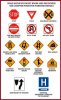
In the United States, road signs are, for the most part, standardized by federal regulations, most notably in the Manual on Uniform Traffic Control Devices (MUTCD) and its companion volume the Standard Highway Signs (SHS). There are no plans for adopting the Vienna Convention on Road Signs and Signals standards.
MUTCD_(2003-Edition)_Adoption.svg.png


road-signs-driving-school-brooklyn-nyc.jpg


Quick Color Tips

There are general color schemes that traffic signs throughout the United States follow. When you recognize what each of these colors mean, you can easily interpret most signs, even those that you aren’t very familiar with.

Brown – Typically, brown signs indicate recreational areas and scenic areas such as parks.

Red – This is the color for stop. Whether it’s on a sign, a traffic light or the side of a school bus, you should always stop when you see a red.

Yellow – Yellow signs are warning signs used to indicate changes in the driving environment, including curves, obstacles ahead or a change in road surface.

Blue – A blue sign indicates an exit with restaurants, gas stations and/or hotels.

Green – This color almost always means go so, if you see green, it’s a safe bet that you can proceed down the road.

Black and White – Black and white signs are known as regulatory signs. These signs indicate speed limits and the legal direction for traffic to flow.

Orange – Orange signs are used to denote a construction zone. They often communicate the same information as yellow signs with the additional caveat that workers are present.
 
Years and years ago I received a very stern lecture (ass chewing actually) from a OK state trooper as he was writing me a ticket that if something was in my way I was to STOP at a yield sign.
Making an attempt to politely disagree that one was not like the other did absolutely no good that day.
 
Okay, I've heard of bipolar but this is ridiculous
index.php

Yes, it is--primary residence is just south of Erie, so access to PA, OH and NY, secondary residence is just south of Pittsburgh, so access to PA, OH, WV and MD--I am a contractor, and got tired of motels and my Airstream trailer doing work out of Pittsburgh and surrounding areas. The major "signs" that you have to watch for around here are the brown ones--this state is littered with deer, turkeys and other wildlife--they are all brown--and they mean STOP. My uncle had a $900 turkey dinner (probably about 15-20 years ago), because that was what it cost to repair the grille and A/C coil on his truck when he hit it--and we ate it.
 
Years and years ago I received a very stern lecture (ass chewing actually) from a OK state trooper as he was writing me a ticket that if something was in my way I was to STOP at a yield sign.
Making an attempt to politely disagree that one was not like the other did absolutely no good that day.

Because the trooper was 100% correct.

Prepare to stop and yield the right-of-way to vehicles and pedestrians in, or approaching, the intersection. You must come to a full stop at a yield sign if traffic conditions require it. When you approach a yield sign be prepared to stop.

The only difference between a "stop" and "yield" is that when you get to a STOP you must stop and look and then continue if conditions allow it. When you get to YIELD it's basically a "rolling stop" situation where you are ready to stop, but if no one is coming you keep on going. Sadly, this is how many people treat a STOP sign,

And THAT is the answer you get from someone that's 50+ :)
 
I know, I know, no doubt. I was young - about 19 at the time.
I've learned since then trooper is 100% correct 100% of the time, they'll get no argument from me and my driving habits have changed drastically accordingly.
 
Back
Top Bottom