
• The move to the new server is done. There are some software and database maintenance updates in process. This has us passing the hat around to help out. We appreciate any donations. Seriously, even a dollar helps. The payment page may be found here - https://www.audiokarma.org/support.html

Tiny SMT capacitors, do they even work?

John3655

Well-Known Member
Wondering what the general opinion on tiny SMT capacitors is, replacing them with polypropylene film seems to make a vast improvement imho.

SMT on the left, it measures 91nf.
Red on the right is Panasonic ecwf at 98nf
IMG_20260727_112047.jpg

Here the SMT capacitors around the base of lm78nn /lm79nn regulators, red capacitors added.
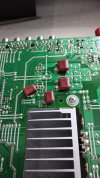
IMG_20260720_111016.jpg
 
Register to hide this ad
Surely the SMT caps are ceramics, no? Comparing those to film caps might not be a fair fight.

If one needed to use SMT MLCC caps in an audio application, C0G/NP0 formulations might be the way to go.
 
I have never experienced this vast improvement. What I do notice is that putting large leaded components on pads designed for surface mount parts is that the leads can be thick and rigid enough to act as a very big lever, and a very slight touch on the component can then rip the pads right off the board.
 
Surely the SMT caps are ceramics, no? Comparing those to film caps might not be a fair fight.

If one needed to use SMT MLCC caps in an audio application, C0G/NP0 formulations might be the way to go.
Yes you're right, it's not a fair fight both in dielectric and value because the films are 300nf on the input of the regulator and 100nf on the output whereas the ceramics are 100nf on both, as you say c0g np0 would I'm sure be better. The regulators are providing the power for the preamp so it's all very audible, some I've seen just have 10nf on the output which would seem far too low, maybe just enough to stop oscillation.
 
Last edited:
I have never experienced this vast improvement. What I do notice is that putting large leaded components on pads designed for surface mount parts is that the leads can be thick and rigid enough to act as a very big lever, and a very slight touch on the component can then rip the pads right off the board.
Yep I had to put the films on the back of the capacitor pads which is worse because it's further away and hence more inductance but I'm thinking the qualitative improvements outweigh that, the smts are so tiny my soldering skills can't deal with them except to cut them off.
 
These tiny SMT caps, MLCC, have very low inductance and make excellent bypass caps. But they are prone to fracture near board edges due to board flexure and can even fracture due to thermal expansion/contraction caused by nearby heat generating components.

For audio applications? Stay far,far away.
 
Capacitance is capacitance, so I would expect zero difference based on package.

What you might get is more coupling to adjacent circuitry with the bigger packages. Not a huge issue in audio, but with RF, could really screw things up.
 
Capacitance is capacitance, so I would expect zero difference based on package.

What you might get is more coupling to adjacent circuitry with the bigger packages. Not a huge issue in audio, but with RF, could really screw things up.
The mlccs can vary in capacitance against voltage and temperature. Some don't release all their charge quickly they have all sorts of issues that make their capacitance not as useful, but they are cheap.
 
Last edited:
Back
Top Bottom