
• The move to the new server is done. There are some software and database maintenance updates in process. This has us passing the hat around to help out. We appreciate any donations. Seriously, even a dollar helps. The payment page may be found here - https://www.audiokarma.org/support.html

Toshiba SR-50 photocell (light sensor): need infos & possible replacement.

david winter

Classical music lover.
Hi,

I'm not sure if I'm posting in the correct section. At the same time, I'm asking about a quite particular semiconductor, but it's used in a rather rare turntable which has no known service info: the Toshiba SR-50, which uses the TPS-50 auto player. So I thought I could get more info here than in the Turntable section, but could be wrong...

My problem is the pictured light sensor. It is made of two parts: a metal body containing a small light bulb, and a black plastic body containing a photocell made in a TO5 / TO39 transistor body. One of the two legs is cut too short so I need to replace at least the photosell part, if not the whole assembly.

Any info would be really welcome. The only use of this sensor is to detect the end of record playing to trigger the tonearm lift.

Thanks !


David
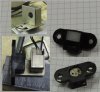
 

Attachments

  • Dscn0566.jpg
    Dscn0566.jpg
    61.9 KB · Views: 39
Register to hide this ad
If you know the specs maybe you can get one from Jameco, did a web search and they have several. Hope this helps.
 
Well, the problem is that I can't find any technical info on this turntable. No schematic, no values.
So far as I think, the only problem is that the turntable won't stop automatically at the end of the record.
 
That's a shutter interrupt to trip the end of record. There's a TO-5 housing for the light sensor - the round metal can - and a nice little light source.

If the light is on, then the problem will be with the sensor. Given the age, you'll likely have to adapt a newer part into the housing for the TO5 device. Here's a nice approach to do so - in this case, you would have to adapt the light side to an LED. Here's a plain old sensor you could stuff into the housing.

Cheers,

David
 
As the sensor is already damaged, you may try to push it back out of the housing using the opening that the light comes in (try and not to break the housing!) this MAY reveal a device number that can be traced or at least what type of device it is (photo resistor, photo transistor, etc.)

You could try and hold a straightened out paper clip in a vice, place its tip in the small front opening, then place a small block of wood at the back of the device and tap gently to free the opto sensor (if the "light" opening is large, just push using a larger object).

Once you determine a suitable replacement, it could be epoxied in place in the housing (you may not need to do this if a circuit board goes onto the back, polarity may have to be observed if the unit is a photo transistor).

Mark T. :music:
 
The problem right now is that I have no idea how the sensor works precisely.
From what I understand the light source is always on. When the arm reaches the end of the record, the light is either obturated or left (if obturated during playback).
I need to determine whether those new devices will work like the old one.
Extracting the old device doesnt look easy without damaging. I tried to remove the white plastic cover but it seems blocked somehow. The sensor seems also glued but not sure.
What I even do not know is whether the sensor is a photocell, a photodiode, or a phototransistor. Not sure if any will be compatible. I have too little time for trial & error right now....
 
In a TO-5 case it might be a Cds photocell. If it is an older unit this is very possible.

I do believe some are still available because they were used in some high end test equipment, but they were usually packaged with the lamp and used to tune an oscillator bridge or for super low distortion ALC because of their linearity.

If it is a Cds photocell and you can't get one, to use a regular detector of today might require a bit of modification. Just hope they aren't putting AC through it because that stickies the wicket to no end. However it is doubtful they would have AC across it anyway, just isn't necessary.
 
Very few sensors live in TO-5 cases other than CdS cells. If it were a phototransistor there'd probably be the usual case connected lead aligned with the tab. I don't see that. Can you attach a sharp pin to your DVM leads? If so, a photo diode will always look like a diode in the dark. If it doesn't read like a diode in the dark, shine light on it and read resistance. Should be the same in both directions. That would make it a CdS cell. There are still CdS cells available as people are using them in LDR volume controls.
 
Back
Top Bottom