• The move to the new server is done. There are some software and database maintenance updates in process. This has us passing the hat around to help out. We appreciate any donations. Seriously, even a dollar helps. The payment page may be found here - https://www.audiokarma.org/support.html

Trace Elliot Acoustic Cube - Help, urgent!

MuseChaser

Super Member
I bought this amp used several years ago, and it's wonderful. However, it died on a gig last night, and I need it for another gig on Thursday. I've purchased and downloaded the service manual with the schematics, but the parts list page for the preamp stage is wrong.. it's a duplicate of the parts listing for the power output stage.

In any case, here's the symptom, and I've never had an amp do this before. I'm hoping someone can point me to where to start searching for the cause..

While playing, it started to buzz very loudly and steadily, and turning the output volume and preamp gain down all the way didn't reduce the loud steady buzzing sound at all. I powered off the amp (I use it as a right channel in a small-room keyboard rig) and continued and limped through the gig using an SWR bass amp I use for the other channel and low end. I powered up the Trace a few more times throughout the gig, hoping it had just overheated or something. Upon power up, it sounded great... for a few seconds, then the loud steady buzz started up again. I gave up.

Sooo... I'm about to open the amp up, schematics in hand, and have a good 'scope, multimeter, function generator, and good soldering skills. What I don't have is a lot of experience troubleshooting. Any help would be GREATLY appreciated.

Thank you.
 
Register to hide this ad
I bought this amp used several years ago, and it's wonderful. However, it died on a gig last night, and I need it for another gig on Thursday. I've purchased and downloaded the service manual with the schematics, but the parts list page for the preamp stage is wrong.. it's a duplicate of the parts listing for the power output stage.

In any case, here's the symptom, and I've never had an amp do this before. I'm hoping someone can point me to where to start searching for the cause..

While playing, it started to buzz very loudly and steadily, and turning the output volume and preamp gain down all the way didn't reduce the loud steady buzzing sound at all. I powered off the amp (I use it as a right channel in a small-room keyboard rig) and continued and limped through the gig using an SWR bass amp I use for the other channel and low end. I powered up the Trace a few more times throughout the gig, hoping it had just overheated or something. Upon power up, it sounded great... for a few seconds, then the loud steady buzz started up again. I gave up.

Sooo... I'm about to open the amp up, schematics in hand, and have a good 'scope, multimeter, function generator, and good soldering skills. What I don't have is a lot of experience troubleshooting. Any help would be GREATLY appreciated.

Thank you.
Musical instrument amps tend to get things like jack issues or broken solder joints due to the fact that they're moved around a lot and, unlike home stereo stuff, has inputs plugged and unplugged constantly.

If the volume controls have no effect I would look at the output stage. In particular, check the power supplies feeding the chip amp. C8 or C9 could have broken solder joints or even broken leads from the caps. I've seen both in guitar amps. I know from personal experience that amps aren't handled with the same care at 4 AM as they are at 4 PM. :)

Also, you should be able to isolate the preamp from the power amp using the effects loop. But if the volume controls have no effect than I'd concentrate on the output stage.
 
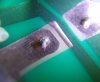
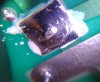
Thanks, Ray. I have the amp apart and did indeed find a cracked solder joint on the positive terminal of C8. You're amazing! Fixed that connection, reflowed the other three C8/9 joints and cleaned up a corroded ground connection.

CapCrack.jpg


GroundCorr.jpg


...and now, amp is reassembled and have been playing through it for about half an hour. So far, so good... sounds great, clean, strong, and whisper quiet. Can't thank you enough! Will continue to play through it for the next couple days, just to make sure it doesn't die on my Thursday gig.
 
Thanks, Ray. I have the amp apart and did indeed find a cracked solder joint on the positive terminal of C8. You're amazing! Fixed that connection, reflowed the other three C8/9 joints and cleaned up a corroded ground connection.

View attachment 2555760


View attachment 2555761


...and now, amp is reassembled and have been playing through it for about half an hour. So far, so good... sounds great, clean, strong, and whisper quiet. Can't thank you enough! Will continue to play through it for the next couple days, just to make sure it doesn't die on my Thursday gig.
Glad you got it going!

I never trusted any piece of gear that died on a gig. Even after fixing it, I'd always have that failure in the back of my head.
 
Glad you got it going!

I never trusted any piece of gear that died on a gig. Even after fixing it, I'd always have that failure in the back of my head.

I hear ya.... will definitely have backup on hand for the next ... oh, I dunno... year or two. I might open it back up and silicone glue or hot glue the caps in place. They made some pretty strange choices as to what to completely cover in glue snot (multi pin connectors, mostly, to make sure the connectors prevent anyone from easily removing a board) and what to barely touch (these caps, for instance, so they're free to vibrate and ruin the solder connections).

What do you use? The internet abounds with dichotomous advice... silicone is evil and will rot your components... silicone is the right stuff to use because it stays flexible and doesn't degrade.... I have no idea who to believe... so I'll believe you.
 
I hear ya.... will definitely have backup on hand for the next ... oh, I dunno... year or two. I might open it back up and silicone glue or hot glue the caps in place. They made some pretty strange choices as to what to completely cover in glue snot (multi pin connectors, mostly, to make sure the connectors prevent anyone from easily removing a board) and what to barely touch (these caps, for instance, so they're free to vibrate and ruin the solder connections).

What do you use? The internet abounds with dichotomous advice... silicone is evil and will rot your components... silicone is the right stuff to use because it stays flexible and doesn't degrade.... I have no idea who to believe... so I'll believe you.
There's an electronic grade of silicon adhesive that is recommended for applications like these. It doesn't have that powerful aroma that regular silicon RTV has, and is considered safe for this use. I see Chip Quik makes one, which I saw on Amazon. Non-corrosive, non-conductive.

Do a search on threads or posts by retrovert. He really knows about stuff like this.

I carried a backup amp for years, which I never needed. Probably because I carried a backup amp for years...
 
Tube guitar amps using turret or eyelet boards seem to suffer less from these problems, except for jacks. I've worked on several of my son's amps, SS and tube.
The SS amps had more problems than the tube amps. Broken jacks soldered to the board, bad solder joints, etc. The older amps using turret and eyelet boards seem to suffer far less from these type problems. I recently restored a big 120w tube head amp my son has. New electrolytics and power tubes along with cleaning the pots has it sounding good again. Even the two small circuit boards were fine. The componant leads were soldered to each other on the back side.
No printed circuit. Just point to point on a board. None of the joints were bad.
When he brought a little Peavy SS amp over for repair the back side of the circuit board was the first thing I looked at. I found broken joints on the input jack and a couple caps. The jack itself was damaged as well.
 
Tube guitar amps using turret or eyelet boards seem to suffer less from these problems, except for jacks. I've worked on several of my son's amps, SS and tube.
The SS amps had more problems than the tube amps. Broken jacks soldered to the board, bad solder joints, etc. The older amps using turret and eyelet boards seem to suffer far less from these type problems. I recently restored a big 120w tube head amp my son has. New electrolytics and power tubes along with cleaning the pots has it sounding good again. Even the two small circuit boards were fine. The componant leads were soldered to each other on the back side.
No printed circuit. Just point to point on a board. None of the joints were bad.
When he brought a little Peavy SS amp over for repair the back side of the circuit board was the first thing I looked at. I found broken joints on the input jack and a couple caps. The jack itself was damaged as well.
+1 on turret vs PCB. Some of the "newer" Fender amps I worked on had the PCB suspended by the pots and jacks, with a few screws to hold the board in. Cracked solder joints on these came as no surprise.

Mesa/Boogie probably has the most reliable designs. Thick PCB's, and all the pots and jacks connected by flying leads. I never had one of their amps on my bench.
 
+1 on turret vs PCB. Some of the "newer" Fender amps I worked on had the PCB suspended by the pots and jacks, with a few screws to hold the board in. Cracked solder joints on these came as no surprise.

Mesa/Boogie probably has the most reliable designs. Thick PCB's, and all the pots and jacks connected by flying leads. I never had one of their amps on my bench.
I just finished a junk drawer build of a 5F1 this morning. All scrounged parts from around my bench. It sounds pretty good too.

.
 

Attachments

  • 20220503_125145.jpg
    20220503_125145.jpg
    130.4 KB · Views: 12
  • 20220503_125205.jpg
    20220503_125205.jpg
    102.1 KB · Views: 13
  • 20220503_120406.jpg
    20220503_120406.jpg
    158.4 KB · Views: 13
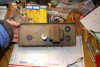
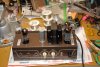
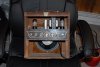
Equipment used on-the-road takes a pounding. When I was newly divorced, and living in Redondo Beach with some musician buddies, I made some serious coin fixing cables, jacks, cords, amps, and keyboards. Mostly mechanical damage from heavy abuse, along with cleaning up the occasional spilled beer that found it's way into things.

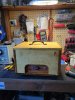
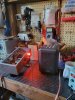
A couple of years ago I rebuilt a Valco "Supro" three-tube amp. Sounds good for what it is, but yowie, it was a junker when I got it.

upload_2022-5-3_17-34-50.jpeg
upload_2022-5-3_17-35-25.jpeg

upload_2022-5-3_17-36-13.jpeg

upload_2022-5-3_17-36-43.jpeg
 
Guitar amps are easier. You download the schematic and a drawing of the layout, and just follow the layout. Kinda like painting by numbers. :D
Pretty sure I read somewhere that Leo Fender's original amps were plucked right from an RCA tube handbook.
 
Equipment used on-the-road takes a pounding. When I was newly divorced, and living in Redondo Beach with some musician buddies, I made some serious coin fixing cables, jacks, cords, amps, and keyboards. Mostly mechanical damage from heavy abuse, along with cleaning up the occasional spilled beer that found it's way into things.

A couple of years ago I rebuilt a Valco "Supro" three-tube amp. Sounds good for what it is, but yowie, it was a junker when I got it.

View attachment 2557092
View attachment 2557093

View attachment 2557095

View attachment 2557096
Damn Jim, that Valco really came out nice!
 
Equipment used on-the-road takes a pounding. When I was newly divorced, and living in Redondo Beach with some musician buddies, I made some serious coin fixing cables, jacks, cords, amps, and keyboards. Mostly mechanical damage from heavy abuse, along with cleaning up the occasional spilled beer that found it's way into things.

A couple of years ago I rebuilt a Valco "Supro" three-tube amp. Sounds good for what it is, but yowie, it was a junker when I got it.

View attachment 2557092
View attachment 2557093

View attachment 2557095

View attachment 2557096
I like it.
 
There's an electronic grade of silicon adhesive that is recommended for applications like these. It doesn't have that powerful aroma that regular silicon RTV has, and is considered safe for this use. I see Chip Quik makes one, which I saw on Amazon. Non-corrosive, non-conductive. Do a search on threads or posts by retrovert. He really knows about stuff like this.

Here's a distillation what I previously wrote about silicones.

Two types of silicone exist: acid cure and neutral cure.
Acid Cure: During crosslinking the methyl triacetoxysilane liberates an acetyl group, which then forms acetic acid, a mild acid we call "vinegar".
Neutral Cure: A slightly differently formulated is used which instead of acid, liberates an alcohol.​

The tradeoff, of course, is that the neutral cure is never as strong as the acid cure.

The adhesive gods giveth, and the adhesive gods taketh away.

Neither one would cause any harm to the crossover, particularly since the mounting plate can be glued on while the back is removed. The silicone fully cures overnight and all of the acetic acid harmlessly dissipates into the air, poof!, it's GONE!

Once again joy reigns in Mudville.
 
As long as you don't get any on the soldered connections, wires, or PCB traces, you can use the "Bathtub RTV" type of sealant to stake things down or hold them in place.

The stuff with the "vinegar" smell with definitely corrode copper and aluminum. I've seen people use it to seal coax connectors, and it turns the copper braid green for several inches back, under the outer jacket.
 
If using RTV keep it off the wiring. Also let it cure completely in the open air before you seal it up in a speaker cabinet.
 
I've been using the stuff with the vinegar smell for decades on crossovers, but ALWAYS let it cure for a day or two before installing in the speaker. Thanks for the cautions .. will definitely heed the advice if I use it in the Trace.
 
Last edited:
Back
Top Bottom