


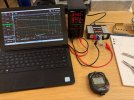
Just wanted to share a little setup I made for matching transistors. The curve tracer is a PC-based Electron Plus CTL503. When I first bought it years ago the software wasn't great, but it's been quite improved and the newest version does everything I need. There are useful cursor functions like calculating the hFE value for a particular base current curve at a particular collector voltage (or the average hFE over a span, which is more useful for small signal BJTs given the noise present at very low currents). After conducting each sweep you can switch between various displays for the gathered data, so for instance you can determine hFE and then switch to a Vbe graph without re-running the sweep, allowing for easy matching of multiple parameters at once (and in the same test fixture, which helps with consistency). Obviously the benefit of a curve tracer is that you can match device characteristics under actual circuit conditions (collector voltage and collector current) rather than under the conditions chosen by the manufacturer of a simple component analyzer.
The unit is capable of pulsed operation at up to 100 v and 3 amps, so useful testing of drivers and output devices is possible. Quite nice for characterizing old and obscure transistors.
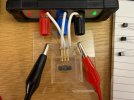
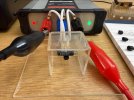
Made a little test jig for TO-92 transistors using Mill-Max pin receptacles and a bit of acrylic. There is a resistor which sits on top of the DUT and dissipates a small amount of heat to obtain a more consistent and realistic temperature, and the acrylic enclosure helps minimize airflow. I used a thermocouple to determine that items in contact with the resistor heat to about 40c. A proper temperature controlled oven would be better, and I might add one in the future, but this should be good enough for pedestrian matching purposes. Electron Plus does sell test fixtures for the CTL503, which would have been a much easier starting point, but where's the fun in that?
Curious what setups others use for this task (or any feedback on this one!) Also curious how everyone stores their matched transistors. Right now I am taping them to a piece of paper with all the characteristics written next to them, which I don't think is ideal. I should probably buy a couple hundred very small ESD safe bags for the purpose.
The unit is capable of pulsed operation at up to 100 v and 3 amps, so useful testing of drivers and output devices is possible. Quite nice for characterizing old and obscure transistors.
Made a little test jig for TO-92 transistors using Mill-Max pin receptacles and a bit of acrylic. There is a resistor which sits on top of the DUT and dissipates a small amount of heat to obtain a more consistent and realistic temperature, and the acrylic enclosure helps minimize airflow. I used a thermocouple to determine that items in contact with the resistor heat to about 40c. A proper temperature controlled oven would be better, and I might add one in the future, but this should be good enough for pedestrian matching purposes. Electron Plus does sell test fixtures for the CTL503, which would have been a much easier starting point, but where's the fun in that?
Curious what setups others use for this task (or any feedback on this one!) Also curious how everyone stores their matched transistors. Right now I am taping them to a piece of paper with all the characteristics written next to them, which I don't think is ideal. I should probably buy a couple hundred very small ESD safe bags for the purpose.
