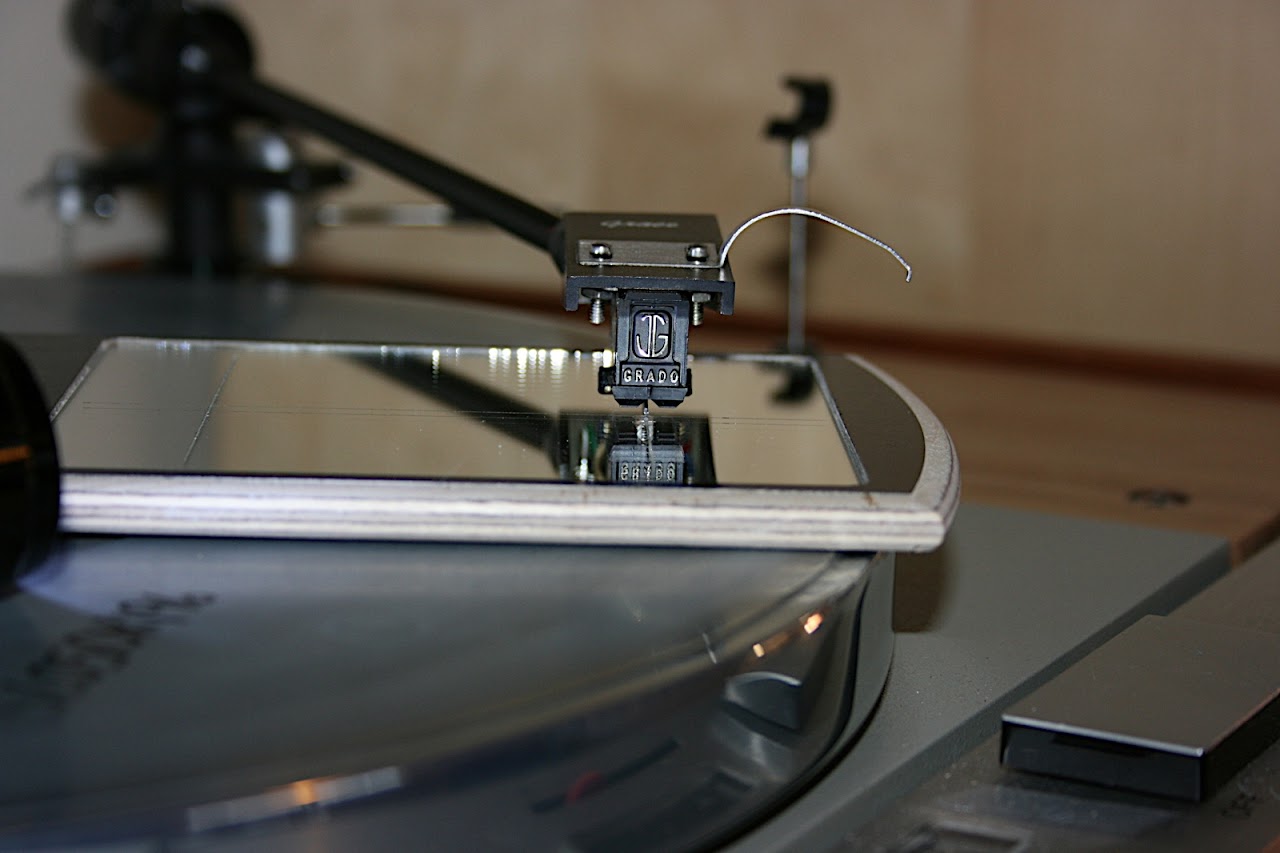
I tried both Technics overhang tool and two point protractors.
I have 2 Cartridges - Denon DL-110 and Shure M97xe. I was reading about cartridge alignment since I built my Pearl 2 Phono stage. I used Shure's Stock Protractor (Baerwald two point) for alignment of both the carts. I was not happy with the thin sound from DL-110 and muddy sound from 97xe.
Please note cart loadings are always kept to correct values of respective carts: 97xe -> 47KΩ parallel with total 250pF and DL-110 with 47KΩ without using provided spacer cum weight. Also correct VTA was maintained for each of them.
Approach 1: Started with Baerwald Protractor.
M97xe realigned and VTA set correctly. Removed headshell and measured it on Technics overhang tool. Now stylus tip is approx 2mm farther than specified 52mm on Technics Tool. Also Cart body skewed (Clockwise), cantilever pointed towards spindal. This sounded nice but still less stereo separation and like AM Radio.
DL-110 realigned in the same way and VTA set correctly. Same results as above but more stereo separation and crisp HF. Still this sounded thin.
Approach 2: Used Stevenson protractor.
Both carts realigned and now carts moved inside. Again measured ~52mm on Technics overhang tool with same settings. This means tool's 52mm matched with Stevenson's protractor. Still this has little IGD and sibilance.
Approach 3: Used Technics Overhang Tool.
Both carts realigned for body parallel to headshell. Measured correct 52mm on overhang tool. This time both sounded best of their ability. This made me happy.
For approach 2 and 3, I tweaked for VTF and antiskate. For 97xe it was happy with 1.4gms on both and for DL-110 it was best for 1.75gm for both.
Observations:
Though approach 2 and 3 are looking same, why approach 3 produced accurate result? May be because - I could use another SS scale as a helper tool to make carts body parallel to headshell. Earlier in approach 2, I was dependent on my eyesight and error prone parallax method of visual inspection. Approach 3 was less error prone (IMO).
Apart from full bodied sound, another difference I noticed - same record playing after approach 1, popped up cone more for edges of records till middle. This was not reproduced after approach 2 and 3. Means there was some relation of tonearm resonance which was producing subsonic signal after approach 1, difference than suggested overhang. With Technics' recommended settings this tonearm behaved best in terms of speaker cone popping out.
Just to share my observations. Thanks!
I have 2 Cartridges - Denon DL-110 and Shure M97xe. I was reading about cartridge alignment since I built my Pearl 2 Phono stage. I used Shure's Stock Protractor (Baerwald two point) for alignment of both the carts. I was not happy with the thin sound from DL-110 and muddy sound from 97xe.
Please note cart loadings are always kept to correct values of respective carts: 97xe -> 47KΩ parallel with total 250pF and DL-110 with 47KΩ without using provided spacer cum weight. Also correct VTA was maintained for each of them.
Approach 1: Started with Baerwald Protractor.
M97xe realigned and VTA set correctly. Removed headshell and measured it on Technics overhang tool. Now stylus tip is approx 2mm farther than specified 52mm on Technics Tool. Also Cart body skewed (Clockwise), cantilever pointed towards spindal. This sounded nice but still less stereo separation and like AM Radio.
DL-110 realigned in the same way and VTA set correctly. Same results as above but more stereo separation and crisp HF. Still this sounded thin.
Approach 2: Used Stevenson protractor.
Both carts realigned and now carts moved inside. Again measured ~52mm on Technics overhang tool with same settings. This means tool's 52mm matched with Stevenson's protractor. Still this has little IGD and sibilance.
Approach 3: Used Technics Overhang Tool.
Both carts realigned for body parallel to headshell. Measured correct 52mm on overhang tool. This time both sounded best of their ability. This made me happy.
For approach 2 and 3, I tweaked for VTF and antiskate. For 97xe it was happy with 1.4gms on both and for DL-110 it was best for 1.75gm for both.
Observations:
Though approach 2 and 3 are looking same, why approach 3 produced accurate result? May be because - I could use another SS scale as a helper tool to make carts body parallel to headshell. Earlier in approach 2, I was dependent on my eyesight and error prone parallax method of visual inspection. Approach 3 was less error prone (IMO).
Apart from full bodied sound, another difference I noticed - same record playing after approach 1, popped up cone more for edges of records till middle. This was not reproduced after approach 2 and 3. Means there was some relation of tonearm resonance which was producing subsonic signal after approach 1, difference than suggested overhang. With Technics' recommended settings this tonearm behaved best in terms of speaker cone popping out.
Just to share my observations. Thanks!
Last edited: