muovimies
Super Member
Straight tonearms are common in DJ tables because of getting rid of skating force tracking is better and less prone to skipping when scratching etc. heavy duty use. Tracking distorion is obviously highly increased because the underhung geometry can reach only 1 null point over the course of the record. This is why there really haven't been many arms aimed at hifi use with this sort of geometry, the two commercial examples I'm aware of:
http://audio-heritage.jp/YAMAHA/etc/ysa-2.html
( http://www.audiokarma.org/forums/showthread.php?t=661904 link to a japanese blog in this thread by Theophile)
http://www.stereotimes.com/post/viv-lab-rigid-tonearm/
Skating force and compensation for it with antiskate is a compromise of course, but one that is necessary to obtain the geometries with two null points and the lessened tracking error. Now it is arqued by some, that the skating force is actually more detrimental to sound quality than the increased tracking angle error of an underhung tonearm.
I find this very interesting and would love to hear a high quality truly straight tonearm with this sort of geometry. Since that is unlikely, I decided to pursue a project of some sorts to modify a tonearm for underhung geometry with zero offset angle.
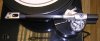
As a proof of concept I mounted a Shure M75 with EVG stylus on a Thorens headshell in this manner, I used the TP-60 headshell but mounted the cartridge in the holes that are not meant for cartridge mounting. It's very slightly offset, but underhung and the geometry is such it reaches a null point around 75mm from the spindle or so.
This is far from optimal but sounds better than I expected. Worth noting is the TP-16 arm has magnetic antiskate, and even when the dial is set at 0 there is still some little antiskate present, so this is less than optimal arm for this test, since on of the keypoints was to get rid of skating forces and the need for antiskate.
I can say it seems that taking skating out of the picture, cartridge alignment is not nearly as sensitive - if the arm was overhung and there was this much tracking angle error, tracking would be very poor in the inner grooves and distortion would be lot more prominent. Needless to say I've been spinning only beater records at this point, but as a testing of the waters this was a success. There is no obvious increase of mistracing / mistracking nor any nasty side effects like inner groove distortion. There is something quite punchy about the sound, but at this point I'm inclined to think I'm probably hearing increased harmonic distortion.
I think the next step is to modify (in a reversible way) a Connoisseur SAU2 tonearm for completely straight geometry, I could accomplish this quite easily by replacing the headshell with a wooden mounting block for the cartridge and wiring the tonearm externally, there's no timeframe for this but I expect it to happen some rainy day When I get something more feasible than this M75 setup put together, I'll try to do some comparisons and hopefully put up sound files as well.
http://audio-heritage.jp/YAMAHA/etc/ysa-2.html
( http://www.audiokarma.org/forums/showthread.php?t=661904 link to a japanese blog in this thread by Theophile)
http://www.stereotimes.com/post/viv-lab-rigid-tonearm/
Skating force and compensation for it with antiskate is a compromise of course, but one that is necessary to obtain the geometries with two null points and the lessened tracking error. Now it is arqued by some, that the skating force is actually more detrimental to sound quality than the increased tracking angle error of an underhung tonearm.
I find this very interesting and would love to hear a high quality truly straight tonearm with this sort of geometry. Since that is unlikely, I decided to pursue a project of some sorts to modify a tonearm for underhung geometry with zero offset angle.
As a proof of concept I mounted a Shure M75 with EVG stylus on a Thorens headshell in this manner, I used the TP-60 headshell but mounted the cartridge in the holes that are not meant for cartridge mounting. It's very slightly offset, but underhung and the geometry is such it reaches a null point around 75mm from the spindle or so.
This is far from optimal but sounds better than I expected. Worth noting is the TP-16 arm has magnetic antiskate, and even when the dial is set at 0 there is still some little antiskate present, so this is less than optimal arm for this test, since on of the keypoints was to get rid of skating forces and the need for antiskate.
I can say it seems that taking skating out of the picture, cartridge alignment is not nearly as sensitive - if the arm was overhung and there was this much tracking angle error, tracking would be very poor in the inner grooves and distortion would be lot more prominent. Needless to say I've been spinning only beater records at this point, but as a testing of the waters this was a success. There is no obvious increase of mistracing / mistracking nor any nasty side effects like inner groove distortion. There is something quite punchy about the sound, but at this point I'm inclined to think I'm probably hearing increased harmonic distortion.
I think the next step is to modify (in a reversible way) a Connoisseur SAU2 tonearm for completely straight geometry, I could accomplish this quite easily by replacing the headshell with a wooden mounting block for the cartridge and wiring the tonearm externally, there's no timeframe for this but I expect it to happen some rainy day
When I get something more feasible than this M75 setup put together, I'll try to do some comparisons and hopefully put up sound files as well.