• The move to the new server is done. There are some software and database maintenance updates in process. This has us passing the hat around to help out. We appreciate any donations. Seriously, even a dollar helps. The payment page may be found here - https://www.audiokarma.org/support.html

Tube Amp: Warming Up & Idling

mozcho

Well-Known Member
Some simple questions:

1. Tube amp should not be powered on without speakers connected to it. True?

2. Some manufacturers suggest that their tube amps sound best after 30 minutes powered on. Should we play any music on it during that period of time, or should we just leave it silent while warming up?

3. Any harm if a tube amp is left powered on but not receiving any signal (idling)? Would it just shorten the lifespan of the tubes, or would it cause any damage to the amp?

4. My speakers Diatone DS-2000 are in 6 Ohms, but both amps do not have 6 Ohm terminals. The AU-70 has 8 and 16 Ohm, the R8 has 4 and 8 Ohm. What should I do?

I'm using: Sansui AU-70 (1965) and Willsenton R8 (2020).
 
Last edited:
Register to hide this ad
Some simple questions:

1. Tube amp should not be powered on without speakers connected to it. True?

2. Some manufacturers suggest that their tube amps sound best after 30 minutes powered on. Should we play any music on it during that period of time, or should we just leave it silent while warming up?

3. Any harm if a tube amp is left powered on but not receiving any signal (idling)? Would it just shorten the lifespan of the tubes, or would it cause any damage to the amp?

4. My speakers Diatone DS-2000 are in 6 Ohms, but both amps do not have 6 Ohm terminals. The AU-70 has 8 and 16 Ohm, the R8 has 4 and 8 Ohm. What should I do?

I'm using: Sansui AU-70 (1965) and Willsenton R8 (2020).

1/ true
2/ does not mattter
3/ All time powered on will consume tube lifetime, but it won't hurt the amp
4/ use 8 ohm tap
 
I'll disagree with #2. Tubes, especially output tubes, can take a while to reach full transconductance. I certainly wouldn't attempt to bias and/or balance my output tubes until they'd been on for at least ten minutes.
 
I'll disagree with #2. Tubes, especially output tubes, can take a while to reach full transconductance. I certainly wouldn't attempt to bias and/or balance my output tubes until they'd been on for at least ten minutes.
The question was "can i play music". There was no mentioning of adjustment.
 
Some simple questions:

1. Tube amp should not be powered on without speakers connected to it. True?
.

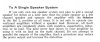
That’s actually an “it depends” question. HH Scott built its integrated stereo amps so that they could be run with no load connected. According to the owner’s manual…

81A32FF5-CF9D-4D5E-BD7B-6BCACF78D030.jpeg

The amp’s output has an internal load. Of course, you need to see if your amplifier particular needs an external load, but I figure someone doing a search on this question might find the Scott amp info useful. I find it handy to know I don’t have to worry if I find that one of the speakers has become disconnected on one of my Scott amps for any length of time.
 
1.) Unless you absolutely know for sure that your amp has an internal load (speakers off, using headphones for example), keep speaker or a dummy load on the output's.

2.) Use your own judgement on it. Turn it on, wait a minute or so and start playing. Note if the SQ changes for the better or not over next 30 minutes or so. If there is a change, note how long it took, and whether it's subtle or not. Then decide if it's worth it or not to you.

3.) Idling without playing consumes tube life. Just like your car uses gas warming up by idling on a cold day. It's just not doing anything productive and there is wear and tear on the parts. Lousy analogy I know.

4.) 8Ω tap.
 
I usually turn things on, then go find a record. By the time I'm ready everything is as warmed up as it needs to be for playing music. If I turned things on and waited 30 minutes it would sit there for 3 hours before I remembered I turned anything on.

Beyond wasting tube life and burning electronics, idling doesn't cause any particular harm.

I'd try the 4 and 8, use which sounds best. I have 6 ohm speakers that do better on 8 on some amps and 4 on other amps.
 
The hh Scott is loaded but not with a high enough wattage resistor to drive the channel.
When they ask you to put in left channel only mode, I'm pretty sure they do this to prevent you from driving the unused channel.
If it's not being driven the load resistor can be 1/2 Watt.
Do as you wish with your equipment.
I always try and load my amps, occasionally I forget and I've been lucky that I've never damaged anything.
In tube amplifiers and in life you must keep your head about you and be very skeptical of advertising and promotional literature.
The same document probably claimed 36 watts steady state both channels driven and more on peaks... Yeah, About that, um...
 
I agree with whatever tap sounds best with any given speaker. I have a pair of 6 ohm speakers that sound best using the 4 ohm tap on one of my amps. This particular set of 6 ohm speakers an dip pretty low. I have another smaller pair of 6 ohm Speakers that sound better using the 8 ohm taps. So my answer to no.4 is, it depends.
 
Last edited:
Acoustat Servo amps are never really off, the high voltage (5000V) shuts off, but the rest of the amp stays on to detect a signal. The neat part is when the unit is "off", the filaments are switched from parallel at 6 volts to in series pairs, at 6 volts. The tubes are 6HB5's, Horizontal output tubes for old tv sets. They were notorious for failure, and were money makers in the repair industry. By keeping them at 1/2 voltage with no DC flow, they have lasted for decades. Over the 40 years of my ownership, I think I've retubed them 2 times since new.
 
Last edited:
Half voltage is probably why they survive. Running tubes at full heater for extended periods with no plate supply can kill them from cathode poisoning. It happens with tuner tubes sometimes in receivers where the B+ is shut off and it runs for long periods of time.

and before someone freaks out and starts talking about guitar amps, yes I know they have standby switches that shut off the plate supply. I'm not talking about short periods between playing, I'm talking hundreds or thousands of hours of operation.

I have an old CB that has "instant on". The way they did this is idiotic. Across the power switch is a common diode. Turning the thing off you get current flow through the diode so it runs basically half duty cycle, or 30 hz. It makes the transformer buzz like you wouldn't believe. its a 2 pole switch so B+ is also shut off but the idea is the heaters are running at ~3 volts instead of the usual 6. I guess it kind-of works but every single one of those radios I've come across that didn't have the diode cut out had a bad diode. I actually fixed one just to see how it worked and the hum was so obnoxious that I "broke" it again within minutes.
 
Acoustat Servo amps are never really off, the high voltage (5000V) shuts off, but the rest of the amp stays on to detect a signal. The neat part is when the unit is "off", the filaments are switched from parallel at 6 volts to in series pairs, at 6 volts. The tubes are 6HB5's, Horizontal output tubes for old tv sets. They were notorious for failure, and were money makers in the repair industry. By keeping them at 1/2 voltage with no DC flow, they have lasted for decades. Over the 40 years of my ownership, I think I've retubed them 2 times since new.

A sane approach to long tube AND power supply cap life. Frequent cold cycling starts are killers. I no longer have tubed audio amps, but even my solid-state ones have an idle state, until they detect a signal or are switched to "on." I believe that the more powerful the amp, the more this idle state is needed to lend to a long life. :thumbsup:
 
Back
Top Bottom