• The move to the new server is done. There are some software and database maintenance updates in process. This has us passing the hat around to help out. We appreciate any donations. Seriously, even a dollar helps. The payment page may be found here - https://www.audiokarma.org/support.html

Tube amps do something special

I got a cheap class D amp for Christmas, a Fosi something or other. I will use it to drive some audio exciters from my synthesizers instead of using monitors. Still, it's an amp. I should listen to it in my system right?

My current combination of tubes and operating points gives me 6 watts of class A power. This amplifier is 150 watts per channel. On paper it has far less distortion and noise than any tube amp. How does it sound? Dead is the best word I can come up with.

When people ask why I spend so much on my stereo I tell them that regular systems can only let me hear what music sounds like. Hi-Fi does something else, it gives me realism in some capacity. Usually systems have to choose between tonal, dynamic, soundstage, or scale accuracy. Few speaker systems can give you two of those at mortal budgets and it takes a huge amount of money to get all three. This amplifier does the classic solid state sin of homogenizing the tonal qualities of instruments. That is something that I highly value, especially when listening to acoustic instruments. It also lacks any sort of drive and dynamics seem to be compressed despite having more than an order of magnitude more power. It can play noticeably louder without an issue. On the other hand you have to crank it up to try to get some sort of life or interest in the sound. It sucks at lower volumes.

To be fair I don' think this amp is even $200 so it isn't nearly a fair comparison. Still, engineering types will tell you that this is a superior amp and if I like a worse measuring one I'm just listening wrong. Tubes do something special and we still don't know what it is. Long live tubes!
 
Register to hide this ad
Tubes do something special and we still don't know what it is. Long live tubes!

I totally agree.

To my mind, the continuity of tubes - that means no high-speed switching - has a lot to do with the "special" sound of tubes.

This also explains why tubed rectification - done right - can add to that magic!

I'm not rubbishing solid-state anything - and personally own both - but there is no denying the spatial dimensionality and flow that better tube amp designs deliver... Even relatively cheap tube amps!
:beerchug:
 
Well, first, it's hard to take off the THC hazed rainbow colored glasses that tube harmonic content offers, and look again upon the comparatively bland, cold, stark world through clear lenses again. I don't think solid state audio is sterile, so much as tube audio is "enhanced". But class D I think has a lot of accuracy issues with the filtering required to cleanly recover the analog waveform from the high amplitude PWM signal. It's also important to say that you are not hearing class D at it's best by any means- lots of cheap implementations of analog integrated circuitry, SMD ceramic caps, marinated in switching noise. It's like microwaved dinner. Yeah, it's technically food.
 
Last edited:
I started making my own tube amp in the 6th grade and that was over 45 years ago and while I can tell the difference between a tube amp and transistor it was the accomplishment that made the best sound. Point I'm getting at is as pointed out even cheap tube amps can and often do sound better than some of the best solid state has to offer be it the big boys like Pioneer & Marantz or the esoterics like McIntosh and the others with the big-azz pricetags. Don't buy it build it. Mix & match make it your own. Tubes do have a special sound not because they have gray or black plates with a winged logo on the glass but because they're a high impedance mutual transductance device that basically converts voltage variations into current variations and it's this transductance that plays a big role in the overall accuracy of the sound. Some tubes are better at it than others and there is also some influence in the placement of components in the overall design layout. Starting in the 6th grade with the help of my Elmer I made a stereo amplifier using various off the shelf parts he had in his vast collection and tack soldering said parts to brass thumbtacks on a chunk of plywood. First it was following some of the designs in the RCA Receiving Tube Manual then changing this or that be it the coupling capacitors or maybe the resistors in the phase splitter which started out as a 6GH8. Around this time I picked up a Fisher 800B receiver at a garage sale and learned to fix it myself using a Triplett 630-NA meter which I still have today. My entire quest at the time was to learn why tubes sounded so much better, even as a kid I "knew" tubes were "better" but didn't really know why.

So now we're entering 2026 and I'm still working with tubes and have yet to figure out the real reason "why" they sound so much better... I have a really good idea but it's still opinion with no factual basis. The amp I was working on has since been stuffed into an aluminum chassis and sports a set of 2E26 transmitter finals driven by 6GH8s with a 12AU7 based phono preamp. It uses a #83 HV rectifier plus 6AL5 double diode in a negative doubler for bias and the lower voltages are all regulated using a 5751 reference on a power triode. Power output is about 35 watts tested and I'm running very little HF feedback. Things like capacitors and resistors are nothing specials that come from the local Ax-Man surplus store in St. Paul MN and tube sockets liberated from a dead Tektronix 545 scope. I only use the amp for vinyl listening, turntable is a Dual 1229 with an AT12S nothing special cartridge. I've always had the philosophy of the more tubes the better. My daily driver TV is tubes... over 20 of them and even my scope uses nuvisters in the front end.

I do have transistors in my audio path and they do well don't get me wrong and as the Pioneer SX-1080 was a well designed receiver but it really comes down to not only the amplifier and everything before the speakers but also the source material itself. I keep a number of original printing albums from the 60's that were originally mastered and ultimately cut using tubes, examples include Henri Mancini Peter Gunn, Dwayne Eddy and Young Rascals to name a few as references and I have to say they have a much fuller sound than the modern remasters that seem to have been taylored for the modern reproduction equipment. Far "fatter" or "richer" than what's out there today and that being said is a perfect example of why new isn't always better.

20201003_163853.jpg

This was running 6146's at the time.
6146amp.jpg
 
Last edited:
SS amplifiers can sound good. MOSFET amplifiers can sound very good.
I have an old Marantz model 140 SS power amp I restored and like.
Then I have a Crown CDi-1000 that sounds very sterile. It uses a well filtered SMPS and some flavor of a well filtered Class D amp pushing a bank of discrete output transistors. It has really good specs, but sounds dull and lifeless. I use it in my garage system using an old SS preamp.
I have the Bryston 4Bst power amplifier that I bought used and not working for cheap. Output devices one channel were shorted. I replaced the bad bipolar junction transistors and that got it woking again. Poor thing had bipolar disorder. Maybe some Valium could have helped that amp.
 
I think there are two parts to the valid truth that tube audio "sounds better"- The first part is the even-order harmonic enhancement from the tubes, and the phase shifting behavior from the transformers, which is undeniable- it's why we prefer vinyl or tape over digital, 12 string guitars over 6 string- it provides a very "musical" enhancement. But the other part that is more often overlooked is about clarity and dynamics. If you look at any tube circuit, it will in general be vastly minimalistic compared to any modern solid state design- only a handful of carefully chosen, high quality capacitors and resistors necessary to implement the bare bones requirements of the circuit, carefully point to point wired to minimize cross-talk and parasitics. Every component and trace inevitably imparts it's own delay, mud, distortion, noise, and flavor on the music, and the best sounding tube gear is often those with the fewest components and complications. Compare this to a modern audio-video integrated receiver- You follow the circuit snaking around in packed little copper foil traces all over this board, through cheap capacitors, and worse, analog integrated circuits for source selection, pre-amplification, Dolby, tone controls, etc, that will have hundreds of internal noisy/resistive/capacitive traces, and poor capacitors and resistors, and poor CMOS transistors, then it jumps boards in substandard ribbon cables, to another board full of crap, then another board and another. By the time the precious audio signal makes it to speakers, it has been folded, spindled, and mangled by hundreds of interacting elements (like a bad telephone game) and the result is often muddy. I think this is where a lot of the "lifeless, sterile" quality comes from. A lack of clarity and dynamics.
 
What we prefer is always subjective, and I've owned and heard many amps. I try to keep an open mind, but historically good tube amps float my boat in a way I've not heard a solid state amp do. I hear depth, room ambience, and timbre that seems less present with the solid state amps I've owned, but is there in spades with my modified Dyna/VTA amps, and the Convergent tube amps I've heard. Where my affordable tubes amps seem to fall short is with deep bass extension, control, and impact (damping factor?). Once I hear a SS amp that offers the magic my tubes amp do, I'd hope that I'd realize and acknowledge it.

My speakers are conducive to bi-amping, so I run the tubes on the midbass/tweeters from ~ 65hz up, and a solid state amp on the woofers below that range, which gives me a taste of the best of both worlds. I recently tried some of the cheap Class D amps in that application and none worked as well as my B&K or Linn amps.
 
Last edited:
What we prefer is always subjective, and I've owned and heard many amps. I try to keep an open mind, but historically good tube amps float my boat in a way I've not heard a solid state amp do. Where my affordable tubes amps seem to fall short is with deep bass extension, control, and impact (damping factor?). Once I hear a SS amp that does what my tubes amp do, I'll acknowledge it.

My speakers are conducive to bi-amping, so I run the tubes on the midbass/tweeters from ~ 65hz up, and a solid state amp on the woofers below that range, which gives me a taste of the best of both worlds. I recently tried some of the cheap Class D amps in that application and none worked as well as my B&K or Linn amps.
When I listened to a tube amp. It sounded so magical. It was like 3D. But the lower end was not as tight or strong, which I like. When you say a taste of both worlds are you completely satisfied with the sound? I need to try biamping one of these days. Tube and SS. Just not sure how it would work. Tube amp has 12W. And SS amp has 100W.
 
When I listened to a tube amp. It sounded so magical. It was like 3D. But the lower end was not as tight or strong, which I like. When you say a taste of both worlds are you completely satisfied with the sound? I need to try biamping one of these days. Tube and SS. Just not sure how it would work. Tube amp has 12W. And SS amp has 100W.

There are a lot of variables in play, so your approach will likely vary from mine. The crossover between my tube amps and SS takes place at ~ 65hz, which is right about where the lowest male vocal range can hit, so the vocals and up are all on the tube amps, which they do really well with. Blending would likely get more complex if it occurred up higher, but that's also a variable. Blending the amp output was easy. I use the gain adjustment on the active crossover to adjust the woofer amps with the main tube amps. It helps that each driver of my speakers has it's own input. DSP might help, but I've never messed with it so can't advise from first hand experience.

My tube amps are 17wpc, my SS amp is 100 wpc, then there's the active sub that I think is around 150 watts. The balance is room dependent, and subjective, but I have a fair amount of flexibility to make it thump or dial it back where it sounds more natural which is really my preference with most of the music I listen to. It was quite a revelation when I first hooked up the SS amp. It gave deeper, more impactful bass with better control, but also cleared up the tube amps even more. I'm in heaven most days. Love it!
 
Last edited:
What we prefer is always subjective, and I've owned and heard many amps. I try to keep an open mind, but historically good tube amps float my boat in a way I've not heard a solid state amp do. I hear depth, room ambience, and timbre that seems less present with the solid state amps I've owned, but is there in spades with my modified Dyna/VTA amps, and the Convergent tube amps I've heard. Where my affordable tubes amps seem to fall short is with deep bass extension, control, and impact (damping factor?). Once I hear a SS amp that offers the magic my tubes amp do, I'd hope that I'd realize and acknowledge it.

My speakers are conducive to bi-amping, so I run the tubes on the midbass/tweeters from ~ 65hz up, and a solid state amp on the woofers below that range, which gives me a taste of the best of both worlds. I recently tried some of the cheap Class D amps in that application and none worked as well as my B&K or Linn amps.
SS for bass and using tubes for mids and highs can sound very good.
I heard a Dynaco ST-70 setup like that around 1998. It sounded really good.
The mains, woofers, and subs were all custom made including the drivers.
Man that system sounded good.
 
I am in the camp of those who think that if well designed and built, if well-cared and suitably used, tube or solid-state amps can be equally excellent.

For Class D amps, I have no continuous experience than the amp+Xover module that I use in my DIY Ripole Subwoofer. Frankly, it does the job mighty fine. Very conclusive...

The sole Class D amp that I listened was a Behringer 4x 900W unit, hooked in Bi-Amp on Magnepan MG3.5 and Tympany IV speakers. It seemed power limitless... But also harsh limitless... That said, I strongly suspect that the owner had poorly set his system, boosting the treble because he had audition losses. In this case, the suitably used question came to mind, at least subjectively, concerning the settings rather than the amp itself. So inconclusive here...

T
 
I use very efficient speakers, 15 tube watts is plenty.

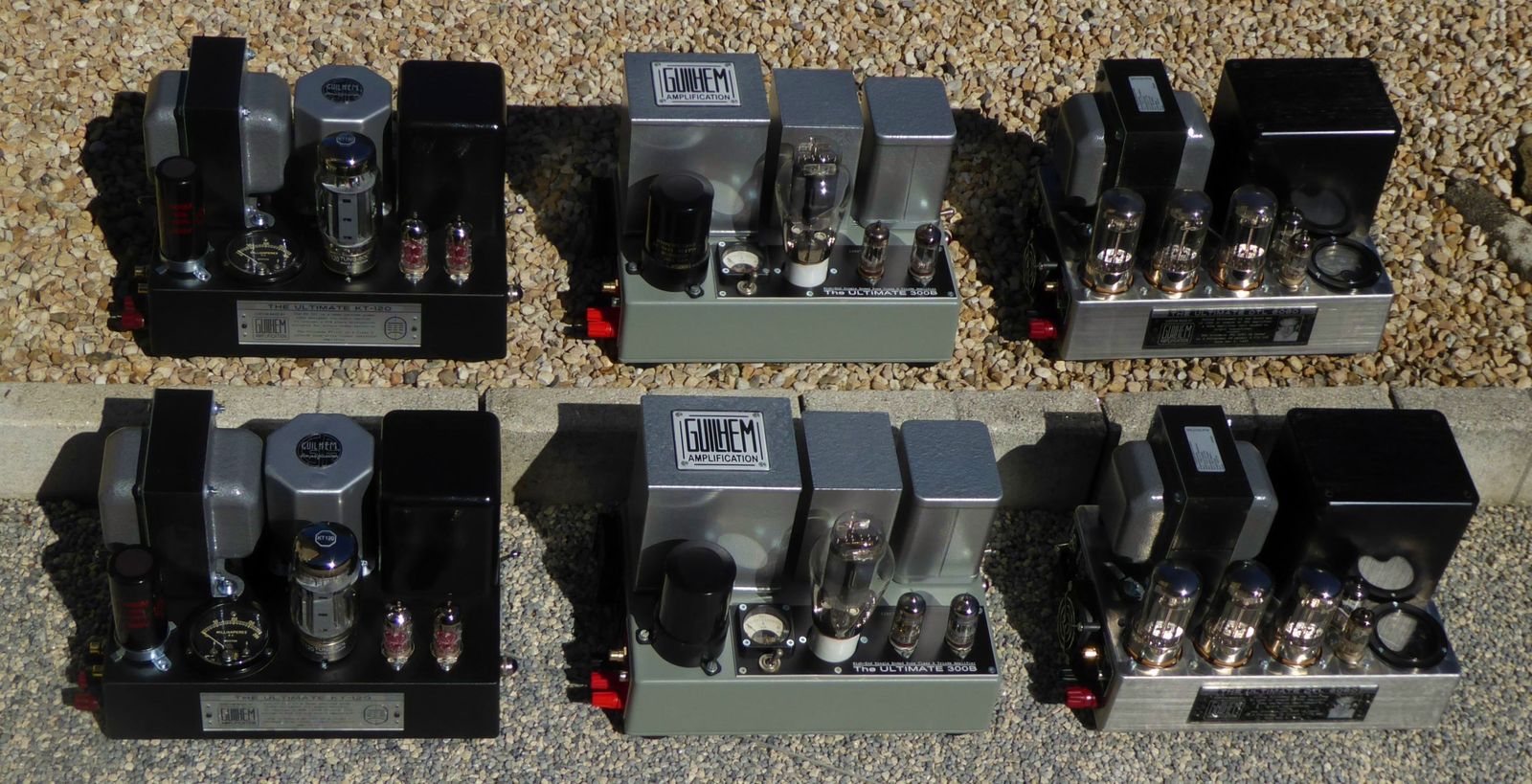
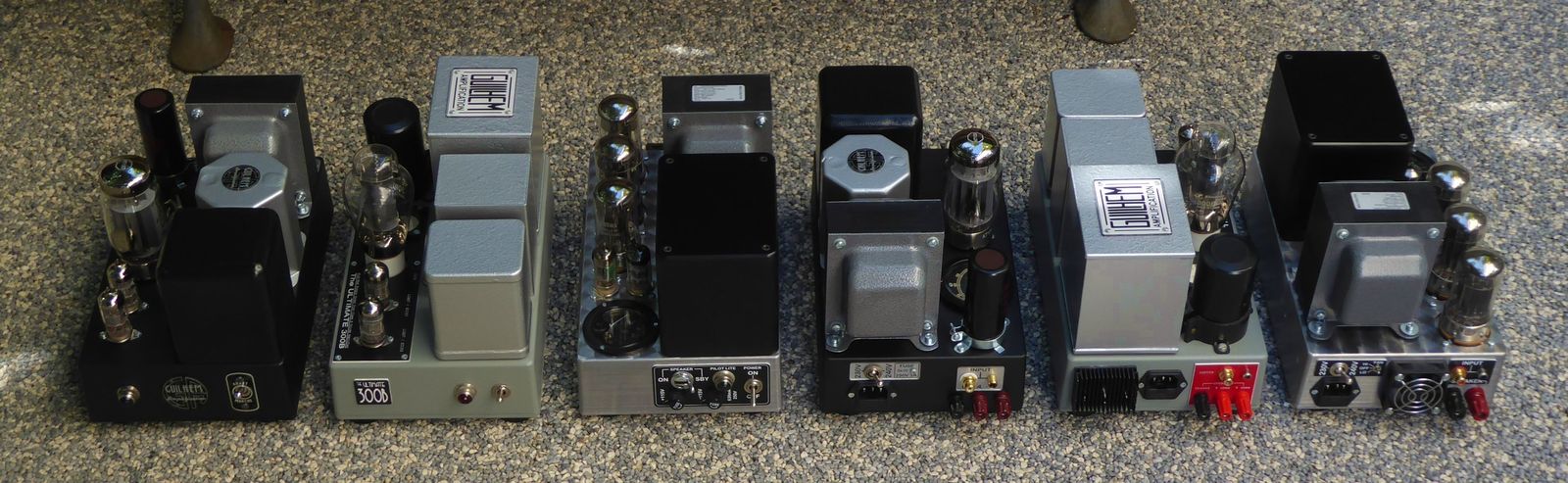
Yes, absolutely... None of my DIY Tube mono-blocks below exceeds 15WRMS (Ultra-Linear 12.5W / Triode 4/8W / OTL 10W) :

8oyKQb-P1190446.jpg


OryKQb-P1190456.jpg


And my most efficient speakers are only 95db/W/m. It's enough for the everyday listening - at least for me !

T
 
Back
Top Bottom