• The move to the new server is done. There are some software and database maintenance updates in process. This has us passing the hat around to help out. We appreciate any donations. Seriously, even a dollar helps. The payment page may be found here - https://www.audiokarma.org/support.html

Tube covers HH Scott 222D

Dca

New Member
Hi All: I will confess I’m a tube novice (except for guitar amps; I’ve owned a ‘67 Fender Bassman blackface for 30 years) and may be asking dumb questions for the foreseeable future.
I just acquired an HH Scott 222D recently. It’s paired with my vintage KLH model 17’s an Orbit U-Turn turntable (which sounds WAY better than the Thorens TD160 I had for 30 years…so don’t judge me ).
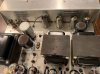
The Scott came with 4 metal conical covers for the 12AX7 tubes at the front. I used one to cover the tube close to the wire coming from the power switch(?) because it seemed like it would protect the wire from the heat. Are these covers recommended or necessary? Thanks for any insight.
 
Register to hide this ad
They're are called and referred to as "Shields"

2387234-793ec28f-hh-scott-222d-beautiful-1960-amp-with-original-wood-case.jpg

Notice they are on your pre-amp tunes, I'm sure the more knowledgeable will be along to explain why certain tubes have shields but I think in most cases it's due to RFI (radio frequency interference) and in some instances to keep the tubes protected in the socket.
 
The shields prevent, as mentioned, RF (radio frequency) interference and, especially, shield from hum pick up particularly in the high-gain phono pre-amp stage. Always run with them in place on the four tubes shown. Two are for the phono pre-amp and two are for the line/tone amp audio stage.
 
Thank you guys for the info. They are now in place! I only have about 30 hours on the new tubes that came with the amp, but it seems to sound better with every play. I just played (vinyl) Karla Bonoff's first two albums. It sounded like she was sitting next to me on the sofa! It's disconcerting how old technology is so much better sounding than new (streaming, Mp3, CD).
 
One step further with the Scott amplifier. If you are running it on the bench, it will probably hum if the bottom plate is not attached. You gotta trust me on that. For that matter, you can "Carefully" sit the amplifier on the plate, making sure it is centered and not touching anything below deck. The cover over the controls is usually not as critical and believe it or not, the tube shields can be off whilst working on it. About 10 LK-48/LK-72/222/299 amps have gone across my bench in the last two years. I have found that to be always the case.
 
One step further with the Scott amplifier. If you are running it on the bench, it will probably hum if the bottom plate is not attached. You gotta trust me on that. For that matter, you can "Carefully" sit the amplifier on the plate, making sure it is centered and not touching anything below deck. The cover over the controls is usually not as critical and believe it or not, the tube shields can be off whilst working on it. About 10 LK-48/LK-72/222/299 amps have gone across my bench in the last two years. I have found that to be always the case.
There is a slight hum when nothing is playing- but I don’t notice it when music is on. Actually, putting the shields in place reduced the hum considerably.
 
There is a slight hum when nothing is playing- but I don’t notice it when music is on. Actually, putting the shields in place reduced the hum considerably.
If you are using the Phono or Tape Head inputs, there usually is a slight amount of hum with no input connected (open circuit). That is normal. Note that I said "slight". But with all shields and covers in place, a Scott amplifier should be relatively quiet. Hum that you hear that is controllable by the volume control is before the driver/phase inverter tube. In other words, if you turn up the volume, it is before the 6U8/6GH8/7199 tube. Hum that is all of the time is in the power supply. Sorry, if you already know that. I only offer the comments for members checking this thread that may not have had any "Scott" experience. But these general comments apply to just about any amplifier be it tube or solid state.
 
Back
Top Bottom