

You are using an out of date browser. It may not display this or other websites correctly.
You should upgrade or use an alternative browser.
You should upgrade or use an alternative browser.
Tube radio rectifier diode
- Thread starter jpatti75
- Start date

Along with switching wall wart power supplies, incandescent dimmer switches, some older fluorescent lights.turn off the lights, modern electronic lamp ballasts kill AM.

I’ve gotten rid of all the older ballasts in the house, but switched everything over to LEDs to hopefully cut down on interference.  No ballasts in the garage, for what it’s worth. Only ballasts are in the basement and were off for testing.
I tried the radio with all the garage lights off, not a real improvement in reception, but I was able to pick up a couple AM stations enough to notice the distortion there, too. So, whatever the issue is, the distortion is present regardless of broadcast frequency…or both FM and AM bands are in need of alignment. Wish I had the gear for that. Not too concerned about AM reception thankfully…other than helping to isolate this distortion issue.
No ballasts in the garage, for what it’s worth. Only ballasts are in the basement and were off for testing. I tried the radio with all the garage lights off, not a real improvement in reception, but I was able to pick up a couple AM stations enough to notice the distortion there, too. So, whatever the issue is, the distortion is present regardless of broadcast frequency…or both FM and AM bands are in need of alignment. Wish I had the gear for that. Not too concerned about AM reception thankfully…other than helping to isolate this distortion issue.

Am you can do by ear but when its out of whack it usually just sounds weak, not distorted. No its not quite "proper" but if you find a weaker station you can just go through the IF strip and peak the cans for best performance. If it starts booming in too loud, just find a weaker station. Oscillator can be done using two known radio stations near the suggested frequencies, usually 600 and 1400 or so, and the antenna peak can be done using the same stations.
The only real trick to it, you have to use the right aligmnent tools or it can either crack the cores or just de-tune them. Not sure what this radio uses but it will be either a plastic hex tool or a plastic flat blade screwdriver. The hex ones are IMO nicer, you can do the upper and lower adjustment from the top simply by pushing the tool through the upper core and into the lower one. the screwdriver ones you have to flip the thing over to get at the bottom.
The only real trick to it, you have to use the right aligmnent tools or it can either crack the cores or just de-tune them. Not sure what this radio uses but it will be either a plastic hex tool or a plastic flat blade screwdriver. The hex ones are IMO nicer, you can do the upper and lower adjustment from the top simply by pushing the tool through the upper core and into the lower one. the screwdriver ones you have to flip the thing over to get at the bottom.
Thanks, Gadget. I first thought this distortion was bad speakers, as that is what it sounded like to me, even though the speakers gave proper ohm readings (6 ohm, 1.5 W) and the cones were in decent shape. So, I picked up new speakers for cheap and got the same result. The situation improved after I replaced the small electrolytic cap I missed in the recapping process and the fusible resistor. It starts out sounding decent, but as I mentioned, the speakers distort (sound blown) after about 5 minutes of run time. It’s more noticeable for music, the sound for talk radio is tolerable. Maybe it’s worth setting this one aside until I get a VTVM and a signal generator someday and take my first whack at an alignment. Since this radio isn’t probably worth much, it would be a good first candidate to try an alignment on. If I screw it up, it isn’t a big loss.
see if any of the resistors in the audio section are way off value. Might be one is off, and with heat it drifts even more. They should mostly read in-circuit. Anything across them will make it read low, and I've never had a resistor fail low, they always drift high. Tolerance on these things isn't super critical but it ought to be within 20%. I've had old carbon resistors at 50-200% high before.
^^^spot-on. To help identify any offending components, try finding a can of freezing spray (is that the proper term?) and shoot some on the resistors, one at a time, when your radio is sounding your worst. As the potential offender is suddenly cooled, you may get a pleasant surprise & find the problem plain as day.
Compressed air would probably work, but there is such a thing as 'component cooling aerosol spray' that I believe uses the propellant itself contained therein that can actually frost up on whatever you squirt with it.Great tips … thank you both!
Catmanboo - by freeze spray, do you mean those cans of compressed air?
Compressed air would probably work, but there is such a thing as 'component cooling aerosol spray' that I believe uses the propellant itself contained therein that can actually frost up on whatever you squirt with it.
Sounds darn handy! I’ll look into it. Thanks!
Still going to get some freeze spray, but tonight I didn’t fire it up and just tested the resistors throughout. I found two - R17 and R31 — that tested about 30% above the rated value. Not ridiculous, but certainly above 20%. Every other resistor was well within 20% tolerance. So, maybe those two are suspects.

canned "air" is usually R152, which is a refrigerant.
I think R17 is part of the AFC circuit? Can't tell where that goes, but if it lands at a varactor diode somewhere in the FM front end, thats what its for. That shouldn't carry much current so it being off value likely won't bother much. Other option is it that its the FM audio output and will go to the band switch. Still shouldn't be carrying any significant current.
R31 is in the power supply though, if thats way off it will cause low voltage to what looks like the first AF amplifier. Not sure what else that might feed but if the voltage at the AF amp is too far off it won't act quite right.
I think R17 is part of the AFC circuit? Can't tell where that goes, but if it lands at a varactor diode somewhere in the FM front end, thats what its for. That shouldn't carry much current so it being off value likely won't bother much. Other option is it that its the FM audio output and will go to the band switch. Still shouldn't be carrying any significant current.
R31 is in the power supply though, if thats way off it will cause low voltage to what looks like the first AF amplifier. Not sure what else that might feed but if the voltage at the AF amp is too far off it won't act quite right.
canned "air" is usually R152, which is a refrigerant.
I think R17 is part of the AFC circuit? Can't tell where that goes, but if it lands at a varactor diode somewhere in the FM front end, thats what its for. That shouldn't carry much current so it being off value likely won't bother much. Other option is it that its the FM audio output and will go to the band switch. Still shouldn't be carrying any significant current.
R31 is in the power supply though, if thats way off it will cause low voltage to what looks like the first AF amplifier. Not sure what else that might feed but if the voltage at the AF amp is too far off it won't act quite right.
Thanks, Gadget. R31 is right next to that fusible resistor, which gets hot and is right next to the output tube, so a lot of heat in that small area of the chassis. Seems like that one would be worth replacing. Darn postage is going to be more than the resistor.

I finally got about to change out that R31 resistor today, but not sure it resulted in much improvement. I didn’t pull the plug on purchasing the freeze spray as it is running about $30 a can, but I did take some temp measurements with my digital meter to see if anything was reading really hot. The 47 ohm fusible resistor was 187 deg, C, the 470 ohm R31 resistor read 161 deg. C, and the 50EH5 power output pentode was at 132 deg. C. I didn’t find anything overtly concerning about those necessarily, as the resistors are fire rated well above that, and the tube is rated for up to 220 deg C.
Since I was in my workshop, I just fiddled with the rabbit ears and seemed to minimize the distortion when I found the station’s tuning sweet spot, so I’m thinking this points to the alignment like we had been discussing, and not necessarily a bad component. Guess some day if I invest in a VTVM and signal generator, I might be able to tackle this distortion. I’m thinking for now, I should probably just find another radio for my garage.
Thanks for all the help, gents. Sorry I wasn’t able to report success, but you both definitely helped be troubleshoot this down to confirming an alignment is in order!
JP
Since I was in my workshop, I just fiddled with the rabbit ears and seemed to minimize the distortion when I found the station’s tuning sweet spot, so I’m thinking this points to the alignment like we had been discussing, and not necessarily a bad component. Guess some day if I invest in a VTVM and signal generator, I might be able to tackle this distortion. I’m thinking for now, I should probably just find another radio for my garage.
Thanks for all the help, gents. Sorry I wasn’t able to report success, but you both definitely helped be troubleshoot this down to confirming an alignment is in order!
JP
Have C30 and C31 been changed?
Have you tried to substitute the output tube?
Yep, all of the original wax paper caps and electrolytics have been changed. I haven’t swapped out the 50EH5 tube. I tested it on my Sencore Continental, and it passed all the tests (Emissions, Gm, Leakage, Life), so I considered it good. I suppose I could pop for the ~$6 for a replacement (I don’t think they are too pricey), but my tube tester was calibrated recently, so I hope it’s giving me good readings.
Definitely a head scratcher!

maxhifi
Addicted Member
Yep, all of the original wax paper caps and electrolytics have been changed. I haven’t swapped out the 50EH5 tube. I tested it on my Sencore Continental, and it passed all the tests (Emissions, Gm, Leakage, Life), so I considered it good. I suppose I could pop for the ~$6 for a replacement (I don’t think they are too pricey), but my tube tester was calibrated recently, so I hope it’s giving me good readings.
Definitely a head scratcher!
Sometimes a gassy tube will misbehave after it has been on a while.
Sorry to leave you guys hanging on this. I was finally able to get a NOS output tube installed this evening, and that seemingly has done the trick. The sound is no longer distorted, and when hooked up to my garage attic antenna it pulls in a good signal. I ran it for about 5+ minutes, as that was usually when I started to notice the distortion, but the sound was great the whole time.
Maxhifi- looks like it was a misbehaving tube was the case. Perhaps the old/bad resistors contributed to its demise before I replaced them.
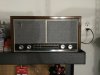
Thanks to all three of you for the help troubleshooting this one! It’s a cheap old radio, but with a little polish and some fresh grill cloth, it doesn’t look half bad. With all of your help, I’m glad it has some new life in it!
Maxhifi- looks like it was a misbehaving tube was the case. Perhaps the old/bad resistors contributed to its demise before I replaced them.
Thanks to all three of you for the help troubleshooting this one! It’s a cheap old radio, but with a little polish and some fresh grill cloth, it doesn’t look half bad. With all of your help, I’m glad it has some new life in it!
Last edited: