• The move to the new server is done. There are some software and database maintenance updates in process. This has us passing the hat around to help out. We appreciate any donations. Seriously, even a dollar helps. The payment page may be found here - https://www.audiokarma.org/support.html

Tube rectifier equivalent question

c.coyle

Fighting the Dunning-Kruger effect.
These circuits are equivalent, right? Both full wave rectifiers? I could spend $10 on a drop-in solid state replacement, but I have the diodes lying around.

It's an old Hallicrafters receiver. I'm crazy for putting a nickel into it, since there's nothing left worth listening to on SW, but it was free and it looks cool.
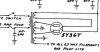
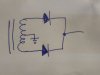
5y3.jpg solid state full wave.jpg
 
Register to hide this ad
Yes, sorta. The high voltage will be more since the diodes have less voltage drop. Voltage drop on the 5Y3GT is 50V @ 125mA, whereas the diodes will be a volt or so. If there is less than 125mA on the tube there will be less voltage drop, but still more than the diodes. May need to consider a dropping resistor to compensate.
 
Handy reference for vacuum tube full wave rectifier characteristics (FWIW & in case you don't have it):
http://www.fourwater.com/files/fullrect.txt

Conversion to ss rectification will require some additional voltage dropping resistors (or maybe adding a choke?).
You'll also lose the "soft start" behavior of a direct-heated vacuum tube rectifier. Probably not a huge deal for a radio, but still - arguably - not ideal.

Why do you want to get away from tube rectification? Decent 5Y3s are a dime a dozen ('specially used ones).
I can't a priori (and FWIW) think of a reason why to switch, so I am curious :)
 
Add a resistor before each diode, it will work out fine. Probably something around 50 ohms each leg. Or grab a 5Y3 since they are cheap. Whatever works for you.
 
Why do you want to get away from tube rectification? Decent 5Y3s are a dime a dozen ('specially used ones).
I can't a priori (and FWIW) think of a reason why to switch, so I am curious :)

I think it was already mentioned. Essentially, a couple of $0.10 diodes in the drawer is less than the $10 tube on the shelf at the store.

That said, having to work out and install the necessary dropper resistors may have been a point not considered.
 
. . . Why do you want to get away from tube rectification? Decent 5Y3s are a dime a dozen ('specially used ones). I can't a priori (and FWIW) think of a reason why to switch, so I am curious :)

Like a lot of things I do, there is no reason!

I'm still in the early stages of thinking about this project. I've got an awful hum when powered up, and I'm thinking of buying a new 30/10/10 450 volt can capacitor from Hayseed hamfest, so I guess I'm thinking about rebuilding the entire power supply, and I have pre-paid diodes sitting in a drawer.

But I get the thing about voltage sag and I know there are two schools of thought on "cathode scraping."

EDIT: I guess I should also allow for the possibility that I might want to sell it some day, and keeping it original would most likely be a plus. It's a Hallicrafters 8-R40, which is not a collector's favorite.
 
I think it was already mentioned. Essentially, a couple of $0.10 diodes in the drawer is less than the $10 tube on the shelf at the store.

That said, having to work out and install the necessary dropper resistors may have been a point not considered.

I wasn't clear. I was looking at a solid state drop in replacement.
 
Well, if you're just tinkering,,, put the diodes and resistors in an old octal tube base,, and plug it in... you were already given the R values, and have the diodes... Have fun!!!
 
You'll also lose the "soft start" behavior of a direct-heated vacuum tube rectifier. Probably not a huge deal for a radio, but still - arguably - not ideal.

It's indirectly heated rectifiers, those with a separate cathode (like the 5AR4), that exhibit "soft start" behavior, not directly heated (like the 5Y3).

I'm thinking of buying a new 30/10/10 450 volt can capacitor from Hayseed hamfest, so I guess I'm thinking about rebuilding the entire power supply, and I have pre-paid diodes sitting in a drawer.

But I get the thing about voltage sag and I know there are two schools of thought on "cathode scraping."

I know the Hayseed Hamfest caps are well regarded and high quality but they are not cheap. If you're trying to do this on a budget, such that you're concerned about the difference in price between a pre-made SS plug in and the rectifiers you already have, you'll get the job done much cheaper if you install individual PS caps under chassis.
 
go to a hamfest, either sell the unit or if it doesn't, then buy an equivalent tube rectifier.

I have bought boxes of 5U4's for about a buck a piece. you could get there at the crack of
noon, buy one, insert, and sell for big bucks.
 
I frequently use indirectly heated 6106 , but directly heated RCA 5Y3GT too, they provide good sounding characteristics.

Sometimes I use my Weber WY3GT too, not big difference vs. tube, but power transformer runs cooler.

My equipments have thermistors for soft start.
 
Thanks to all of you. This is helpful. I haven't worked on a piece of tube gear since the 70s.
 
if you're going to swap/sub rectifier tubes/ss-equivalents, then dl the schematic and
adjust the PS resistors to provide the required voltages. this is part of the tune-up.

the b+ voltages change due to increased AC line voltages, higher voltage drops across
rectifier due to sub/swap, and changes in dropping resistors values.

leads to higher sales prices - marketing-speak craft correlation to high-water marks.
and less returns due to eventual/final deterioration of 30-50 YO gear.
 
These things pictured here used to be available, don't know if that's still the case. Plug-in s/s rectifier replacements for full-wave tubes . At any rate, these took 2-3 amps off the power transformer's load, helping it run cooler, & helped keep the heat down under the hood.
 

Attachments

  • 20180508_211351.jpg
    20180508_211351.jpg
    64.3 KB · Views: 29
Like others have said...your B+ will be higher due to less voltage sag. May or may not be an issue. I replaced the 5y3 in my amps with 5r4 rectifiers. I was happy with the result...hard hitting bass didn't get "muddy".

You also need to be careful as some tubes don't take kindly to a sudden rush of high voltage before filaments are warm.
 
Is the socket empty now? Just because the caps are bad, doesn't mean the tube needs replacing. In fact, I can't remember ever having to replace a failed 5Y3 in a radio, but bucket loads of caps. Even if the 5Y3 is a tad on the weak side it will be just fine for an old radio.

If you want to do an absolute minimum make it work type repair, start by changing the filter caps, the capacitor coupling the audio output tube's grid to the driver stage (usually a 0.047), and any across the line capacitor which connects the chassis to the incoming AC line.
 
Back
Top Bottom