• The move to the new server is done. There are some software and database maintenance updates in process. This has us passing the hat around to help out. We appreciate any donations. Seriously, even a dollar helps. The payment page may be found here - https://www.audiokarma.org/support.html

Tube type comparisons and questions (EL84 Vs Type 45)

nick parkin

Well-Known Member
Greetings all!

I had so e questions regarding Type 45 tubes Vs. EL84

1st: Do type 45 tubes overall sound better than EL84? I know there’s a lot of factors such as the circuit, tube brand, speakers, output transformers etc... but do type 45 have the potential to sound better in general? I’ve heard great things about them.

2nd: what are the general operating conditions of a Type 45 vs and EL84. What is the optimal B+ for a type 45? I know an el84 is approximately 315V.

3rd: With minor adjustments, are Type 45 and el84 tubes swappable in the same circuit (with voltage adjustments of course)?

Thank you all!
 
Register to hide this ad
No offense Nick, but all of this info is available from tube data sheets. And you can not make these 2 tubes swappable since tube base is different and even worse the filament voltages are way different. Well, if you are bound and determmined i suppose you could essentially build 2 amps that shared the same power supply on 1 chassis.
 
Last edited:
Both tubes are excellent sounding, IMO. Very different specs though and not interchangeable.

Maybe you're already aware of this site but, if not, here's a link to a repository of tube data from various tube manuals. For the EL84 you may want to also look under 6BQ5, which is the American name for the same tube.

https://tubedata.altanatubes.com.br/index.html
 
Considerable difference in power handling, one is a relatively modest late 1920s power triode, the other a considerably more powerful power pentode from the 1950s.
 
Last edited:
Those are pretty different tubes, how did you conclude that 315 V is the ideal voltage for a 6BQ5? That could be very circuit dependent, as far as operation goes most data sheets suggest the 6BQ5 typical plate voltage to be around 250v but many amps do tend to run them closer to 300v mostly for a little bit more output power.
 
Those are pretty different tubes, how did you conclude that 315 V is the ideal voltage for a 6BQ5? That could be very circuit dependent, as far as operation goes most data sheets suggest the 6BQ5 typical plate voltage to be around 250v but many amps do tend to run them closer to 300v mostly for a little bit more output power.
Just based off of my RH84 which I’m told is a pretty well rounded design for most EL84’s. Glowinthedark hifi ( The same guy who reviewed the zenith 49cz852 and coral holey baskets) says that the type 45 is the baby of the triode world and has the best sound and I’m curious as to how they sound so I would like to build my own just for fun.
 
Datasheet typical conditions for an EL84 are in the 250-300v range. Keep in mind that tube datasheet voltages are plate to cathode, so subtract out whatever is dropped across a cathode resistor.

The 45 also isn't really the baby of the early direct heat power triode family. That would be the 71A, but now we're just nit-picking.

anyway, if you were to triode-wire an EL84, the power output is pretty similar to a 45. Datasheet says 1.6w at 250v into a 3.9k load for a 45, and 1.95w at 250v into a 3.5k load for the EL84.


You get into a lot of practical difficulties using a 45. It wants a 2.5v heater for one thing. The cathode resistor also gets slightly more involved. Since there is no seperate cathode, what you have to do is either have a center-tapped heater winding to put the resistor on, or you use a balancing pot between the two heater legs and the resistor goes to the wiper. Pot gets adjusted to kill the hum. They're also more expensive, especially in NOS form, and the sockets eat up a lot more space. The low transconductance also means a lot of bias voltage. For the conditions I mentioned above, its 50v of bias on the 45, so you'd need a 300v supply to net 250 across the tube. That also means you need 50v worth of drive to get full output from the tube. The EL84 datasheet says 6.7 volts of drive, which tells me its going to want right about that for bias voltage. Call it 260v worth of power supply and you're set.

so while you might share an output transformer, the drive requirements, filament voltage, and bias situation are different enough that they won't interchange.

Personal opinion here, if you want to play with low power triode stuff, I'd experiment with triode-wired cheap pentodes if you don't already have the real-deal triodes on hand. New production EL84 can be had for about 13 bucks a tube. I don't think anyone is making a new 45, and used ones are nowhere near as cheap as 13 bucks each. If you really want to do real triodes, go for the 2A3. Those are in production now and can be had for about 50-75 per-tube depending where and which ones you buy. More power output as well. Sovtek makes a 6A3 which is a 6v version that makes the power supply transformer a little bit easier.
 
Just based off of my RH84 which I’m told is a pretty well rounded design for most EL84’s. Glowinthedark hifi ( The same guy who reviewed the zenith 49cz852 and coral holey baskets) says that the type 45 is the baby of the triode world and has the best sound and I’m curious as to how they sound so I would like to build my own just for fun.
Single-ended amps using directly heated (no separate cathode) triodes (DHTs) have a lot of fans and the 45 does sound great. I've never run 6BQ5s in triode so I can't comment on sonic differences.

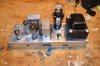
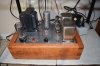
My first DIY build was the Bugle 45 SET, a highly regarded design by Gordon Rankin. Here's the article explaining the build. The article will give you a good insight into the design process.

http://www.wavelengthaudio.com/bugle.pdf

I call my build a Budget Bugle because I saved money by using scrounged transformers. I used a PT I found cheap on eBay. It's from a 1930 Philco radio that used 45s. It looks just like the one pictured in the article but I don't know if it's the same or not. My OTs, which have a 4.1k primary, came from a Wards Airline console that used SE 7868s. Lots of people have built these and they sound excellent. There are other good designs out there too.
 
Oh, another thing that can be used as a 45 sub, the 1619 is a metal 2.5v direct heated pentode tube that can be had for small money. If you triode-wire it, it will work as a sub for a 45. Not sure precisely how close it is since datasheets don't seem to have info on triode operation of that tube, but its a cheapie that works to experiment with. Still have the need for a 2.5v heater supply of course. There are a few guys with radios that are missing their 45 tubes that have knocked together adapters to use a 1619 in that spot. My one radio that runs 45's still has them otherwise I'd probably do this myself. I've got a couple 1619's around.
 
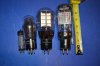
I think some people on this thread should have their vision checked. I don't see any difference between these 2 tubes.:rflmao:DSC_0456.JPG DSC_0457.JPG DSC_0458.JPG DSC_0459.JPG
 
Back
Top Bottom