• The move to the new server is done. There are some software and database maintenance updates in process. This has us passing the hat around to help out. We appreciate any donations. Seriously, even a dollar helps. The payment page may be found here - https://www.audiokarma.org/support.html

TubeCube | 7 has quit; any ideas on troubleshooting?

Wildcat

¡Que siga la fiesta!
Admin
Moderator
Subscriber
From another thread...

And now, over the past few days, it won't turn on. I have to fiddle with the power switch a few times before the tubes start lighting up. Two years old and it's failing already. :rolleyes:

so it's been a few weeks and my tube cube actually seems to have broken. i've had the same set of tubes in for about 3 weeks and today it wouldnt turn on. i can see the powerlight is on in the back but no sound. i tried switching out the pre and power amp tubes and it still doesnt work.
the power tubes usually have a little glow and get warm, same with the pre but there is now no glow and they dont get warm... the tubecube itself does feel quite warm however...

So recently, mine was taking an hour or two before the tubes would light up and the amp would be usable. Yesterday was the final straw--I had turned it on after dinner on Saturday, and naturally it didn't work. Sunday morning, I got to the computer desk and realized I'd left it on--still, nothing. Just prior to 11am, I go into the room and it is finally glowing.

One thing I noticed every so often is that there is a very faint tick coming from the unit. It does not get warm at all--it remains cold. The power switch is lit, and the power fuse is OK. (Don't know if there are any internally.)

I'm guessing it's a power supply issue. Has anyone ever cracked one of these open to see what it's made of, and if there is anything that can be repaired? I almost wonder if a cap has failed somewhere. Reminds me of how my Hafler preamp would act up when one of the two large power supply capacitors would go bad.
 
Register to hide this ad
Seems like a relay of some kind. A bad switch would not get good over a period of time. They either work or they don't.
 
Seems like a relay of some kind. A bad switch would not get good over a period of time. They either work or they don't.
Not necessarily. The power switch could be intermittent. Even if the switch lamps works, it has a separate circuit. The tick could be a small arc across the switch. I'm a Tech. so I would open it, check the switch for continuity. Then maybe jumper it out just to see if the amp. works normally. A switch is easy to change, even for a layman.
 
Without a schematic we are just guesstimating. But, i have never seen a switch that started to conduct or work after a few hours of being energized.
 
Based on another thread here, and a post or two on Head-Fi, I have a set of capacitors coming to replace all of these and see if it can be brought back to life. (A few of them are also said to improve the sound, like the coupling caps and the cathode caps.) The caps in here now are all off-brand/unfamiliar.

My Mouser order should be here Tuesday. It took a bit of digging to find caps that would fit in the case--they can be no higher than 25mm. But, I did it. This is the BOM I came up with:

upload_2018-10-21_1-8-43.png

Unfortunately they were not stocking the Nichicon "Muse" caps (which is their higher-grade audio cap), but since this isn't exactly a high-end product, I'm not going to worry about it. :)
 
A schematic won't happen--this is one of those chi-fi amps. Lesson learned. The caps are still no-name quality (or lack thereof) either way, so they're getting replaced.

If that doesn't fix it, it's gone.
 
A schematic won't happen--this is one of those chi-fi amps. Lesson learned. The caps are still no-name quality (or lack thereof) either way, so they're getting replaced.

If that doesn't fix it, it's gone.
Did you solve the "no turn on issue"? Changing out the coupling or power supply caps would not solve that issue.
 
The power supply in that thing is a switcher. Before I started randomly changing capacitors in a device that does not have the symptom of failed capacitors, if I were going to start changing stuff at random, I would randomly change the MOSFETS or IC's that are part of the power supply.

Start right at the incoming AC. 125VAC there? Look at the traces near the socket. Stress cracks? They should go almost directly to a rectifier. 200+ Something VDC coming out of the rectifier?

Warning: There will be caps after the rectifier that store high voltage even after the unit is unplugged. It's actually worse than a classic tube amp plate supply since the current available from the incoming AC line is higher.

Check the PS output voltages. If the tubes are not glowing, check the heater pins. Should be ~12 or ~6 volts. Could be AC or DC. Check the plate pins of each tube. Should be a few hundred volts DC. More on the output tubes than on the 12AX7.

There isn't room in that thing for there to be a whole lot between the input Power rectifier and the supply voltages to the tubes (plate and heater voltages). If you want to start replacing stuff at random, that is where I would start. Yes, there are capacitors in that area, too. Note that the "big" capacitors on a little switcher like that will be on the incoming AC line. The power supply output capacitors are filtering the much higher switching frequency of the ps, and thus are probably relatively small.

Again, it is the switching components in the PS that are under the most stress, so that is where I would look (looking with your nose can help, too. -- When unplugged and de-energized.)

(Note: In addition to classic switching power supplies, Buck or Boost circuits also fall under what I am calling a "switcher" here. I don't have one of these amps. Don't jump on my for my possibly over-simplified terminology.)
 
The caps arrived a day early, before lunch, so I took a break and installed the new Nichicons. The 100 uF 350V caps are a cool dark purple color. :D But I realized that two of the caps I bought were indeed from one of the Nichicon Muse series (gold printing on black), and those are the cathode caps, so with the WIMA film caps we should be golden, right?

While beginning to work on the amp, I noticed that I overlooked one small cap which is wedged between two others. Crap! But once I had the other caps out around it, I checked it and fortunately it is within spec.

Speaking of specs...all of those craptastic Chong-brand caps :rolleyes: tested really low. I mean, they are very barely within 20% tolerance of their values. One smaller cap, which was next to a chip mounted to a heatsink (the chip being the central part of the switching power supply) measured low, way out of spec, outside any ±20% tolerance that cap may have had.

Comparing the Nichicons, they were all well within the ±10% tolerance range.

Interesting about that one cap, though, being way out of spec. Hmmm.

Most of the new caps went in OK. It appears as most (or all?) of the soldering was PTH (plated through-hole). I only had one scare--removing one of the caps took part of one of the solder pads with it. Fortunately with the lead sticking through the board, I was able to fish that into another nearby hole in the same circuit path, so, no harm done.

So after getting it back together, cussing a bit at some of the poor build quality inside this thing, I fired it up. We're back up and running! Since that small cap I found out of spec was so close to a heat sink, it's probably that the heat baked that cheap little thing into submission. Or it was just marginal to begin with.

IMG_20181022_115030-01.jpeg

Does it sound much different? No. But I need to let the new caps settle in a bit first. It does sound like it has a little more headroom--that might be due to the higher capacity cathode caps. That dullness is still there, however. I think it's just a poorly designed amp to begin with, and/or a victim of the variable build quality I found inside.
 
See it all the time at work with Chinese components. ;)
This amp was nearly the poster child for "out of spec." :D Given all the other parts I could not test, I can only imagine what they spec out to. It's a wonder this thing works at all.

I could have spent a lot more time reflowing the solder joints in this thing--some of them look ugly, but being through-hole plated, they looked workable on one side if the other side looked rough. The SMDs looked well-soldered though. Main thing is, it's working.

It's sounding a little less stuffy after having run for nearly eight hours now. But I don't hear that the coupling cap change has made much difference at all. I'll know better after a couple of weeks.
 
View attachment 1312539 Glad your up and running again I have the Appj version of your amp. I am thinking about just replacing all the caps in it as a preventative measure even though I have a year left on the extended warranty. Funny part is on all the photo's of what is supposed to be inside the amp they show Nichicon capacitors ,must have been for the photo shoot only. But this photo is of someone elses amp with Nichicons makes me wonder what the deal is.
View attachment 1312538
If they are real Nichicon caps. I've noticed the printing on some Nichicons I've seen in some Chinese stuff is kind of faded or poorly screened. They didn't look nice and clear like ones I buy from Mousr or Digikey.
 
Funny part is on all the photo's of what is supposed to be inside the amp they show Nichicon capacitors ,must have been for the photo shoot only. But this photo is of someone elses amp with Nichicons makes me wonder what the deal is.
On that cap which is cemented to another nearby cap, the 100µF/350V matches the value of the Nichicons I bought, and the color might be the same also (mine were a very dark purple). I wonder about that either--I wonder if someone had already swapped caps in that amp, and made other modifications since there is none of that white cement (or whatever it is) on the capacitor or that transformer in the middle. On mine, all someone did was throw some cement alongside the power socket, so it didn't pull out of the chassis when disconnecting the power cord.

And that sideways cap on mine fits fine, without having had to twist it on an angle like that.

One thing to watch for, though. See the two smaller blue capacitors in the upper right corner? Then, see the fatter capacitor beneath it? There is a really small electrolytic sandwiched in there! That is the only one I did not replace, as I totally overlooked it. (Some of the inductors in this amp are plastic-covered like capacitors, so it is possible I overlooked it because of that.) Regardless, I did get a photo of that small capacitor and can add it to the list.

But yeah...I'd not be convinced those Nichicons in the photo you attached are legit either--they counterfeit so much in China now that it's hard to tell what actually might be in there.

IMG_20181022_133732.jpg

IMG_20181022_115038_1.jpg


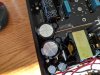
These are some of the cheap capacitors in the flesh:

IMG_20181022_114958.jpg

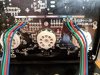
See how sloppy some of the soldering is? The tube sockets were soldered on from the top, not the bottom. The wiring is also not prepared nicely.

IMG_20181022_115210.jpg

It doesn't exactly exude quality here, in other words. And I have a feeling each batch of amps is assembled differently (from different parts, or maybe they even assemble these in different factories).

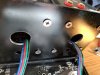
Here's another boneheaded move. See if you notice what is wrong with this picture. :D (Even more bone-headed--I forgot to remedy the problem before reassembling!)

IMG_20181022_114733.jpg

I was too short on time and never got a chance to photograph things after I swapped the caps out! My bad.
 
Yours has a different layout than mine. Looks much cleaner! And yes, I see the soldering also looks nicer. It's hard to tell from my pictures, but it looks as though it was sloppily assembled. The SMDs are nicely flowed but elsewhere, there were bits of flux, evidence of someone lightly scraping off a few things here and there, and it also looked as though the circuit board itself had been wiped off with a damp cloth in places.

Can't tell 100% from pictures but those Nichicons do look like the real deal, so those won't need to be replaced. I see the larger power supply caps are 82µF as opposed to 100µF in mine. (In mine, the 100µF was a bit of work to find in a height that would fit the case; the most you can go is about 25mm in height, so be aware if you decide to change out any of the caps.) And am I right in guessing that those two film caps (the coupling caps by the tubes) are 120nF? Those I replaced with the WIMA 470nF films, and like the other caps, the lead spacing was the same on these, so they fit right in.

I guess my parts list wouldn't apply to your unit. I wonder how many versions of this amp are out there.
 
Hope your amp now gives you some more years of no problems.

So far, so good on the amp--it has fired up every time now. Interestingly, the tubes seem to glow a little brighter than before. (This Mullard 12AX7 does not have much of a visible glow, but the Mullard EL84s look really nice.) It could be those nasty out-of-spec caps were throwing off the circuitry in all sorts of ways.

You can go larger on the cathode caps also--I went up to 1000µF/50V on those. (The original in mine was 470µF/50V.) The cap that fit was the Nichicon UKW1H102MHD (25mm x 12mm). This was the cap that was supposed to give more solidity to the bass. If you replaced those and the film caps, the order would probably cost you more to ship than what the parts are worth. ;) (Mouser does have a cheaper shipping option at checkout--I think I paid $3.99.)
 
Funny...every time I see a photo of those Chong capacitors now, my mind says "up in smoke." :D

So the left channel is rustling a bit. Turns out the left EL84 seems to be the culprit--I tap it lightly, I hear a thump from the speaker, and the rustling goes away for the rest of the evening. The right does not make a similar thump in the speakers. The new-issue Mullards do sound good in this little amp, but I might see about a brighter 12AX7 to see if I can lift some of that remaining "haze" over the sound, which I am afraid is just due to its design.

I did read of a diode mod on another forum, but I would have to dig more to find out what exactly that involves. And, since the photo is of an earlier version of the amp (with two driver tubes), it may not even apply anyway.
 
I had a rustling sound in one of my amps and it seamed to be the output tube at first. It turned out to be one of the driver tubes. Tapping lightly on the power tube gave me similar results. The vibration from the tapping was just transmitted to the driver tube. I changed that tube and I haven't had any more problems. You might try a different 12ax7 and see if that power tube still makes noise. One half of the driver tube I replaced was failing.
 
I do have a spare set of the original tubes from this amp, so I can easily swap as needed. For now, just a quick couple of taps on the EL84 quiets it down, but whichever tube it is, I know it will only get worse with age.

In this amp, though, I don't know if the 12AX7 is considered a preamp tube, or a driver tube...both, maybe? It is not all that complicated with only three tubes in the circuit.
 
Back
Top Bottom