• The move to the new server is done. There are some software and database maintenance updates in process. This has us passing the hat around to help out. We appreciate any donations. Seriously, even a dollar helps. The payment page may be found here - https://www.audiokarma.org/support.html

Tweeters- Best ones

No one will believe me, but I have to call it like I see it: I am convinced that how a driver is used, and how it fits the system requirements, has at least as much to do with tweeter sonics as the make and model. There are tweeters that I have come to like a lot over the years, but this has mostly to do with consistency, reliability, ease of use, cost-performance and well-thought out specs, as anything. Just as with cars and drivers, and chefs and food, average tweeters in the hands of a pro will almost always sound better than expensive, fancy parts in the hands of a someone without training and experience.


-k

I have been working with Paul for two years on an array project. Painfully slow in getting the meld of driver and cabinet design.
A main pain for me are drivers that do not meet their own spec. Driver manufacturers seem to like to "fudge" their info.
 
When it comes to a soft dome tweeter the Hiquphon 20mm are my favorite.
I have used some of the Dynaudio and Seas domes but prefer the Hiquphon.
The off axis dispersion and life like sound is very musical.

I prefer the version with ferrofluid for it's high power handling.

http://www.ellisaudio.com/hiquphon.htm

http://www.ellisaudio.com/hiqcomments.htm

OW2Fried.jpg


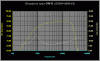
Do they list specs for their tweeters? I could not find any.
 

Attachments

  • Curve-OWII.gif
    Curve-OWII.gif
    14.6 KB · Views: 10
No one will believe me, but I have to call it like I see it: I am convinced that how a driver is used, and how it fits the system requirements, has at least as much to do with tweeter sonics as the make and model. There are tweeters that I have come to like a lot over the years, but this has mostly to do with consistency, reliability, ease of use, cost-performance and well-thought out specs, as anything. Just as with cars and drivers, and chefs and food, average tweeters in the hands of a pro will almost always sound better than expensive, fancy parts in the hands of a someone without training and experience.

I used to judge various amateur speaker building contests, and got to listen to the best efforts of both first-time and well-known amateur designers, year after year. Submissions invariably used very well-regarded drivers, yet it was very rare for any of the judges to find a submission that would make it on the market at any price.

I'm not meaning to be snobby. Anyone can learn to be a great speaker designer. But, you have to learn, and you have to try dozens and dozens of different designs. Most importantly, you have to hone the skills to listen very quickly, analytically and brutally, and understand exactly how to correlate listening to engineering, without philosophical biases.

If you think that the finest drivers make the finest systems, you aren't paying attention!! Ingredients are only a start.

-k

Yeah, I have to agree with that. Look at all the great speakers over the years that used piezo tweeters. I don't fit into that "anybody can design a great speaker" statement though. I'd botch it with kid gloves.
 
No one will believe me, but I have to call it like I see it: I am convinced that how a driver is used, and how it fits the system requirements, has at least as much to do with tweeter sonics as the make and model. There are tweeters that I have come to like a lot over the years, but this has mostly to do with consistency, reliability, ease of use, cost-performance and well-thought out specs, as anything. Just as with cars and drivers, and chefs and food, average tweeters in the hands of a pro will almost always sound better than expensive, fancy parts in the hands of a someone without training and experience.

I used to judge various amateur speaker building contests, and got to listen to the best efforts of both first-time and well-known amateur designers, year after year. Submissions invariably used very well-regarded drivers, yet it was very rare for any of the judges to find a submission that would make it on the market at any price.

I'm not meaning to be snobby. Anyone can learn to be a great speaker designer. But, you have to learn, and you have to try dozens and dozens of different designs. Most importantly, you have to hone the skills to listen very quickly, analytically and brutally, and understand exactly how to correlate listening to engineering, without philosophical biases.

If you think that the finest drivers make the finest systems, you aren't paying attention!! Ingredients are only a start.

-k[/QUOTE

I agree.
I prefer working with existing (vintage) designs. Most of these made a solid impression on me back in the day when they were new.
But after acquiring these speakers years later you soon realize the strengths and weaknesses.
Along with your current expectations, as well as comparing them to the improvements in modern speaker design.
With some luck, lot's of research, and trying many different drivers, I was able to make my stock AMT3's into something really special.
Lot's of trial and error, and yes you really have to listen carefully and thoughtfully-coming back time and time again to make sure you just weren't having a bad hearing day(this makes a huge difference!).
You have to be able to take notes-notes that help with in remembering the sound quickly and easy. Repetition of sound/tracks etc is helpful, but also very tiring as well.
Even replacing the CTS tweeters on a set of DLK 1 1/2's and Model 2's required some serious listening and again trying more then a few drivers, and some crossover tweeking.
Working with a good basic designed speaker is helpful, as you have a lot of the really hard work already done for you.
You have to realize which speakers are worth the efforts, and have the basic sound, tonality etc your looking for-but just need some tweeking.
So you are not trying to totally change the speaker-just improve it.
Being able to break down exactly what the shortfalls are with some thoughtfulness and intelligence, and seeing the big picture, if you will, is a must.
And be willing to deal with lots of trial and error, setbacks and lot's of time and patience.
Not to mention the cost, and time of finding the right drivers-especially matching these up to a Great Heil, and dealing with the constraints of a existing box.
After 4+ years I am still working on getting my 2 pairs of "Super AMT3's" just right...a labor of "love"....
To some here it's more or less "blasphemy"-changing vintage classic designs. Heard plenty of this. Everyone's entitled to their own opinion-but the nice thing is we as free individuals can chose to take it to heart, or leave it.......
I prefer to look at is as creating a speaker that the original designer(s) would have (or may have-depending on your perspective) made if they access to modern speaker design techniques and components.
IMHO not everything vintage is good, or the last word in design. Modern speaker design techniques and materials OMHO clearly have some very good advantages over many vintage/classic designs. And that doesn't mean having a speaker that lacks musicality. How you integrate them into the existing design is key.
Not always throwing the "best" and most expensive drivers/ caps etc. I.E. the "cheapo" Goldwood Gt-510 working better then $100+ tweeters in DLK Model 2's. They seem to, IMHO, blend in with the existing design almost perfectly. Go figure....
Not holding anything "reverent"-it must be this way, it's a classic and can't be improved upon", etc is a must.
Not for everyone for sure, but the end result can be pretty darn amazing!

 
Last edited:
I have been working with Paul for two years on an array project. Painfully slow in getting the meld of driver and cabinet design.
A main pain for me are drivers that do not meet their own spec. Driver manufacturers seem to like to "fudge" their info.

Maybe so, but it is also the case that getting repeatable data from a driver is very difficult. Most speaker companies with multiple facilities have all kinds of ongoing headaches about getting measurements to match between facilities.

-k
 
Yeah, I have to agree with that. Look at all the great speakers over the years that used piezo tweeters. I don't fit into that "anybody can design a great speaker" statement though. I'd botch it with kid gloves.

Oh, I botched my first 300 designs, too! But, I'll get one right one of these days....

-k
 
Oh, I botched my first 300 designs, too! But, I'll get one right one of these days....

-k

I know... I've heard some stories. :D

Nah, I'm just playin'... I HAVE heard you have quite the resume, actually... You and many other AK'ers... And Poultrygeist is the DIY king, based on what I've seen the past few years.
 
Thanks for the kind words!


Actually, I'm always a bit surprised at how few pros participate on Audio Karma and other online venues.

-k
 
Thanks for the kind words!


Actually, I'm always a bit surprised at how few pros participate on Audio Karma and other online venues.

-k

Don't mention it... I know a few industry guys occasionally post over at the Hoffman forum (I need to get on there again... I used to be a member, but then I found AK and decided to stay on, and eventually my membership over there must have expired... I'll have to re-sign up... I had a nothing system when I left that place, and now it's pretty-respectable, so I wouldn't mind rejoining the fold).
 
Back
Top Bottom