


Carbsandcaps
Super Member
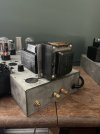
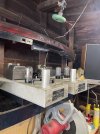
I’ve been messing around with these for quite some time now. Two Wurlitzer 6420 mono amplifiers. Through the help of the amazing people on this site they’re finally finished. My goal was to push a 6L6gc as hard as I could and I think I did it. There was many variations through the process, this is why there’s a bunch of random holes drilled into the chassis.Without going through too much of the trial and error I’ll try to explain the finished project.
I’ll start with the power supply. Contrary to popular belief these do not use the field coil speaker inline with the power supply. The field coil is tapped off the B+ but is not in series with it. Therefor it technically does not need a choke or resistor on place of the field coil speaker. I already had 2 matching chokes and planned on using them so I did anyway. I eliminated the rectifier tubes in favor of diodes. This give you about 480vdc for b+ plenty to make some power. This also spikes at 530vdc at turn on so 600v capacitors are a must. My power supply went 22uf-choke-1500ohm resistor (factory)- 47uf. There is also a capacitor in the preamp section that I used 22uf for. These are all 600v.
Preamp I didn’t do much with. Replaced the 100k input to ground resistor with a 1 megaohm, this almost doubled the volume. The input capacitor was replaced with a 1uf film. It sounded muddied so I experimented with coupling capacitors and ended up with .047uf instead of the original .22uf. This is totally subjective and just what my ears liked. Replaced all resistors while I was there.
Now the fun part, biasing the new 6l6gc’s. I wanted adjustable biasing but I didn’t have any negative voltage so I had to stick with the cathode biasing. I ordered up some 5 watt 100ohm pots and went to work. After many, and I mean probably 40 different resistors and resistor combinations I ended up with (2) 240ohm 5 watt resistors from cathode to the pot. They were a little out of spec so the final measurement of the 2 combined is 492ohms plus the 50ohms of the centered pot gave me 542ohms total. With a 420v plate to cathode voltage that has the tubes running at 95% dissipation. The other advantage of this is when I turn the pot all the way down to John’s I got almost exactly 100% dissipation! After playing for an hour at 100%, not even a sign of red plating. I also put in a 100k pot for adjusting feedback which really does nothing to the sound but was an experiment.
I wanted a better output transformer. I took a chance on some inexpensive transformers from China but there weren’t even close to 30 watt output so I came across some from a Scott 208 amp that puts out 32 watts. That’s about the most I’d expect from 2 6L6gc tubes. They were too big to fit on the amplifier chassis so they hang off the side. This isn’t ideal but looks were never my goal.
Some other additions were warm white led bulbs tapped into the 6.3 heater and glued to broken car taillight lens plastic to give an interesting orange pilot light. Power switches and 3 prong power cords. Speaker and rca terminals on the back.
All in all they sound great and have plenty of power. Hifi? Maybe not but they’re organ amps you can’t expect too much I was going to for top speed not gas mileage.
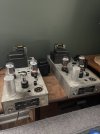
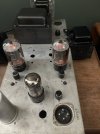
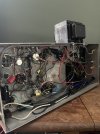
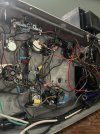
I’ll start with the power supply. Contrary to popular belief these do not use the field coil speaker inline with the power supply. The field coil is tapped off the B+ but is not in series with it. Therefor it technically does not need a choke or resistor on place of the field coil speaker. I already had 2 matching chokes and planned on using them so I did anyway. I eliminated the rectifier tubes in favor of diodes. This give you about 480vdc for b+ plenty to make some power. This also spikes at 530vdc at turn on so 600v capacitors are a must. My power supply went 22uf-choke-1500ohm resistor (factory)- 47uf. There is also a capacitor in the preamp section that I used 22uf for. These are all 600v.
Preamp I didn’t do much with. Replaced the 100k input to ground resistor with a 1 megaohm, this almost doubled the volume. The input capacitor was replaced with a 1uf film. It sounded muddied so I experimented with coupling capacitors and ended up with .047uf instead of the original .22uf. This is totally subjective and just what my ears liked. Replaced all resistors while I was there.
Now the fun part, biasing the new 6l6gc’s. I wanted adjustable biasing but I didn’t have any negative voltage so I had to stick with the cathode biasing. I ordered up some 5 watt 100ohm pots and went to work. After many, and I mean probably 40 different resistors and resistor combinations I ended up with (2) 240ohm 5 watt resistors from cathode to the pot. They were a little out of spec so the final measurement of the 2 combined is 492ohms plus the 50ohms of the centered pot gave me 542ohms total. With a 420v plate to cathode voltage that has the tubes running at 95% dissipation. The other advantage of this is when I turn the pot all the way down to John’s I got almost exactly 100% dissipation! After playing for an hour at 100%, not even a sign of red plating. I also put in a 100k pot for adjusting feedback which really does nothing to the sound but was an experiment.
I wanted a better output transformer. I took a chance on some inexpensive transformers from China but there weren’t even close to 30 watt output so I came across some from a Scott 208 amp that puts out 32 watts. That’s about the most I’d expect from 2 6L6gc tubes. They were too big to fit on the amplifier chassis so they hang off the side. This isn’t ideal but looks were never my goal.
Some other additions were warm white led bulbs tapped into the 6.3 heater and glued to broken car taillight lens plastic to give an interesting orange pilot light. Power switches and 3 prong power cords. Speaker and rca terminals on the back.
All in all they sound great and have plenty of power. Hifi? Maybe not but they’re organ amps you can’t expect too much I was going to for top speed not gas mileage.



 Seriously though, one of the best saw purchases I've ever made.