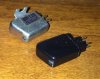
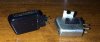
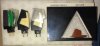
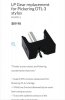
There were a range of stylus alternatives for the Pickering TL/TLV-series, including a Stereohedron (LPGear have a Vivid Line alternative for that), and 0.4 x 0.7mil or 0.3 x 0.7mil elliptical tips, as well as a base-level 0.7mil conical. Since I’ve never owned a Pickering p-mount, I don’t know that much about them, except that in typical Pickering confusing fashion, there were two different stylus carrier shapes which fitted the same cartridges, known as wide or narrow, or sometimes short or tall, which had the same part numbers.
The ‘short’ or ‘wide’ stylus type, which wrapped around the sides of the cartridge body, could take the optional Pickering stylus brush, which of course requires an additional 1g tracking force id it's used (not seen at the tip, so it doesn’t affect record wear – the brush absorbs the extra 1g). The brush-type stylus obviously would only be acceptable for p-mount tonearms with adjustable tracking force when used with the brush, or half-inch mount tonearms using the p-mount adapter, but would be OK for all tonearms when the brush is removed, as it just clips off the stylus grip, and is held by two holes in the stylus grip sides, and two ‘bumps’ in the brush holder, like all Pickering brushes.
The ‘tall’ or ‘narrow’ stylus type wrapped over the top corner of the cartridge, similar to Stanton styli (e.g. 881S) – they are actually held more securely than the wide styli, and may have been an acceptance by the Pickering side of the Pickering/Stanton factory building that the Stanton-type stylus grips were actually better than the Pickering ones! I’ve used both types on the Stanton cartridges I own (881S and 681EEE), and the Stanton ‘wrap over the top’ stylus grips are certainly better than the original Pickering ‘wide’ ones which wrap around the sides of the cartridge bodies, but it probably depends on the luck of the draw which you get – either will fit. Like most Pickering cartridges, there were also near-equivalent Stanton versions.
The cartridges themselves were actually the p-mount versions of the moving iron (sometimes called induced magnet) Pickering XV-15 or Stanton 680/681-series cartridges. Here is (I think) the complete list of the five Pickering p-mount cartridges with their interchangeable styli, the near-equivalent Pickering half-inch mount cartridges, and the equivalent Stanton p-mount cartridges and styli (which should fit the Pickering p-mount cartridges, and are probably easier to find):
- Cartridge number TLC, stylus number DLC, 0.7mil conical tip, no Stanton equivalent
- TL-1 or TL-1E or TLV-625E, stylus DTL-1 or DTL-1E, 0.4 x 0.7mil elliptical tip, Stanton equivalent p-mount L727E (replacement stylus Stanton D72E)
- TL-2 or TL-2E, stylus DTL-2 or DTL-2E, 0.3 x 0.7mil elliptical, Stanton equivalent p-mount cartridge L737E (replacement stylus Stanton D73E)
- TL-3 or TL-3S, stylus DTL-3 or DTL-3S, bonded Stereohedron tip, half-inch mount close equivalent cartridge XV-15/757S (see LPGear for a Vivid Line replacement of the DTL-3S stylus), Stanton equivalent p-mount L737S (replacement stylus Stanton D73S)
- TL-4 Super, stylus DTL-4 or DTL-4S, nude Stereohedron, half-inch mount equivalent cartridge XV-15/1800S, Stanton equivalent p-mount L747S (replacement stylus Stanton D74S)
So there are five different Pickering stylus alternatives of different performance and four different Stanton styli, depending on how much you want to spend, or which aftermarket alternatives are offered by your particular vendor. LPGear/LPTunes have close aftermarket replacements for the DLC, DTL-1E, DTL-2E and DTL-3S styli, and probably also the Stanton versions.
Having said that, you could upgrade the stylus of your ‘LPGear’ cartridge, which is made by Audio-Technica. Look up the ATN3472VL (Vivid Line) and ATN3472SA (Shibata) styli on LPGear, and that may be a cheaper option than buying a complete new cartridge, with similar performance between the 3472VL stylus on your current cartridge, and the LPGear Reference Series VL cartridge (the bodies are almost certainly exactly the same, and in fact, the top-end LP Gear T4P Reference Series VML uses the ATN3472ML stylus!). Or for an upgrade (at extra cost!) to the best tip available, try the superb ATN3472ML stylus. I actually have the genuine AT-made ATN3472ML on my AT-92ECD cartridge, and it elevates it a long way above the stock 0.3 x 0.7mil elliptical stylus.
The Vivid Line tip is an extended line contact tip exclusive to LPGear, meaning one with a much longer ‘footprint’ up the groove wall than an elliptical or conical stylus, and given similar tip quality (smoothness/polish) should wear records much less, and produce lower distortion, if it’s aligned properly. That’s because its pressure on the record is much lower for a given unit of area, because the pressure is spread over a much larger surface area. The Vivid Line is the same in radius dimensions to the original (best) Shibata Mk1 tip, that is, 6um x 75µm, or 0.24 x 3 mil, although that doesn’t mean that it’s the same shape as the Shibata 1.
Whether it is similar in polish to the Shibata 1, which is still made by the same company (Namiki Jewel) who developed it with JVC engineer Norio Shibata, after whom it’s named, is unknown (but probably doubtful, seeing it costs a lot less), and we also don’t know who manufactures the Vivid Line for LPGear, and haven’t seen any details on its exact shape, unlike many of the best patented tips. So it’s an unknown quality, although users generally seem to be happy with its sound, and it does cost less.
Note that I'm not making any recommendations - that's up to you to decide which one to buy. If it was me (and you were paying

), I'd upgrade your current cartridge with one of the ATN3472VL, ATN3472SA or ATN3472ML styli, content in the knowledge that styli for the AT cartridges will be widely available around the world for some years to come.
Possible things to consider are that the Pickering cartridge recommended capacitance load of 275pF is probably much easier to meet for most amplifier and turntable output cable combinations than the very low 100-200pF recommendation for the Audio-Technica cartridges (including the LPGear-branded ones) for the flattest frequency response. If the AT cartridges are loaded with too much capacitance, they'll develop a shrill sound, because an electrical resonant peak is developed in the frequency response in the region between about 6 and 14kHz (depending on the capacitance).
However, to counter that, it's probably much easier to find styli for the AT cartridges, and AT are still manufacturing cartridges and styli, while Pickering isn't.