• The move to the new server is done. There are some software and database maintenance updates in process. This has us passing the hat around to help out. We appreciate any donations. Seriously, even a dollar helps. The payment page may be found here - https://www.audiokarma.org/support.html

Understanding amp power vs speaker RMS/max

Jfaustus

AK Subscriber
Subscriber
Hi all, I'm trying to understand the interaction between amp power ratings and speaker demands. Not wanting to wade into debates about solid state vs Class D vs Tube, or different sound signatures. This is more of a technical question and I'd be grateful for help understanding.

I hear various speakers, including some I own, described as 'power hungry' or as 'needing XYZ watts to sing.' That's where I get confused. If a 100 wpc amp and a 250 wpc amp are driving the same set of speakers, then for a given SPL level wouldn't each amp be putting exactly the same output into the speakers? Even if they're using more or less of their total available power?

To take an example: I have a pair of Ohm Fs redone by Dale Harder. They are slightly more sensitive than the originals, at 88/89 dB 1w/1m. I currently have them in my listening room about 10-11 ft from my ears. Let's call it 3.5 meters. So math says that at my current listening level of 74 dB average / 81 max I'm using basically 1 watt. Pumping the 150 watts Harder lists as the max continuous power (and close to the 200w everyone says is what's needed to make them sing) would be an ear-splitting 102.9 dB at my listening spot. In fact to have an SPL of 81.7 dB at the listening position I would need to sit 40 meters away from the speakers. That's obviously absurd? And yet Dale Harder recommends a 400w amp and says these speakers are appropriate for a 200-400 sq ft room.

This happens to be my example but substitute any 'they need power to really shine' speaker into this scenario.

What am I missing? Is everyone listening to their music at stadium concert sound levels?
 
Register to hide this ad
I had a set of Walsh 4s (wish I had them back, too!) so I can attest that the big Ohms do benefit from a lot of available power. The move from an Acoustat TNT 200 to a Tandberg 3016A was enlightening, to say the least. There was only 25 watts or so difference in their rated power output, but there was no comparison in the two amplifiers’ ability to instantaneously deliver massive amounts of power on demand. I wouldn’t get too hung up on numbers.
 
1 watt, regardless which amp it is coming from, should produce the same SPL for a given pair of speakers.

Probably where the "needs 400 watts to sing" thing comes from is headroom. Every doubling of wattage produced 3 dB more SPL. So, going from 100 to 200 watts amp output, only increase SPL by 3 dB or give 3 dB more headroom. Same for going from 200 to 400 watts.

I bought a pair of Ohm Walsh Twos from @similost a long time ago. Think it was him that told me it took 250 WPC to make them sound good and 251 WPC to blow them up. Am pretty sure he was just kidding. :dunno:
 
1 watt, regardless which amp it is coming from, should produce the same SPL for a given pair of speakers.
This is not quite true. To some extent It depends on the interaction of the amplifiers' output impedance and the impedance curve for the speakers.

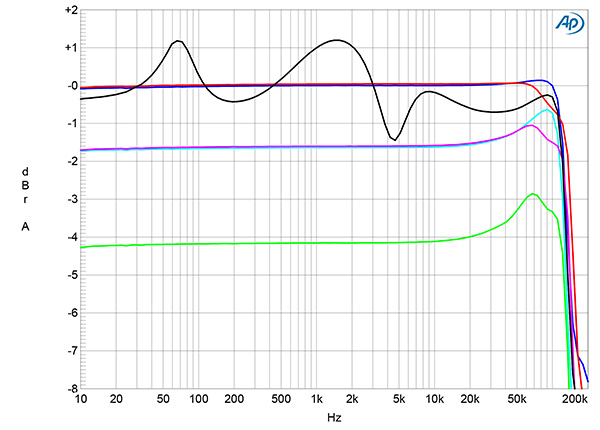
If one follows Stereophile Magazine, this is demonstrated on a regular basis looking at the frequency sweeps with impedance where they use a "realistic" load rather than a fixed resistor to access power vs frequency. And tube amps are typically far worse than solid state.

0226-DoshEVOSfig1-600.jpg

Fig.1 Doshi Evolution Stereo, frequency response at 2.83V into: simulated loudspeaker load (gray), 8 ohms (left channel blue, right red), 4 ohms (left cyan, right magenta), and 2 ohms (green) (1dB/vertical div.).

1775693303316.png
Fig.1 Eversolo AMP-F10, sensitivity set to "23dB," frequency response at 2.83V into: simulated loudspeaker load (gray), 8 ohms (left channel blue, right red), 4 ohms (left cyan, right magenta), and 2 ohms (green) (1dB/vertical div.).

In both cases they are putting "1 watt" into the simulated speaker load. If this were a speaker, does anyone really think that pink noise played over both amps is going to sound the same, or even the same volume?
 
Last edited:
What am I missing? Is everyone listening to their music at stadium concert sound levels?
I suggest what is most often missed when this comes up is the very important distinction of power necessary to achieve your needs vs. the power needed to extract the maximum design performance from the speaker (or the maximum power it can withstain for some period of time without damage).

Those two situations can be and often are completely different use cases.
 
Last edited:
One watt is one watt, no matter the power rating of the amp, or the power handling capability of the speaker. And 200 watts is only about 3dB louder than 100 watts. Some speaker designs take more power before they're really operating in their optimum performance window, they simply don't sound quite as good at lower volumes.

WHY would you want to max your speakers and amp? It serves no useful purpose. Listen at the level you're comfortable with, call it good, and enjoy it!

I decided long ago that 100-125ish watts per channel was about all I'd ever need, and I've never blown a speaker or put an amp into protection, in 40+ years in the game. My current amp is about 130wpc, my speakers are rated 250 watts RMS, 90dB+ efficient, and they'll play as loud as I can stand with very little power. Everything else is headroom.
 
WHY would you want to max your speakers and amp? It serves no useful purpose. Listen at the level you're comfortable with, call it good, and enjoy it!
I don't! And that's why I don't fully understand the genre of "these need a lot of power" speakers. What does that mean? Even a horrifically insensitive speaker at 84 dB 1w/1m will give a respectable 76 dB at 3.5m (give or take depending on room etc). So "needs a lot of power" means what in practice? 5 watts? 10?

So no, I don't drive my speakers anywhere near their RMS max. I doubt I could even be in the same room with them if I got close.

But what I don't get is why, then, it appears that some speakers need to be fed A LOT of power. Why, for example, would Dale Harder recommend a 400w amp for a speaker that has 150w RMS maximum? There must be some additional factor(s) I'm not seeing.
 
Answered justjed before reading the rest of the responses. Thanks for that. So the answer is headroom. And does "grip" enter into it or is that made-up reviewer pablum?

@toddalin could you explain why the speaker line is so different in the two graphs?
 
What am I missing? Is everyone listening to their music at stadium concert sound levels?

Headroom, as mentioned, is absolutely the reason to have extra power available. But there are also more complexities to real music listening that aren't done justice by simple sensitivity ratings.

It doesn't take a lot of power simply to create loud sound. A smoke alarm is plenty loud, powered by nothing more than a 9V battery. With speakers, lower frequencies require more power to reproduce properly. This is why tweeters often have voice coils rated to handle ~10-20w, midrange drivers have voice coils rated to handle maybe 20-50w, while woofers usually have voice coils rated to handle hundreds of watts.

So if you have two different songs, one with relatively little low-frequency content, and another with significant amounts of low-frequency content, the latter song will use much more power even when both songs are playing at the same volume. You don't want to end up in a situation where you have "plenty of power"... as long as a song with deep bass isn't next on the playlist.
 
My integrated amp rarely ever hits the 1 watt mark. I think I have plenty of headroom. Apartment life.

Now have a backyard party out in the sticks and maybe that 200 watts doesn't look like so much anymore.
 
Of course, if you are driving your amplifier into clipping trying to drive inefficient or demanding speakers, problems may arise. Good to have some power reserve.
I had an ITT Schaub Lorenz 4500 Stereo receiver that was driving a pair of B&O S60 speakers. I don't remember how many times I had to replace the midranges and sometimes the tweeters. Maybe I played a little too loud on those inefficient speakers.......maybe.
 
Sometimes I wonder if "needs more power" is really "needs more current". Some speakers have nasty impedance dips, and if the amplifier cannot deliver enough current the output power drops. Broadly speaking a higher power amp is more likely to be able to deliver that current than a low power amp. Not a hard rule for sure but high power amps often have multiple transistors in parallel for the output stage, and that lets them deliver more current at a given output voltage.
 
Sometimes I wonder if "needs more power" is really "needs more current". Some speakers have nasty impedance dips, and if the amplifier cannot deliver enough current the output power drops. Broadly speaking a higher power amp is more likely to be able to deliver that current than a low power amp. Not a hard rule for sure but high power amps often have multiple transistors in parallel for the output stage, and that lets them deliver more current at a given output voltage.
And beefier power supplies.
 
1 watt, regardless which amp it is coming from, should produce the same SPL for a given pair of speakers.

:dunno:
Very true!

However, a bigger amp is prolly going to have more reserve and not "run out of gas."

I think of it like a 1300cc VW engine putting out 25HP and a 440CI Dodge putting out 25 HP. The Mopar has way more reserve to handle sudden power demands.

;)
 
The recurring point is the need power is relative to the use case. Mine for me, you for yours, the OP for his, and so on.

If the situation is such that a 1300cc VW engine satisfies the use case there is no point to the 440ci.

If that doesn't work, it's not the concept that's in error, it's that either you didn't really understand your use case or that your use case has changed.
 
Back
Top Bottom