• The move to the new server is done. There are some software and database maintenance updates in process. This has us passing the hat around to help out. We appreciate any donations. Seriously, even a dollar helps. The payment page may be found here - https://www.audiokarma.org/support.html

Upgrading a Hafler DH110

Bob

Super Member
The DH-110 replaced Hafler’s first preamp, the DH-101, and was produced from the early 1980’s to the early 1990’s. I picked up this unit and decided to look inside and upgrade it.

This unit has everything. A headphone amp that’s not very loud. A muting circuit to prevent downstream thumps that scare you. A mono switch. An external processing loop. A defeatable tone control switch. A rumble filter.

This unit has a build date of Dec 11, 1984 noted on the edge of an internal sheet metal bend. So, this is an early unit but there’s a stamp on the board that indicates it’s a PC14C. There is available on eBay a blank PC14D. That assumes 4 versions. We’ll see this again a little bit later.

Now for some not so good news. Seems that this preamp has a zillion parts on it. The DH-100 has about 10 eCaps. The DH-101 has about 16 eCaps. This DH-110 has 30! This more than the other two combined. Not that this is any indication of audiophile excellence but it does mean a lot more eCaps to change.

Another issue is that the holes are very narrow and you have to be careful how you remove the leads in the hole. I used solder braid rather than a solder sucker and with a lot of flux (solder doctor’s assistant).

00-main.JPG
 
Register to hide this ad
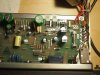
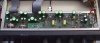
And here’s what the inside looks like:

01-original.JPG

At the very far right is the volume control – in this unit it’s a blue Alps unit with a stepper ring to simulate a stepped attenuator. I’d prefer it didn’t have this “feature” but it does feel good. Punching above its weight type of praise. Some folks have seen a black Noble pot here.

There’s a lot of non-electrolytic caps here. I see the polys and some I believe are polystyrene. None of these need replacement. Only the eCaps since the unit is 33 years old.
 
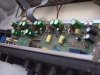
Here’s a completed recap with all the caps labelled by value. We’ll cover the power supply separately.

03-parts-id-1000.JPG

You’ll note the green Nichicon eCaps. These are non-polar and eliminates the possibility of wiring them for explosions. Besides, the green confirms the gracious fluidity of massed strings. As you might guess, I’m not a card carrying member of the boutique parts party. If I were I would use the huge Russian teflon caps from tube amps and declare victory. These greenies are as close as I get.
 
Last edited:
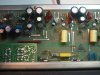
Here’s the power supply

Note that there are lots of diodes here. I replaced 8 of the 1N4003s (200PIV 1Amp) with UF4007s and there were a few I left alone. The circuitry with the carbon film (beige) resistors is the muting circuit which I left alone also. More on this later.

The power supply is built from discrete regulators and is designed to yield +/- 23.2 volts. With these rail voltages, caps across the rails rated at 25v are too close, I’d choose 35v.

The post regulator eCaps seemed small at only 22uf but there are 8 downstream 470ufs assisting with the heavy lifting. These are labelled 22uf as per the schematic but I used 100uf as replacement since I already had them.


05-psu-finished-1000.JPG
 

Attachments

  • 05-psu-finished.JPG
    05-psu-finished.JPG
    97.3 KB · Views: 175
Last edited:
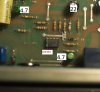
some id and quirks. see lower right for board version - PC14C.

02-pc14c.JPG

It’s not really quirks but some out-of-date information that didn’t make it into the manual. Also, the available manuals seem to be the same one with quirky over-types and misspellings (CM for C36). Both hifiengine.com and hafler.com have the same download complete with the same typos

The parts layout in the manual and the actual parts layout on the board are different:

04-caps-moved.jpg

Others have noted that the two yellow square caps are pictorially shown as between the large green cap and the leftmost regulator. Somebody moved the yellow cheese.

There are other similar oddities if you compare the foil diagram, the parts layout pictorial, and the component side of the board. Nothing to be worried about. Justifiably reasonable if you are new to this fine art of blue-printing and want to be sure of everything before you begin surgery.

Since this unit is mostly metal film resistors I didn’t touch any of them. The carbon film resistors are not in the signal part, they are in the muting circuit. Also, some of them are in very inaccessible locations that require major work, time, and energy with little to no benefits except as armchair arguments.

I am also sure that towards the tail end of the production there were more running production changes so that the information presented here will hopefully still be accurate and therefore useful.

One more mention of the headphone amp. The volume is low, at least with my two headphones, to the point I thought the unit failed during my testing. I had to crank the volume control to 3 o’clock before I could hear anything.

This is the first time I removed all the same value caps then soldered all the replacements in. Usually it’s one-at-a-time: pull, measure pull, measure replacement, solder in replacement then repeat for the next part. This removes the possibility of wiring in the wrong value. And so far, for the DH-100, the DH-101, and this DH-110, the values on each board match the schematic and the parts layouts (although there might be some minor physical movement of “quirky” parts).

Also note that there are two cables connecting the board to the rear panel. Pulling both prevents the unit from powering on. Pulling only the right lets the unit power on but no sound. Time and again, I forget to re-install these two cables after taking pictures and thought it broke again. This DH-110 is really robust – survives several attempts to declare it dead.
 
Now onto the parts listings.

I went with NP versions of the caps and upped the voltage ratings. And these are the largest possible fit in the spaces allocated. This means caps wider than these won’t fit – too fat. Particularly when there’s a group of three. Not quite a menage-a-trois. I also suggest that you review your unit, compare against my list and the parts list before you order the parts. Then add 1 for good luck.


Qty ID original value new value notes

6 C6 C16 C22 22/50 NP 22/50 NP

4 C7 C8 220/10 NP 220/16 NP

2 C13 1000/6 NP 1000/10 NP

8 C17 C18 C23 C24 470/25 P 470/35 NP

4 C29 C39 C40 4.7/25 NP 4.7/25 NP replaced only C39 C40 (Muting)

2 C30 47/16 NP 47/25 NP did not replace


Power supply next

2 C32 C33 1000/50 P 1000/50 P

2 C34 C36 C41 22/50 P 100/50 P did not replace C41


In summary only changed out the eCaps. Did not touch some of the eCaps as listed above because I don’t use any of the filters/switches they’re in. Also, some of them are in hard
to get locations. Also did not replace any non-eCaps, nor any resistors.
 
Now to power on.


Arrgh. Left channel is loud or normal and right channel is low. Thought about this for a while and decided it wasn’t a gain problem. The one time I used the headphones, I recall that they sounded fine but had to up the volume to almost the max. Maybe it’s my headphones.

I researched the web and came up with the J112s in the muting circuit. What I gathered was that the signal on power up or power down was shorted to ground. This is to prevent transients to hit the power amp and blow out the speakers. This is true on power up if you don’t power sequence the preamp first before the power amp.

It seems that these JFETs aren’t perfect and can affect the signal in between power on and power off. My right channel signal was attenuated by these J112s.

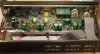
Here’s where they are, the J112s, and the LM393 comparator IC:

09-Q15,Q115.JPG

10-lm393.jpg
 
I replaced the two J112s at Q15 and Q115. I socketed the LM393 and replaced it as well. If I were to keep this DH110, I would socket the J112s and have a bag of spares taped inside the top cover.

And I dabbed some red nail polish on these bad boys to tell the next owner that if he or she gets silence or bad channel balance then it’s likely to be the muting circuit and the J112s.

The test to see if the J112s are bad, is to remove them from the circuit. You will get thumps on power up and power down but if you sequence the power you’ll avoid the thumps at least during testing.


11-Fixed-muting.JPG

That’s it for now and I hope I didn’t leave out any important details. If you’re upgrading a DH110, replace the J112s and maybe the LM393 in addition to any eCap changes. Do remember my note about upping the 470Ufs to 35V and if you’re using Nichicon ES series, these are the largest in diameter that fit on the board.

Last but not least, the DH100 uses the same muting circuit so any change in volume or SQ, then look at the J112s.

Enjoy!
 
@soundmig

I noticed the sound is no longer flat, the sound is alive and the soundstage is very wide.
I must admit that I get into the music and don't hear fingering, background speech, or
when the third violinist sneezes, whether I can id it as an allergy or a cold.

the test I use is the Tsunami track (last I think) from Rising Sun, WesleySnipes and
Sean Connery. super large drums, multiple drum black belts, multiple drum lines,
multiple themes, and one of the classics in Taiku. loud stuff that rattles your chest
but doesn't destroy your ears.

I haven't burned it in for many hours so it should improve.

I have one more - a DH-101 which should be more of a surprise since I'm using special
parts.

enjoy
Bob
 
I accepted a DH110 in trade for some speakers a while back but did not bother trying it out for several months. When I did, I noticed that at idle, one side of the power amp being used got very warm. This revealed 6 volts DC offset at the corresponding output of the DH110. Learning that the J122 transistors were likely to blame, I replaced them.

I was told in advance that the volume knob was not original but managed to locate an OEM one - NOS. At time of acquisition I was also told numerous capacitors were replaced but while "under the hood" changing J112's I discovered this was not so

When new transistors were in the mute circuit, the preamp worked well but since I expected new electrolytic capacitors and there were none, I compiled a parts list to do that myself. The number of non-polarized ones surprised me. I had the possibly mistaken idea that these are preferable but usually not used because manufacturers opt instead for a less expensive polarized alternative. Regular ectrolytics I can cheaply obtain locally but non-polarized came from Mouser or Digikey and cost considerably more. Recapping was successfull but I have still yet to give the pre a longer than a 1/2 hour listen.

Something I noticed and thought odd was the "side firing" power switch. The on/off "mechanism" does not seem have anything wrong as in worn out, loose or broken but sometimes the button must be depressed more than once to turn off the power. The button pops out like it's supposed to but the pilot light may not start to dim on the first attempt.

EDIT: I too have a DH101 and have had for several years. I did no mods but during that time I corrected a few mistakes made by the original builder, had fabricated some stainless steel strips for the RCA jacks (the original fibreboard ones broke), replaced all the RCA jacks with gold plated ones and replaced all it's electrolytics. I hook it up from time to time and the only idiosyncrasy (other than selector switch caps being propelled a foot or two when changing sources) is the volume control. When turned completely down, a faint trace of programme can still be heard. Since an acquaintance has had the same preamp since new and it exhibits the same "condition" I am assuming that it's inherent to the beast.
 
Last edited:
you have just codified the hafler flipping experience. I've followed Haflers (and for a while, Dynacos) and am always amazed at
what is being "marketed" and what is not done for these units.

I have seen more Haflers sold for over 150 with 4 words or less: "turns on, works". I would never buy these units. I also liked
the "pro mods" without any description. What might a "pro mod" be? a shot of DeOxit? then there's the major upgrades without
a single shot of the insides.

the bottom line is whether you trust a 30-40 year old unit in your system. My analogy is a 1984 Corvette with original tires - care
to do a high-speed run? I have a 101 from back in the day and last year developed some random noise in the left channel phono
section. I had to pull it out and replace all the eCaps there and while I was inside, replaced all the other board eCaps (8 total)
(I had already replaced the original 8 10uf tants with mica/films), and also replaced the power supply caps.

I should have my DH101 upgrade thread up shortly.

The 110s seem to suffer from the JFETs (Q15, Q115). socket the puppy and buy spares OR remove permanently.
I think these caused the outputs to pass DC to over-heat your power amp. shouldn't have to add a cap to the
output of the preamp or to the input of the power amp.

The only units I have bought are those untouched by FreddyFlipper, EddieEstateExpert, and WillyWidowCheater, or
Noobies. I like units where there's honesty (one channel is out) rather than IQBusters ("no way to test").

I like to think that before the age of the mega-chip (DAC, preamp, FM tuner, 5 channel class D,... on one chip)
the engineers designed these circuits with the then advanced chips and were careful designers and what they
designed was not compromised. they may have been limited in other ways. And the big goal was to design to
a price point. Today we can upgrade the parts from standard, to recommended, to ultra-boutique
(ever see a 101 with tube film caps? you can barely squeeze the cap onto the board). and the sound
regains its original SQ, and everything marches along. Compare these 100 dollar units to the 5-figure
ones in the magazines.

I salute you for the replacement RCA panel! Its something I don't have patience for. Things I do are in
the problem solving arena.
 
Bob, these old Haflers can be something! I have a p-225 (DH220) that I dropped Musical Concepts driver boards into and I'm absolutely floored by how good it sounds. I've owned Bryston, BAT (tube and SS), Threshold, Krell, Crown, Thor, Arcam, Marantz, Forte 4, B&K amps and few others. I can't say that I've enjoyed any amp more than I enjoy my modified Hafler. I currently use it to drive the mid/highs (150 Hz up) in my system, and its warm, deep, smooth, detailed and 3D all at the same time - I love it. I've not tried any of the Hafler pre-amps yet, but I may have to.
 
Yes, these Haflers are underestimated. If you do go with a Hafler preamp, get one that's been updated
like above (or look for the DH100 version, or the upcoming DH101 version). Or if you're willing and able,
do it yourself.

A DH100 allows you to roll the op-amps, and the 101 is the easiest (less caps than this DH110 and no
problems with the muting circuit since there isn't one).

I also bi-amp but use a DH200 for the bottom.
 
This thread motivated me to do a little work on my DH110. A couple of years ago I got several repair kits for my DH110. At the time, I did not swap out the Q15 Q115 JFETs, the LM317 and LM337 regulators, or the LM393 IC. With a little time on my hands, I decided to finish things up with the new regulators and JFETs. I will wait to do the LM393 until I get a socket. I already did the caps for the line-level stuff. I long ago retired the turn table so the phono section is untouched. Great little preamp that I built from a kit back around 1981. Bob, thanks for the inspiration to finish things up. My main gripe about the preamp are the RCA's. I've had to resolder those output RCAs several times.
 
that's great- and yes, those RCAs are troublesome to the point I don't have the patience to fix them for good
(like others who fabricate a whole new back panel). They are not alone, almost all my equipment from the
80's have this problem.

that muting circuit comes in handy if you have lots of stuff coming in (I can see tuners, CDs, SACDs, tapes, etc)
and no thumps that stop your heart as you realize your dream speakers just passed a sound fart.

PM me with your physical address and I'll send you a socket - no charge (I have thousands? of stamps that are
worthless unless used for good causes like this).

Bob
 
Yes, these Haflers are underestimated. If you do go with a Hafler preamp, get one that's been updated
like above (or look for the DH100 version, or the upcoming DH101 version). Or if you're willing and able,
do it yourself.

A DH100 allows you to roll the op-amps, and the 101 is the easiest (less caps than this DH110 and no
problems with the muting circuit since there isn't one).

I also bi-amp but use a DH200 for the bottom.
I wish I had another Hafler for the bottom on my system. DH100 sounds interesting. Op-Amp rolling is fascinating too. I replaced the op amps in my Forte pre-amp with Sparkos discrete Op-Amps and wow what a difference!
 
yes, the DH100 is ideal for rolling op-amps. I suggest getting a Series 2, updating the eCaps, then
decouple all the sound-path op-amps (V+ to ground, V- to ground, V+ to V- or three per op-amp)
then
ROLL.
 
Well, one of the jfet's that I installed back in March failed and silenced the left channel. Having read about all the issues the DH-110 muting circuit could lead to, I removed the "new" jfet's and used my trusty little component tester. One jfet was properly identified as a jfet but the other wasn't and appeared to just be resistors. The preamp is now working nicely without the jfets and I am debating about just leaving them out or replacing them again. So, Bob, where might I get some sockets for these jfets? If I put them back, I'll definitely go the socket route. While I was in the "innerds" I replaced a pair of the outlet RCA jacks that had kept giving me problems in the past, and the Hafler DH-110 is again singing along.

Bill
 
Back
Top Bottom