• The move to the new server is done. There are some software and database maintenance updates in process. This has us passing the hat around to help out. We appreciate any donations. Seriously, even a dollar helps. The payment page may be found here - https://www.audiokarma.org/support.html

Upgrading B&W 683 crossover

Michael F

Active Member
I recently acquired a pair of these and like them, a lot:). They replaced many far more expensive floorstanders in recent years that were without question more refined but ultimately nowhere near as enjoyable to listen to.
While the 683s are not perfect by any means either, I think I`ll hang on to them for a while which has me wondering if a crossover component upgrade may be a cost effective tweak that`ll bring their performance up a notch.

I have read on a European forum that these speakers respond quite favorably to better crossover components.
My biggest "gripe" with these is that I find the top end a little too polite, lacking some bite and sparkle that I know exists.
The same could be said to a lesser degree about the FST midrange driver but I`m nitpicking on both accounts here.

I`m considering replacing the tweeter capacitors to one of these two:

https://solen.ca/products/capacitors/silver-metallized-polypropylene-capacitors/solen-agm470/
or
https://www.partsconnexion.com/product49372.html

These are the two that are readily available and reasonably priced but I`d be open to other suggestions within the price range.

I`m also considering replacing the two generic resistors in the midrange band pass filter to some non inductive types while in there.
Depending on the results achieved by the HPF cap change, I may be tempted to replace the two midrange and woofer caps at a later point as they are of greater value and expense.
Your thoughts?
 

Attachments

  • HPF.JPG
    HPF.JPG
    49 KB · Views: 137
  • LPF.JPG
    LPF.JPG
    42.2 KB · Views: 37
Register to hide this ad
Certainly are nice capacitors, at $30 each they are out of my price range unless I happened upon some truly high end speakers with bad caps. :p
I don't know when these came out but I see a review from 2015 and from the looks of them they are not very old. Praytell, what else is in your system? What do you hope to hear from a recap that you aren't hearing now? Just as a way of gauging your project.
The speakers are a circa 2008 vintage I`m guessing, not old enough for capacitor deterioration but it`s more a question of capacitor quality, they are after all built to a certain price point.
The rest of the system consists of a Krell 300i, Magnum Dynalab MD-100, Arcam irDAC and Cambridge CXC transport.
 
Whether or not those capacitors are an upgrade would depend on what's in the crossovers at the moment. Do you know? Have you got a picture?
Personally, I think capacitors aren't the weakest link in a typical crossover - the inductors are.
 
Whether or not those capacitors are an upgrade would depend on what's in the crossovers at the moment. Do you know? Have you got a picture?
Personally, I think capacitors aren't the weakest link in a typical crossover - the inductors are.
 

Attachments

  • HP filter.jpeg
    HP filter.jpeg
    30.1 KB · Views: 47
Those look like polypropylene capacitors and air-core inductors. They look good and I wouldn't expect an obvious improvement from changing them.
 
I believe the B&W 800 series use Mundorf capacitors. I've seen crossover shots that showed Mundorf Supreme caps. A Mundorf Supreme is available in the 4.7uF value. A Mundorf EVO Oil could be used for the 47uF. The EVO Oil and Supreme caps use the same manufacturing process, and should sound similar.

Also, the 4.7 and 47 are both series caps, and deserve a decent budget, for a noticable upgrade. Mundorf caps are available at Sonic Craft and Parts Connexion. I've bought from both companies without issue. I've used those 2 series of Mundorf caps too, and loved them. Very clear, very clean. Much more transparent than other caps I have tried. I've received negative comments for recommending boutique caps, but these were well worth the cost. ;):biggrin:
 
Last edited:
Oh yea, those 683's are very nice. I used to sell those. It's tweeter was a big step up from the prior series. I couldn't stand that earlier tweeter; very grainy.
 
s-l1600.jpg
 
This cap should open up the tweeter.

The Audyn Plus caps get great reviews. I haven't tried them yet, but I think I'll use Audyn caps on my next project. Just out of curiosity. See how they compare to the Mundorf, ClarityCaps, and Daytons, that I've tried on other speakers. :)
 
Me again.

I did another B&W crossover search. A lot of the pictures I found, showed that Mundorf MKP caps were often used for the 47uF capacitor.

Just suggesting choices...!
 
Here are a couple of measurements I came across.
The first is Violet curve: pseudo-anechoic response on the tweeter axis, averaged across a 30° horizontal window, combined with nearfield responses of the woofers and port). All measurements were taken at 1 meter.
Pseudo-anechoic response, off-center in the horizontal plane, at 45° (red) and 60° (blue).

The second,pseudo-anechoic response at 15° above (red) and 15° below (blue) the tweeter axis.
 

Attachments

  • 408bw.Fig1.jpg
    408bw.Fig1.jpg
    33.5 KB · Views: 13
  • 408bw.Fig2.jpg
    408bw.Fig2.jpg
    32.2 KB · Views: 10
Some cap brands go nuts on voltages. But, I guess they produce a cap, with a high enough rating, to work in electronics or crossovers, without the need to produce 2 separate lines of products.
 
Those look like polypropylene capacitors and air-core inductors. They look good and I wouldn't expect an obvious improvement from changing them.
I agree with rothwellaudio.
Here are a couple of measurements I came across.
The first is Violet curve: pseudo-anechoic response on the tweeter axis, averaged across a 30° horizontal window, combined with nearfield responses of the woofers and port). All measurements were taken at 1 meter.
Pseudo-anechoic response, off-center in the horizontal plane, at 45° (red) and 60° (blue).

The second,pseudo-anechoic response at 15° above (red) and 15° below (blue) the tweeter axis.
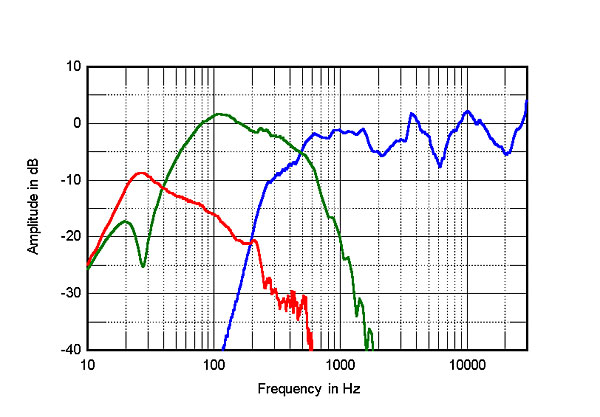
Are your speakers B&W 683 s2? If so, Stereophile published these frequency response curves. The blue curve is the mid-range and tweeter, green is the woofers, and red is the port.
915B683fig3.jpg


I get that you like these speakers. But the mid-range and tweeter responses are far from smooth looking. Do not deceive yourself into believing that simply exchanging capacitors for others of the same capacitance can improve that. It might be possible to design a new crossover that might smooth things out a bit, but I'm only guessing. It also might not be possible.

Before you buy any capacitors, learn their physical dimensions and compare them to the physical size of the existing capacitors. Those caps you mentioned as replacements will be larger because of their higher voltage failure rating. Placing a larger cap in those existing crossover boards may be difficult.
 
Are those hills and valleys on the blue curve due to baffle step? They look like it but this is a tower speaker with hardly any baffle...
 
I agree with rothwellaudio.
Are your speakers B&W 683 s2? If so, Stereophile published these frequency response curves. The blue curve is the mid-range and tweeter, green is the woofers, and red is the port.
915B683fig3.jpg


I get that you like these speakers. But the mid-range and tweeter responses are far from smooth looking. Do not deceive yourself into believing that simply exchanging capacitors for others of the same capacitance can improve that. It might be possible to design a new crossover that might smooth things out a bit, but I'm only guessing. It also might not be possible.

Before you buy any capacitors, learn their physical dimensions and compare them to the physical size of the existing capacitors. Those caps you mentioned as replacements will be larger because of their higher voltage failure rating. Placing a larger cap in those existing crossover boards may be difficult.
According to that graph the crossover frequency is 500Hz, which seems very low to me and asks a lot of the tweeter. Still, I'm loath to criticise B&W because they've been at this speaker-making lark for a long time, have more experience than me and no doubt have much better measuring facilities than I do.
The crossover diagram (post #1) shows a 0.5 ohm resistor in series with the tweeter which is marked as optional. If it isn't linked out at present, maybe that's worth a try.
 
Are those hills and valleys on the blue curve due to baffle step? They look like it but this is a tower speaker with hardly any baffle...
Those cabinets are 7.4" (190mm) wide. I'd expect any baffle step response would be in the range of 500 to 1000 Hz, but not higher. The blue curve begins its many valleys & peaks at ~1500 Hz and they continue to well above 10,000 Hz. I believe those are caused by the mid-range and tweeter drivers themselves.

Any type of baffle step compensation requires new circuits in the crossover for the woofers. Simply replacing existing capacitors cannot have any effect.
 
Last edited:
Back
Top Bottom