• The move to the new server is done. There are some software and database maintenance updates in process. This has us passing the hat around to help out. We appreciate any donations. Seriously, even a dollar helps. The payment page may be found here - https://www.audiokarma.org/support.html

Using 7189's in place of 6BQ5's

Lavane

Lunatic Member
I ordered a set of 6P14P-K's for my Magnavox 9304. They're basicly a rugged version of the 7189. What I was wondering is, will running them at around 300v instead of 400v really shorten the life of these tubes? The 6P14P-K's are rated for 5,000 hours. I read somewhere that running them at the same voltage as a 6BQ5 will shorten there life to around 1,500 hours.
I'm not worried about that too much, since a matched quad was pretty cheap.
I was just wondering if it's true that the tube life will be shorter running than at a lower voltage.
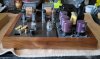
I finished up making a few changes to the amp and it still sounds pretty good even with the very weak original tubes. The new tubes should be here in a couple weeks.
 

Attachments

  • 20221114_092211.jpg
    20221114_092211.jpg
    110.3 KB · Views: 33
Register to hide this ad
Never heard that one.

Dissipation is what really matters and I would think that the lower dissipation the longer you would expect tube life to be. I figure that's why original input tubes pulled from vintage amps often still test new after 50+ years.

There is a lot of confusion about this family of tubes. I've posted about this previously, such as in the following thread:

https://www.audiokarma.org/forums/i...ith-heathkit-iron.978436/page-2#post-15711356
 
See, that's what I thought also. They should last longer. That's what kind of confused me about what I read, since some guitar players use them in place of 6BQ5's because they seem to hold up better.
 
everything I know about tubes says the harder you push them, the shorter the lifespan. Can't see that running at reduced plate voltage would reduce their lifespan.
 
See, that's what I thought also. They should last longer. That's what kind of confused me about what I read, since some guitar players use them in place of 6BQ5's because they seem to hold up better.
Maybe something got lost in the russian translation?
 
I wonder if its a current thing. The 7189 has the same plate dissipation ratings as a 6bq5, but higher voltage ratings. It ends up running at lower current to make that happen. Maybe these don't like to run at higher plate current, but they handle the voltage?
 
I could only find one post in another forum where someone asked about the difference in plate current. Unfortunately there wasn't ever an answer. The tube guitar amp crowd doesn't seek to have had any real problems subbing 7189 types for 6BQ5's. Some prefer them stating they last longer in 6BQ5 amps that beat the snot out of 6BQ5's.
 
That kinda makes sense,, new tubes are mostly made for teh instrument amp crowd these days.... And we know that git amps used to run the snot out of em voltage wise, so getting Pd outta them with higher V ratings than current ratings, seems to follow...
But what do I know,,, I only have a couple of russian tubes 12AX7s, that came in something I scrounged up somewhere!!!
 
As my old man used to say
"Smoke em if you got em"
If you can pay the 7189 tax, by all means use 7189s. Ive heard from numerous sources including Jim Mcshane that the tubes marked 7189 and the ones marked 6bq5 are the same tubes prior to being marked...
 
I ordered a set of 6P14P-K's for my Magnavox 9304. They're basicly a rugged version of the 7189. What I was wondering is, will running them at around 300v instead of 400v really shorten the life of these tubes? The 6P14P-K's are rated for 5,000 hours. I read somewhere that running them at the same voltage as a 6BQ5 will shorten there life to around 1,500 hours.
I'm not worried about that too much, since a matched quad was pretty cheap.
I was just wondering if it's true that the tube life will be shorter running than at a lower voltage.
I finished up making a few changes to the amp and it still sounds pretty good even with the very weak original tubes. The new tubes should be here in a couple weeks.

It's the other way round: Running a tube above their rating will shorten its life, be this voltage or current.

I recently discovered Pearl-HiFi is back in business, buy some tube coolers - it will keep your tubes cooler and extend the life of the tube, often 50% or more. With the current tube prices and diminished availibility well worth it. Tube coolers were originally develloped by the military and Bill Perkinds improved on that. Having a set of coolers normally pays back with the first set of tubes.
 

Attachments

  • 6P14P, 6P14P-V, 6P14P-EV.png
    6P14P, 6P14P-V, 6P14P-EV.png
    263.5 KB · Views: 10
  • 6P14P.pdf
    6P14P.pdf
    171.9 KB · Views: 4
  • 6P14P-EV.png
    6P14P-EV.png
    320 KB · Views: 9
  • Russian 6P14P.jpg
    Russian 6P14P.jpg
    106.1 KB · Views: 8
  • not all Russian tubes report 14 watt Pa.jpg
    not all Russian tubes report 14 watt Pa.jpg
    202.8 KB · Views: 10
Sometimes when the voltage is lower, they also lower the cathode resistor, possibly too low and jack the current through them too high shortening their life?
 
Lots of combinations of voltage and current can be used that result in dissipation levels that don't exceed the total dissipation limit (14w for plate and screen combined) specified for the 6BQ5 (and the 7189) under the Design Center Method.

Amp manufacturers knew this and you'll find that they used a fairly wide range of voltages and currents.

I looked at the operating points used by 7 different manufacturers in their PP 6BQ5 amps. Six are vintage, all of which I own, and one is a "modern" design. Plate voltages ranged from 275v to 420v and currents ranged from 20.8mA to 41.7mA. Total dissipation ranged from 8.58w to 13.96w.

Brands / models were (listed alphabetically): Grommes 40PG, HH Scott 299B, Leben 300, Packard Bell DPA-20, Pilot SA-232, Sherwood S-5000 and Voice of Music 1428.

Anyone care to guess (without researching) which amp runs their output tubes at the lowest dissipation and which runs the highest dissipation? :lurk:
 
Usually the fixed bias designs can run lower current than the cathode bias designs but for some reason I'm thinking Sherwood worked their 7189/6bq5 class tubes hard.

so on the high end I'll go Sherwood, on the low end, probably the Packard Bell since long life would be a little more important than ultimate performance in a console.

cathode bias often idles on the high end to deal with the shifting bias points as the output power increases. Run it too low and you get nasty crossover distortion before it reaches max output power.
 
Back
Top Bottom