• The move to the new server is done. There are some software and database maintenance updates in process. This has us passing the hat around to help out. We appreciate any donations. Seriously, even a dollar helps. The payment page may be found here - https://www.audiokarma.org/support.html

Using lower voltage caps in a crossover?

Mat86

Active Member
I'm upgrading a pair of crossovers and, as you may know, the bipolar electrolytic in many of these are hard to find 1:1 replacements for these days. Is it okay to use a lower voltage 50v cap in place of a stock 100v BP?

I've been reading online and seeing mixed opinions between "never go lower, stick to manufacturer" and "50v is fine, it wont see that much voltage"

The amp I'm using is 150w /8ohm and the speakers are Mirage M-990's. I'm only talking about 1 cap, the rest are all film caps 100v+
 
Register to hide this ad
Volts = √Power x Impedance

√150W x 8Ω = 35

50 will work.

Normally the never go lower is for the electronics as you don't know the voltage in the circuit many times. With a speaker, you can calculate knowing max power and impedance and leaving some cushion. Film caps are usually higher voltage than many lytics.

Why don't you drop the info on what you would need in the way of a cap, maybe someone has a secret source for the exact spec cap you need.

 
Last edited:
Counterpoint, those voltage ratings are for DC. AC is about 1.4x the DC number, depending on waveforms and such. Pure sine its 1.41x, square wave its 2x, etc. Music being an absolute garble of shapes its pretty impossible to say what it is.

so if we're talking pure sine wave, that 35vac is 49 volts peak. 50v cap will work but its just barely within limits. Squares, forget it.


more broadly though if the mfg saw fit to spend the extra penny for a 100v part, I'd say they likely did it for a good reason. I would not drop the voltage ratings on caps.
 
Volts = √Power x Impedance

√150W x 8Ω = 35

50 will work.

Normally the never go lower is for the electronics as you don't know the voltage in the circuit many times. With a speaker, you can calculate knowing max power and impedance and leaving some cushion. Film caps are usually higher voltage than many lytics.

Why don't you drop the info on what you would need in the way of a cap, maybe someone has a secret source for the exact spec cap you need.


and thats 35 total, not per speaker right? so plenty of room

yeah, technically I could go with the Nichicon UVP but I had the ES in my cart earlier and ultimately wanted to know if it even mattered for crossovers. The 1.5uf I'm probably going with a WIMA so 100v isnt an issue, and the 6.8uf probably putting

total need:
1.5uf bipolar / 100v (stock is 10mm diameter, 7mm lead spacing)
1.5uf / 250v (stock mylar is about 30mm long & lead spacing, 7mm wide)
6.8uf / 100v (stock is axial with 30mm lead hole spacings, 12mm diameter with some breathing room)
3.3uf / 100v (stock mylar is also 30mm spacing, 10mm wide)

and the 33uf bipolar 100v, guess can go with either nichicon mentioned above

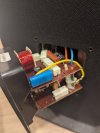
PXL_20241226_215107321.MP.jpg

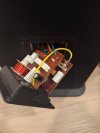
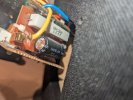
(added a second pic because it looks like someone swapped the blue with the white cap on one of the crossovers? the bottom of the boards look slightly different too despite the close serial numbers, its confusing to me which is why I'm redoing them to match)
 

Attachments

  • PXL_20241226_214326142.MP.jpg
    PXL_20241226_214326142.MP.jpg
    94.1 KB · Views: 8
What's the power supply voltage of the power amp? Assume it can produce that across the speaker. The crossover is a filter so the voltage will be less, but for conservative design it should still support the full PS voltage.
 
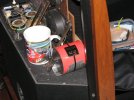
See the two tan resistors just above the coffee cup? That space between them and coil just above them is where the 80µF electrolytic cap was. I made room and added to the leads from the big cap.

You would have to 'creatively' mount the 33 if you went with a film cap. Possibly inside the cabinet with wire coming out to the circuit board. Or get a lytic that fits. In my case the midwoofer signal goes through the 82 so having a film is a bit better. Not like it is just for the woofer which might not benefit from film. Or so I'm told.
 
Don't the crossover caps need to consider peak to peak voltage?

For example the OPs 150W @ 8 ohms amp ends up about 99V peak to peak. So, at least a 100V cap bare minimum?

By rights dictated by the power rating of the speakers though, not of the amplifier.
 
but that peak would be if I cranked things to volumes that would blow out the drivers, no? I never go above 50% volume on these

Was looking at the Nichicon UDB series caps today, they are made for speaker crossovers and only in 50v....but if speakers need 100v minimum, who would use these?


I would rely on the OEM intent, meaning what they were originally, which presumably would be at least somewhat relative to their power handling capacity. I would not go with something less on the presumption of what you or someone else might do, or might forget not to do.
 
Are the caps actually bad? Have you tested the ESR, capacitance, leakage, etc?

the ones in question were over but within tolerance in the end, but other lytic caps measured way out of spec now that I finished the crossover and tested the old stuff

better to just replace everything in one sweep and do it right
 
yeah, volume control position has little relevance to power output, but just making the (wildly inaccurate) assumption that fully clockwise is 100% of rated power, the 50% position would actually represent closer to 10% of the output power because of how volume controls work.

but where the volume control actually lands to make max output depends on how strong the source is and how they designed the thing. Some amps are at full output by the half way point. It was a "thing" to make amps very loud just by cracking the control because it makes them seem more powerful.
 
yeah, volume control position has little relevance to power output, but just making the (wildly inaccurate) assumption that fully clockwise is 100% of rated power, the 50% position would actually represent closer to 10% of the output power because of how volume controls work.

but where the volume control actually lands to make max output depends on how strong the source is and how they designed the thing. Some amps are at full output by the half way point. It was a "thing" to make amps very loud just by cracking the control because it makes them seem more powerful.

even better if that's only 10% power

but if some amps are the opposite, at full output at 12-oclock, how can they go louder without pushing more power?
 
They can't. Thats what I was poorly attempting to explain, the volume control's physical position has almost nothing to do with the actual power output.


Somewhere in the specs is usually buried a sensitivity spec. In aux mode it will say so many volts or millivolts. What that means is with the volume control at full whack, it needs that much signal in to the input to make full power. With a lot of older stuff that might be something like 250mv, 1/4 of a volt. A lot of sources are 1-2 volts, which means the volume control ends up set quite a bit lower with that level of input to make full output. Turning it up beyond full rated output just makes distortion.
 
In practice, the maximum possible peak to peak voltage that an amplifier can send to a loudspeaker is PSU line voltage minus losses. Taking a solid state A/B amp running with power supply rails at =/- 46vdc as an example, your maximum output voltage is 96volts minus power transistor transconduction losses and the loss across the emitter resistors. So the maximum peak to peak voltage in this case is probably going to be something around 92volts. in practice however, the maximum applied voltage is likely to be around 25% of this, unless you are in the habit of driving you amplifier to destruction, so a more realistic figure is probably around 20volts.
 
There is no amplifier destruction that inherently happens from driving to rated output.

The cap voltage really should be based appropriately for the rating of the speaker (100V was OEM as I recall) not a rather idealistic use case of what someone might or might not do with the volume control.
 
Back
Top Bottom