• The move to the new server is done. There are some software and database maintenance updates in process. This has us passing the hat around to help out. We appreciate any donations. Seriously, even a dollar helps. The payment page may be found here - https://www.audiokarma.org/support.html

Vacuum turntable mat

Lexar

Member
Hello,

I got pretty cheaply old Audio Technica AT 666 vacuum mat with a battery pump. It still works pretty ok/well (able to keep pressure more than 30 minutes). I'm just worrying about the weight of it. It weights much more than a normal turntable mat (1,4kg versus 200g - 400g?). Could that harm the motor and/or bearings? I have 4 turntables: Luxman PD 441 with Moerch UP-4 tonearm, Denon DP 59L, Harman Kardon T60, and Luxman PD 277. Could some old bigger belt drive Micro Seiki turntable handle that mat better?
 
Register to hide this ad
Welcome to the forum!

I imagine that will wear things out faster but probably will work. Not trying to be snarky but the question I immediately thought of is: Why is it needed?
 
Welcome to the forum!

I imagine that will wear things out faster but probably will work. Not trying to be snarky but the question I immediately thought of is: Why is it needed?

I do not know was that the correct question either :) ?

* Curiosity?
* Wants to test/try something ''new''?

Micro Seiki made 4 models of Luxman turntables which had that kind of vacuum mat originally (+ few models under their own name). Plus there is a Sofa. The owners of those old Luxman models used to say that their turntables will sound ''different'' as the vacuum is on or off. Hardly so (alone) because of the possible sound of the electric vacuum pump (310, 350, 375? ... 300 had a simple mechanical pump). Better or worse ... yes ... that is another matter.

Ok, many uses the record clamps, or record weights. I know that my H/K really needs one (just to set it up correctly), but I wonder how the same is with most of the cases? Over all, what comes to possible stabilizers ... I see that kind of vacuum mat as a extreme version of the all options. Good or bad, again fully another matter (no idea).
 
Last edited:
The goal of the at666 vacuum platter mat (and other vacuum systems) is mainly to remove warps from records, and it's imho the only system that does this effectively.
Ok, an outer platter ring might also be a good system, but that's also difficult to work with.

My AT666 weighs ~1,5kg btw.

There are 3 things that make the AT666 difficult to work with imho
.
1. the thickness of the platter. it's 9,5mm thick, so you need to have an arm with quite a large VTA range to compensate for that.
Some turntables are designed with a really thick mat, like 4-6mm, but that still leaves a VTA adjustment of up to +6mm which is often more than possible.

2. the length of the platter spindle. A lot of platter center spindles are not high enough to compensate for the extra thickness. My AT666 has a centerspindle extension piece (that you can fit in the center), but also that only works in some cases (the center spindle needs to be really short to use it).
But if you use it on a turntable that was factory fitted with a thick mat, you'll probably be ok.

3. the weight in combination with a subplatter turntable. The extra weight causes a subplatter turntable to sag in a non level way, so if the springs are not adjustable, it's not really suited for subplatter turntables. Heavy record clamps/weights of course have the same issue.

Regarding bearing wear, I wouldn't worry too much. Most turntable bearings/motors are designed to fit an array of turntables and platters, often with very different weights.

Do you have the record press to press down evenly on a record too (to create the vacuum with a really warped record)?
I wonder if that works nice, so if it's worth the efford to make my own.

I bought my AT666 (really cheap) without the accesoiries (except the center spindle piece and a thin rubber mat to lay on the platter), so I also made my own little battery vacuum pump (well, not battery of course but Lipo with USB-C charging..modern times). I even put a little vacuum dial meter in there. It makes slightly better vacuum than the Audio technica spec of the original one.

The vacuum platter system is still used in some systems (very expensive systems I might add). I believe you can get some Sota's with a vacuum system (but then you're already going towards $10k I believe), Techdas has them (starting at $20k) and of course that Continuum Caliburn table that Fremer has, has it too ($150k :oops:)

And of course it's not possible to play with a vacuum platter and not use the vacuum. The record sits higher, is not supported and is wobbeling all over the place (the vacuum seals dont give equal, steady support; they're V seals)


So imho it's only worth it when you have a warped record. Then it's fantastic and one of the only real systems that works (way better than a clamp or centerweight, there is really no comparison), but if your records are straight..it's a bit of a hassle and not suitable for all turntables.
I don't believe the vacuum giving more 'coupling' to the platter or something like that will give a difference that would be audible in a blind test. It would be a nice experiment though.
Warps on the other hand....are sometimes very audible. They can even cause the needle to skip so...
 
Last edited:
The goal of the at666 vacuum platter mat (and other vacuum systems) is mainly to remove warps from records, and it's imho the only system that does this effectively.
Ok, an outer platter ring might also be a good system, but that's also difficult to work with.

My AT666 weighs ~1,5kg btw.

There are 3 things that make the AT666 difficult to work with imho
.
1. the thickness of the platter. it's 9,5mm thick, so you need to have an arm with quite a large VTA range to compensate for that.
Some turntables are designed with a really thick mat, like 4-6mm, but that still leaves a VTA adjustment of up to +6mm which is often more than possible.

2. the length of the platter spindle. A lot of platter center spindles are not high enough to compensate for the extra thickness. My AT666 has a centerspindle extension piece (that you can fit in the center), but also that only works in some cases (the center spindle needs to be really short to use it).
But if you use it on a turntable that was factory fitted with a thick mat, you'll probably be ok.

3. the weight in combination with a subplatter turntable. The extra weight causes a subplatter turntable to sag in a non level way, so if the springs are not adjustable, it's not really suited for subplatter turntables. Heavy record clamps/weights of course have the same issue.

Regarding bearing wear, I wouldn't worry too much. Most turntable bearings/motors are designed to fit an array of turntables and platters, often with very different weights.

Do you have the record press to press down evenly on a record too (to create the vacuum with a really warped record)?
I wonder if that works nice, so if it's worth the efford to make my own.

I bought my AT666 (really cheap) without the accesoiries (except the center spindle piece and a thin rubber mat to lay on the platter), so I also made my own little battery vacuum pump (well, not battery of course but Lipo with USB-C charging..modern times). I even put a little vacuum dial meter in there. It makes slightly better vacuum than the Audio technica spec of the original one.

The vacuum platter system is still used in some systems (very expensive systems I might add). I believe you can get some Sota's with a vacuum system (but then you're already going towards $10k I believe), Techdas has them (starting at $20k) and of course that Continuum Caliburn table that Fremer has, has it too ($150k :oops:)

And of course it's not possible to play with a vacuum platter and not use the vacuum. The record sits higher, is not supported and is wobbeling all over the place (the vacuum seals dont give equal, steady support; they're V seals)


So imho it's only worth it when you have a warped record. Then it's fantastic and one of the only real systems that works (way better than a clamp or centerweight, there is really no comparison), but if your records are straight..it's a bit of a hassle and not suitable for all turntables.
I don't believe the vacuum giving more 'coupling' to the platter or something like that will give a difference that would be audible in a blind test. It would be a nice experiment though.
Warps on the other hand....are sometimes very audible. They can even cause the needle to skip so...

Short answers:

* Nope, I have no record press (yes, I have seen photos of that (or how Luxmans versions of the same looked like). I just have pump and the mat. Is that really necessary? Perhaps one could be done by yourself (DIY)?
* Weight? Right, the silver version. This gold version might weight even a bit more (material)?
* Length of the spindle? About 15mm with both my Luxmans, about 21mm with my Denon DP 59L, And yes, I would not try use it with H/K 60
(springs for suspensions)

PS: There are two new models available:
i-qual IQ1300A
https://www.playstereo.com/en/acces...l-iq1300a-vacuum-disk-mate-4573286911309.html
I think this will be a bit like old Thorens disc vacuum contact stabilizer and/or a bit like Audiotechnica at 666 (at 665 is slightly different). With all, you will first use it and
then you will play the records.

There is also another solution available ... Yukimu cvs-1
https://www.aria-audio.com/products/yukimu-cvs-1
Here the vacuum pump is all the time connected as playing the records and it starts to work every 8 min time (about 30s). I wonder, if the noise (of the pump) can be a issue?

Both are about 900 - 1000euros as new now. Not cheap at all. Based on that, I got mine very cheaply.
 
Last edited:
PS: There are two new models available:
i-qual IQ1300A

There is also another solution available ... Yukimu cvs-1

Both are about 900 - 1000euros as new now. Not cheap at all. Based on that, I got mine very cheaply.
I've seen that IQ1300a indeed on the WWW.
That yukimu is new to me.
€1000 is exactly 20 times as much as I paid for my AT666 (and the materials for the diy pump were maybe €30 or so)

Regarding vacuum pumping while the platter is spinning: We go to great lenghts to make a turntable vibration free and to have a bearing run as smoothly as possible.
If the vacuum system is run through a bearing, first of all the chances of leaks increase, as 2 airtight rotating seals are necessairy, so the old Micro seiki's and luxmans have more chance on that (and that Yukimo too).
2nd: starting and stopping suction gives a pressure wave (especially if it goes through that hose), so that is a big risk in inducing yet more vibrations into the turntable.
Also to create suction without pressurepulses (from a pump), it requires 1 or 2 vacuum tanks, so it quickly becomes cumbersome and expensive. Ideally you want a system with a proportional valve that is very controllable if no vibrations should reach the platter.
Also, a vacuum pump makes noise. Who wants to listen to that while the music plays? Maybe install it in the next room and run the hose over a distance....

If the vacuum can be hold longer than 1 side play takes, I don't really see the point.
There's not that much vacuum needed, the goal is to flatten the record so there is no warp.
Mine also holds vacuum easily longer than 30min. But that might depend on how warped and how many warps the record has. I have no real experience with that.
I also don't use it that much, I have 2 turntables that can fit the AT666 (that have enough VTA adjustment room and not subchassis)

Another issue might be, that if your platter isn't 100% straigth, you can get a little wobble between the vacuum platter and the normal platter.
Of course this shouldn't happen with a quality turntable, but a lot of turntable we play around with are 40+ years old, and a lot can happen in that time. Bent/warped platters happen.
A 0,2mm warp in a platter might not be that noticeable when there's a 4mm rubber mat on it and then a record that,s probably not that consistent in thickness, but if 2 metal plates rest on top of eachother and there's a 0,2mm gap on 1 side, you notice straight away a wobble when pressing from 1 side to the other and you hear that metal tick.
I have such a platter on a ps-x75 biotracer. I don't know if it's a factory defect (quality control issue) or that something happend to it, but I have 2 ps-x75's (one is a parts machine) and one platter is dead straight and one is slightly warped. That platter is odd anyways, its a concave platter (probably also to put a little strain on the edge of the record, also to reduce very small warps), and it's cast. I haven't really looked if the at666 rests on the cast (and unmachined) inner part or on the machined outer part.
But these little niggles can also happen. Not that good if you invest in a €1000 IQ1300a and have to return it (or find a better turntable)

Short answers:

* Nope, I have no record press (yes, I have seen photos of that (or how Luxmans versions of the same looked like). I just have pump and the mat. Is that really necessary? Perhaps one could be done by yourself (DIY)?
I guess whether or not it's useful depends on how warped your record is.
Without the press, there is no suction/vacuum if there is a warp large enough to give a gap at the seals; you have to press the outer edges of the record to close that gap.
I don't have that many warped records (actually only one that I know of...), and I manage to create suction with that record pretty easily, but I have to press with my finger on a few spots on the edges to create the vacuum.
You can see that in the video below (and the record with my largest warp can also be seen). At some point the seals grab and vacuum is pulled.
(in the description of the video a summary on how I build the pump and what materials I used can be found)

But with extreme and multiple warps, I can imagine that press to be really handy. Then again, if you're finished with it, where do you put the thing....(dismantle it again?)
And if you're a bit clumsy...what is the chance you accidentally hit the arm with it when taking it off or putting it on...

That press can be seen in the picture below.
shouldn't be very diffucult to make if you need it (it basically holds the edge of the record down all around so the seals can do its thing).
The design is not that sophisticated; a press that you can fold out real easy would be so much better (like folding out a smalll tripod, or fold the legs out in a rotating way)

u1114263920.1.jpg
 
Last edited:
Bill Firebaugh had a less complex approach, and it's not really about warped records, mating the record to the platter helps reduce resonance in the vinyl itself improving SQ.
 
Last edited:
Bill Firebaugh had a better idea, and it's not really about warped records, mating the record to the platter helps reduce resonance in the vinyl itself improving SQ.
That's often said as an audiophile argument. But I have my doubts if that can actually be heard in a blind abx test.
It's worth doing an experiment on that somewhere in the future, creating a blind test (but it's a hassle, the arm has to be realigned).

But I think the aspect of playing warped records is more important, as I think the sonic effect of a warp is much more audible than the vinyl resonating.

If the sonic effect of reducing resonance is really significant, then it's strange that there are very few turntables out there with vacuumplatters.
 
For those without and doubt it reads as such, those that have know.

I have thousands of records and none are warped.
 
to try and answer OP's question:

adding weight will add some extra stress to the vertical bearing. Most tables have a fairly small contact patch on the bearing for noise reasons. Specifics vary but its generally a point contacting a flat part, whatever form that takes. Some spindles have the point ground in and it runs on a flat thrust plate, some use a ball between two flat surfaces, doesn't really matter for this purpose.

anyway, its just a weight and contact area equation. The number of square inches of contact is what it is, the variable is how many pounds are sitting on those number of square inches. If its all well designed, you're dealing with hardened surfaces that have a lubricant film on them to keep things from actually being metal on metal. Adding weight could push the lube film out and cause extra wear, especially if the oil level is low or its too thin. Would be worth making sure the oil down in the bearing well is at the right level and of the correct type. Even big chunkers like broadcast tables with their heavy platters have a pretty small contact patch and end up with a high PSI figure because of it. Those will go for a very long time so long as the bearing wells are kept oiled.


Record changers are different, many of them use a multi-ball thrust bearing design. Same basic theory applies there but you're talking a half dozen contact points so the load is distributed.
 
In my
to try and answer OP's question:

adding weight will add some extra stress to the vertical bearing. Most tables have a fairly small contact patch on the bearing for noise reasons. Specifics vary but its generally a point contacting a flat part, whatever form that takes. Some spindles have the point ground in and it runs on a flat thrust plate, some use a ball between two flat surfaces, doesn't really matter for this purpose.

anyway, its just a weight and contact area equation. The number of square inches of contact is what it is, the variable is how many pounds are sitting on those number of square inches. If its all well designed, you're dealing with hardened surfaces that have a lubricant film on them to keep things from actually being metal on metal. Adding weight could push the lube film out and cause extra wear, especially if the oil level is low or its too thin. Would be worth making sure the oil down in the bearing well is at the right level and of the correct type. Even big chunkers like broadcast tables with their heavy platters have a pretty small contact patch and end up with a high PSI figure because of it. Those will go for a very long time so long as the bearing wells are kept oiled.


Record changers are different, many of them use a multi-ball thrust bearing design. Same basic theory applies there but you're talking a half dozen contact points so the load is distributed.
In my understanding, (my) Luxman PD 441 (and its bigger brother 2 tonearms version PD 444) are bit unique cases?

https://www.vinylengine.com/library/luxman/pd-441.shtml
''With the new load free spindle system, the motor itself has the repelling power to float the turntable platter, which makes it possible to reduce the platters weight on the bearing to about 1/5 of its actual value.''

http://www.thevintageknob.org/luxman-PD444.html
''Center of the spinning is the Load-Free Spindle structure : by opposing two magnets inside the motor structure, the actual load applied to the bearing is lifted to a fifth of its normal value. The motor's name is MDS152C (or MDS-102C [mkI or mkII]).''

How you will see that extra weight now? I mean I would first like to use it with that turntable (PD 441), but if that is too risky, then put it on Denon DP 59l.
 
Sounds like its not fully levitated but about 80% of the platter weight is carried by magnetic force.

Still, adding weight to the platter will increase the total load on the bearing. The repelling force is whatever it is, but since the platter weighs more with the vac mat on top than it would have originally, its going to put more load on the vertical bearing than it had originally.

its probably not a big deal either way, but making sure the bearing is in good shape and properly lubed is a good idea anyway. Most of this stuff is pretty elderly at this point and oil can oxidize or leak out.
 
New ones:

i-qual 1300

Yukimu CVS-1


Old ones:

Audio Technica at 665

Audio Technica at 666

Thorens Disc Vacuum stabilizer:

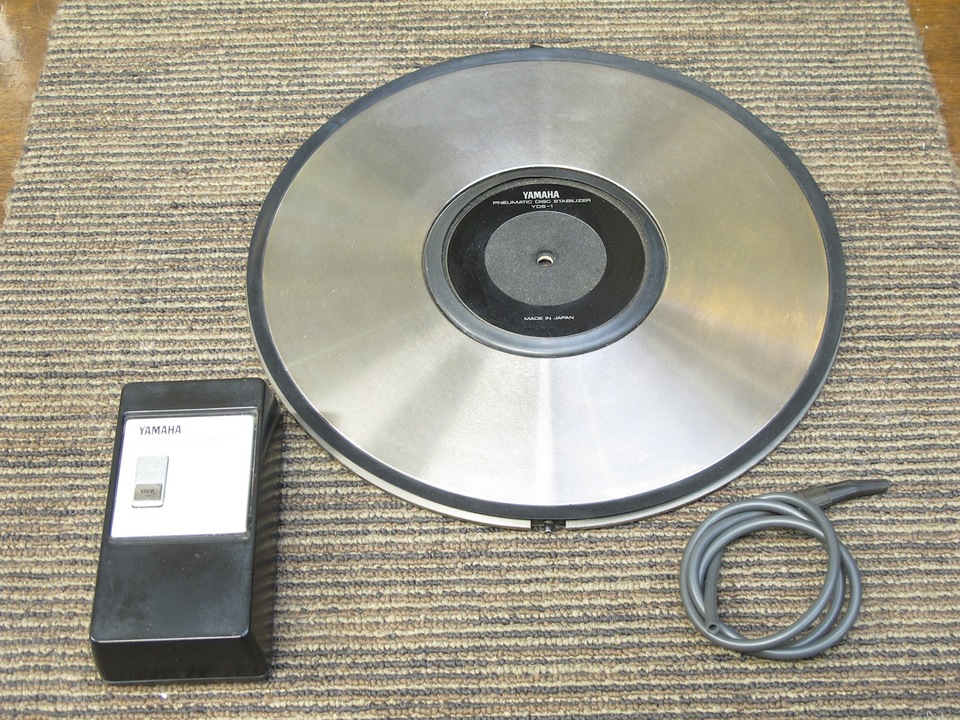
Yamaha YDS-1 disc stabilizer
a.jpg

Looks very similar as Audio Technica at 666

Mine is AT 666 gold (it is heavier than the original one and rumors says it is made from gunmetal or AT's Technihard material).
images
 
Mine is AT 666 gold (it is heavier than the original one and rumors says it is made from gunmetal or AT's Technihard material).
images
How heavy is your version? Gold looks pretty nice.
Do you have the manual? if so, is it possible to scan and upload to the library here or to vinylengine's library.
I don't have a manual.
I obviously know how it works, but it would be nice to see what's in the actual manual. Somewhere I've read (I think on the vintageknob) that the manual from the version with manual pump is 6 pages and the one with motorized pump is only 2 pages (or something like that). That's quite perculiar I think.

That video of the Yukimu CVS-1 is very interesting. The pump sounds quiet, but the first thing I'd do is put a stethoscope against that coupler on the turntable and listen.
My guess is that you'll hear a lot.
 
Last edited:
How heavy is your version? Gold looks pretty nice.
Do you have the manual? if so, is it possible to scan and upload to the library here or to vinylengine's library.
I don't have a manual.
I obviously know how it works, but it would be nice to see what's in the actual manual. Somewhere I've read (I think on the vintageknob) that the manual from the version with manual pump is 6 pages and the one with motorized pump is only 2 pages (or something like that). That's quite perculiar I think.

That video of the Yukimu CVS-1 is very interesting. The pump sounds quiet, but the first thing I'd do is put a stethoscope against that coupler on the turntable and listen.
My guess is that you'll hear a lot.

Thanks. The Gold version weighs 1,8kg, the thichness is about the same 9,5mm? Sorry, I do not have a manual.

Yukimu CVS-1? The hose is said to be 1,5m in length (´how about putting the pump into a soundproof locker/box?)
 
Yukimu CVS-1? The hose is said to be 1,5m in length (´how about putting the pump into a soundproof locker/box?)
I think the biggest potential problem is that sound/vibrations are travelling through the hose into the platter.
That's why I'd first put a stethoscope on that coupler at the platter and listen.
A bit inspired by this video about Jochen&Dirk Räke (transrotor) :biggrin:
 
Last edited:
Still one old one to add: Phonogen Disc-Contact Vinyl Suction Device Vacuum Plate.

This one looks pretty similar as Thorens bit earlier in this thread.

Phonogen 1.jpgPhonogen 2.jpg
 
Do you have the record press to press down evenly on a record too (to create the vacuum with a really warped record)?
I wonder if that works nice, so if it's worth the efford to make my own.


Good news. I contacted the seller (that gold version of TA 666) and asked about the record press (I linked a photo of it).
He said that he actually has that somewhere (it was not shown in the sales photos). And he found it => he will add that to the parcel.

It is always sense to check/ask :). Sometimes something positive can really follow via that.
 
Back
Top Bottom