• The move to the new server is done. There are some software and database maintenance updates in process. This has us passing the hat around to help out. We appreciate any donations. Seriously, even a dollar helps. The payment page may be found here - https://www.audiokarma.org/support.html

VCR modification to sound like R2R

There was a short time period, in between regular mono VCRs and VHS HiFi, when you could buy a stereo VCR that used the edge track, split into two channels. Still very lo-fi (depending on speed), but stereo nonetheless. When VHS HiFi came out, there were a few decks that recorded both ways in stereo - I owned one. It was a Panasonic, and even had level controls for the audio. Once HiFi was established, manufacturers stopped including the linear stereo option.

I own one prerecorded VHS - Concert For Bangla Desh. It's linear stereo, non-HiFi....and of course I can't listen to it in stereo anymore.:tears:
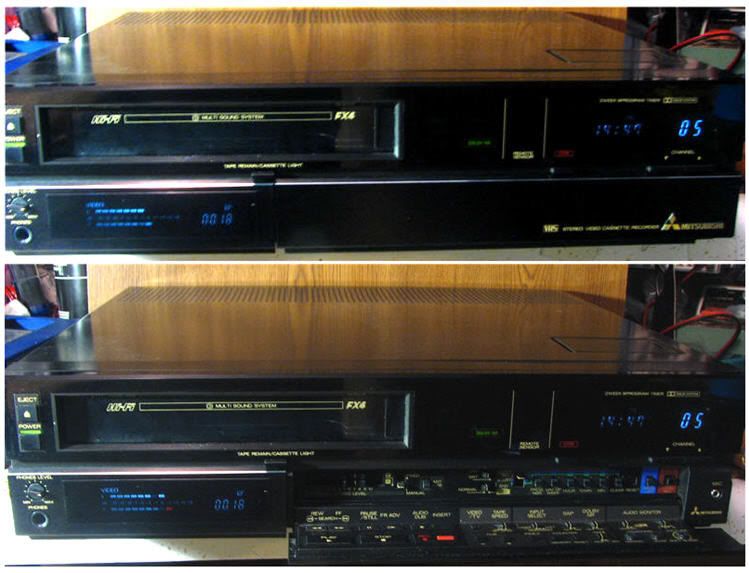
I still have my Mitsubishi HR-430U that has both linear with Dolby and Hi-Fi, keep it because I have a bunch of old recordings made during 1982-1985 with a linear stereo only Panasonic PV-1780 off of Warner-Amex cable that sent the stereo for The Movie Channel and MTV over FM signals received with an FM tuner (Scott LT-112B at the time), and recorded "simulcast". Those were the days!


mit-hs430u-2.jpg
 
I have Philips VR6860, which is the only machine I know of that can record hi-fi-audio and video separately. It can do the usual trick of over-dubbing the linear audio, but it can also dub new video on top of existing hi-fi audio.
 
I remember years ago; when I was in high school; I used to use my standard VHS machine to record Howard Stern...mostly because I could hook a tuner up to it; leave it on and let the timer go.

Before that; I did dabble with HiFi. Consmer Reports recommended HiFi for audio use if you needed 6 hours on a tape. And to be quite honest; it doesn't sound too bad. However; it is plauged by a problem...head switching.

My understanding is that the video heads jump between audio and video duty; since the audio is recorded "under" the video. If you play the tape on the same unit that recorded it; most of the time...you were fine.

Pop that tape in another HiFi machine and you get the same problem I always had with pre-recorded movies; ticking. You'd get this audible ticking in the audio; which I've always understood was due to the rapid switching of head mode.

I used to record hours of Music Choice to tape when I first got satellite; mostly fr dubbing to minidisc later. When I upgraded from my JVC 4-head HiFi to a Panasonic 6-head unit...all my MusicChoice tapes started having this ticking noise.

I recently saw an old dual-mode HiFi and Linear Stereo VCR; I may have to pick it up to see how bad linear stereo tracks sound.

Sent from my SPH-M910 using Tapatalk 2
 
Back in the day (when Beta was Betta) I used Beta tapes for music only. I did have a very high end machine. Possibly others did not do that. It was exceptional and used the entire width of the tape. Later VHS HI-FI offered something similar. Either way the tapes were just too big to lug around and could only be used at my house so I stopped.
 
However; it is plauged by a problem...head switching.

My understanding is that the video heads jump between audio and video duty; since the audio is recorded "under" the video. If you play the tape on the same unit that recorded it; most of the time...you were fine.

Pop that tape in another HiFi machine and you get the same problem I always had with pre-recorded movies; ticking. You'd get this audible ticking in the audio; which I've always understood was due to the rapid switching of head mode.

There is no sharing of duty for the heads - except in NTSC Beta-HiFi.
VHS Hifi machines have two video heads, and two audio heads. The reason there are two heads for each is the simplified loading. The tape can only wrap 180-degrees around the head drum. To get a continuous recording, two heads are required that switch on and off alternately. C-format reel-to-reel recorders do a nearly 360-degree wrap of tape around the head drum so do not need to double up on head count. (*)

With the half-wrap of tape around the drum, there is an instant where the heads change over (both the audio heads and video heads). If this is not perfectly aligned time-wise with the physical condition of the head leaving the surface of the tape, you get a momentary loss of signal, 25 or 30 times a second, with the consequent buzzing. With video it doesn't matter, since it can be timed to coincide with the vertical blanking period, when no video needs to be recorded anyway.

Having two heads in use alternately allows another trick called azimuthal recording: the diametrically opposite heads can have a different gap azimuth. This allows the two adjacent tracks written diagonally onto the tape to be so close as to even overlap slightly, leading to very efficient use of tape, and making 'LP' and 'SLP' modes workable.

NTSC Beta specifications have relatively widely spaced luminance and chrominance subcarrier sideband frequencies. There is enough space between them to put in the two audio FM carriers, and record Hifi audio with the video heads. All 4 carriers (luma, chroma, left , right) are recorded by only two heads - but the carriers are recorded simultaneously, there is no switching or cycling of function.
PAL Beta, and all VHS flavours have closely spaced luma and chroma carrier sidebands, so an additional pair of heads is required to make a depth-multiplexed recording, where the audio is deep, and the video overwrites it, only erasing to topmost layer of video signals. The audio heads read 'through' the video recording on playback.

Machines that claim 4 video heads do so because they need 2 extra heads for noise-free long-play, or noise-free still-frame. They still only use 2 video heads during a normal recording.

(*) VHS-C does a real piece of magic: The head drum is physically smaller (42mm) than the standard VHS drum (62mm), and the wrap angle is 270 degrees. Using 4 video heads and 4 audio heads, and a head drum speed 1.5x faster than normal VHS, it can make a recording that is physically identical to a standard VHS recording, including the hi-fi audio.

 
Last edited:
Back
Top Bottom