


MCM_Fan
AK Subscriber
From the files of: "You Can Never Have Too Many Speakers"...
These followed me home this afternoon:
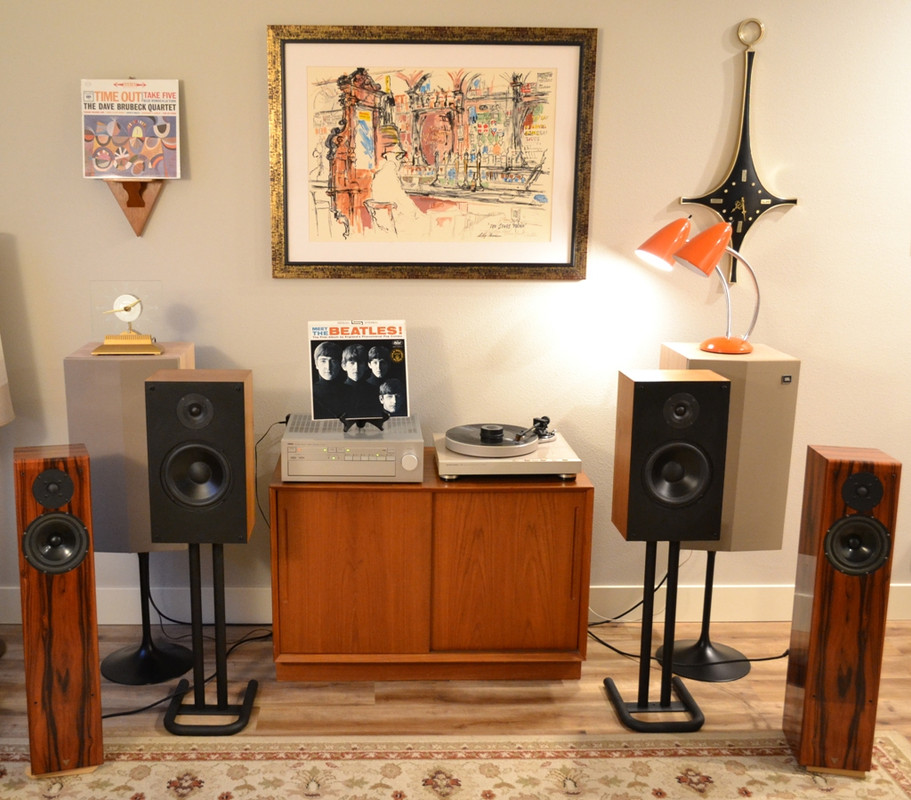
Vienna Acoustics Bachs (the originals, not the Bach Grands) in rosewood.
I noticed when I picked them up that they had a round hole in the bottom and were threaded for spikes, which were not present. I originally assumed the hole was a down firing port and the spikes were required to get them up off the floor to allow the port to do its job.
After reading up on these speakers, I learned that the hole is the entrance to a chamber in the bottom of the speakers that is supposed to be filled with dry play sand - the same stuff I normally use for filling speaker stands. Each speaker is supposed to hold 20 pounds of sand to act as ballast and tighten up the bass. I'm missing the covers for the holes, but I'm sure I can rig something up.
Also, during my research I learned about the recommended placement for these speakers (8 - 10 feet apart, far out from the rear wall, toed in slightly and tipped back. The spikes are supposed to be used for tipping them back. Since I don't have the spikes, I just put a small small scrap piece of wood under the front of each speaker (visible in the photo) to tip them back. They are spaced 8 feet apart and 2.5 feet from the rear wall. That's about the best I can do in my small listening space, but they actually sound great. They are a warm, full sounding speaker, with amazing imaging and a surprising amount of bass given the single 7" midbass driver. It will be interesting to hear if 20 pounds of sand in the bottom of each will make an audible difference in the bass. Only one way to find out.
They may also be the least fatiguing speakers I have ever owned. I have some fairly bad tinnitus that is aggravated by overly bright speakers. I don't usually notice it while listening, but it can really kick in after a listening session and certain speakers tend to really aggravate it. These, thankfully, do not. Not in the least.
So, back to the spikes. In the photos I've seen online, they look quite tall, much taller than most spikes I've seen. Can any of you Vienna Acoustics owners let me know how tall the body of the spikes is, as well as the length of the threaded shaft? Since I don't have the originals, I'd like to get something as close as possible.
Although they look great in the photo, the sides have some pretty deep scratches in the finish. It's a very thick, hard, glossy finish, I'm guessing several coats of some type of spray on polyurethane. It's thick enough that it looks like it did a good job protecting the veneer, but they definitely need to be refinished to look their best. Normally, I do my own refinishing, but given the value of these speakers, the quality of the rosewood veneer and the type of original finish, I think I may hand the cabinets over to a professional in this case. Any recommendations for someone in the Portland, or even Seattle area that does good work at a reasonable price?
These followed me home this afternoon:
Vienna Acoustics Bachs (the originals, not the Bach Grands) in rosewood.
I noticed when I picked them up that they had a round hole in the bottom and were threaded for spikes, which were not present. I originally assumed the hole was a down firing port and the spikes were required to get them up off the floor to allow the port to do its job.
After reading up on these speakers, I learned that the hole is the entrance to a chamber in the bottom of the speakers that is supposed to be filled with dry play sand - the same stuff I normally use for filling speaker stands. Each speaker is supposed to hold 20 pounds of sand to act as ballast and tighten up the bass. I'm missing the covers for the holes, but I'm sure I can rig something up.
Also, during my research I learned about the recommended placement for these speakers (8 - 10 feet apart, far out from the rear wall, toed in slightly and tipped back. The spikes are supposed to be used for tipping them back. Since I don't have the spikes, I just put a small small scrap piece of wood under the front of each speaker (visible in the photo) to tip them back. They are spaced 8 feet apart and 2.5 feet from the rear wall. That's about the best I can do in my small listening space, but they actually sound great. They are a warm, full sounding speaker, with amazing imaging and a surprising amount of bass given the single 7" midbass driver. It will be interesting to hear if 20 pounds of sand in the bottom of each will make an audible difference in the bass. Only one way to find out.
They may also be the least fatiguing speakers I have ever owned. I have some fairly bad tinnitus that is aggravated by overly bright speakers. I don't usually notice it while listening, but it can really kick in after a listening session and certain speakers tend to really aggravate it. These, thankfully, do not. Not in the least.
So, back to the spikes. In the photos I've seen online, they look quite tall, much taller than most spikes I've seen. Can any of you Vienna Acoustics owners let me know how tall the body of the spikes is, as well as the length of the threaded shaft? Since I don't have the originals, I'd like to get something as close as possible.
Although they look great in the photo, the sides have some pretty deep scratches in the finish. It's a very thick, hard, glossy finish, I'm guessing several coats of some type of spray on polyurethane. It's thick enough that it looks like it did a good job protecting the veneer, but they definitely need to be refinished to look their best. Normally, I do my own refinishing, but given the value of these speakers, the quality of the rosewood veneer and the type of original finish, I think I may hand the cabinets over to a professional in this case. Any recommendations for someone in the Portland, or even Seattle area that does good work at a reasonable price?


