• The move to the new server is done. There are some software and database maintenance updates in process. This has us passing the hat around to help out. We appreciate any donations. Seriously, even a dollar helps. The payment page may be found here - https://www.audiokarma.org/support.html

Vintage Newbie - Static / crackle left channel only

Vintage74

New Member
The Amp

I just purchased my first ever vintage amp off eBay (Yamaha CA-610 II). The seller said the pots and switches were cleaned and the unit looks in great shape.

I tested it with an iPod in the AUX input and it sounds AMAZING! Even at 100% volume it's very clean with zero distortion. I'm impressed!

I then unplugged the iPod so there was no input source at all and turned all the pots and flipped all the switches and found:

The Issue

A very slight static / crackle only in the left channel when adjusting the volume knob.

A very noticeable static / crackle only in the left channel when I turn the REC OUT selector switch (even just a touch or wiggle of the switch causes the crackle).

I tested both the A & B speaker outputs and I switched the speakers and wires to eliminate that as a possible issue.

All other pots and switches there is not even a hint of static / crackle in either channel.

The Questions

Why is the static / crackle only in the left channel?

If the issue is in the REC OUT selector switch why only in the left channel?

Is "more DeOxit" worth a try even if it's been done recently?

If I cannot find and fix the issue can I just disconnect the REC OUT selector so even if it's touched or turned there is no static (would disconnecting it cause any other issues)?

Conclusion

I'm excited to get into vintage audio and any suggestions or info on how to fix this left channel issue would be appreciated!

Thank you,

Mark
 
Last edited:
Register to hide this ad
Why would you run anything "vintage" at 100%? You need to measure the DC output, maybe deoxit the controls again.
 
I’d give it a go with more cleaning just to see if it would help. If you didn’t see what was done prior you never really know how well or not so well it was done. I’ve had controls that took huge amounts to finally get working properly.
 
Hi,

Thank you for the replies. I'll try cleaning again and see if any luck!

Follow up questions

Is it normal for a dirty pots or switches to only be scratchy in one channel? I had thought it would be scratchy in both channels. The right channel is quiet on all pots and switches.

When I measure the DC output what am I looking for?

Side note

Not that I'd be listening at 100% volume (I just wanted to see if there was any distortion) but is there a safe volume limit for vintage amps? I always thought high volume could be bad for speakers if it caused distortion but not the amp. Does it over heat if ran at too high of a volume?
 
Welcome!

I’ve had some success getting rid of minor oxidation just working the controls through the full range of motion and pushing the buttons 20 times each - with the power off of course. Regular use helps too so enjoy that Yamaha often! Before deoxit, or more deoxit, I’d give that a whirl.

Deoxit is great stuff and you may very well need to hit it again. If you do, I’d suggest using as little as possible. If you get the kind with lots of solvents (D5) you can potentially ruin the feel of some potentiometers by washing out the damping grease.
 
Hi,

Ahh... I'll try that first before the DeOxit.

I did pick up a can of the D5 and a squeeze tube of the Gold after reading the "idiots guide to DeOxit" here on AK.

Will squeezing in the Gold after the D5 help relubricate the damping grease?

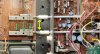
I opened up the amp and found the REC OUT switch in the rear of the amp connected to the dial by a long shaft.

So just spray it in all of the holes on the switch (see green arrows on attached image) or just in the front part closest to the were the shaft attaches to the switch?

I also noticed there is a plastic cover on the shaft that seems to be out of place if you compare it to the input selector switch above it (see yellow arrows in attached pic).

Should I try to push that back into place so it matches the other switch shaft? Any chance that has anything to do with the static / crackle in the left channel?

Mark
ca-610-rec-out.jpg
 
Last edited:
Yes pray cleaner into the holes liberally and work the selector about 50-100 times. Yes 50 - 100 times!!! You really need to clean the contacts for both channels that are inside the switch.


Yeah push that connector sleeve back onto the switch knob.

let us know how it goes.

Nashou
 
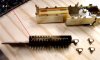
Spraying deoxit etc into the top holes is a "waste" of time, see pic from @avionic link.
The 4 slider contacts sit in a plastic housing which are a barrier to the deoxit. You could
try sparying deoxit at the extreme end, parallel to the circuit board, you might get lucky.
Best approach is to dismantle and clean as per pix, use care, the sliders are fragile and
may bend out of shape. Suggest also dismantle the input selector. Post some pix of the
switch. The pic below is without doubt the dirtiest I've seen.

One channel affected more than the other due to one slider etc... has excessive build up.
Dirty_Switch.JPG
 
I finally got my Yamaha CA-610 II all cleaned up, tested and put back together. Powered her up and sounds amazingly clean!

Big thank you to Avionic for all his advice and help testing the unit!

The REC OUT switch still has a little static but it's much better than before and since I'll never really need to touch it should be all ok.

I tested the DC offset and got:

Left Channel: 5.5 mV
Right Channel: 7.1 mV

Nice and low offset but is it ok / normal for the readings to be different in each channel?

I also noticed a "hiss" when on the Phono input that increases with volume. Pretty noticeable amount.

I do not have the ground terminal on the back of the amp hooked up to anything would that help reduce the hiss or is that normal for the Phono input?
 
Last edited:
If the power plug for the unit is two prongs, then you want to ground the unit to an outlet.

As for why one channel is affected, inside the pot for the volume control there are two wipers and each has its own resistance board. Depending how you orientate the unit, and the angle you spray Deoxit into the pot, will be a factor in which side gets more Deoxit.
 
Back
Top Bottom