• The move to the new server is done. There are some software and database maintenance updates in process. This has us passing the hat around to help out. We appreciate any donations. Seriously, even a dollar helps. The payment page may be found here - https://www.audiokarma.org/support.html

Vintage Sony TTS 3000 - 45 Spinning too fast ! Help me diagnose the problem...

patslice

Patrick
Hello!

I'm helping a friend repairing his beautiful vintage Sony servo TTS-3000.

The problem is only on the 45rpm side: it spins way too fast, at around 75rpm.
33 is working perfectly.

Under the unit there's a screw to adjust the speed of both 33 and 45. The 33 allows some small adjustments in the +-1rpm range (as it should) while the 45 is clearly problematic and varies the speed (pretty randomly and not proportionally to the screw turning) from 10 to 80rpms, sometimes stopping the motor completely.

I opened up the servo circuit but visually it seems pretty fine :
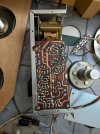
1000062770.jpg

In red you can see the 45' adjustment screw:
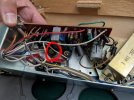
1000062775.jpg

My knowledge in circuits is limited to seeing a cold solder or a blown fuse/cap... Not much more !

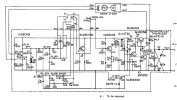
Here is the service manual :

Can you help me diagnose the problem ?
I do have a multimeter if needed and a soldering iron, and I can find some components if they need replacement.
 
Register to hide this ad
Since the speed is working correctly on the 33 rpm setting, everything common to both speeds is working well enough. (This includes the power supply, motor, servo amp, the electrolytic capacitors, etc. Since the speed for the 45 side is so flaky, it sounds to me like it's the variable resistor itself, like the wiper is making poor intermittent contact with the carbon strip. This could have been due to being poked too hard with a screwdriver at some point in it's history, or just a dirty pot. You can start by spritzing the pot with a little cleaner (de-oxit, elecronics cleaner, or just a little alcohol in a pinch will do) and work it a bit, and see if it settles down. If it does not, the trimmer will need to be replaced with another 5K B (linear) taper. Do your best to find one similar, or you may need to use a different style, or mount it in a different place, etc.

Long term you will also want to replace the electrolytic capacitors too.
 
If i read the manual correctly, the 33 and 45 speed switch is a micro switch assembly. I would think this would be your primary suspect, as any open in the servo system will cause the speed to run away, and that is first place to look. You may be able to clean the switches, but I never had good luck with this.
 
Wparks is on the right track. Look for a bad resistor in that circuit if the vr clean doesn't work. It could just be a failed vr. You could also poke around with a wood skewer in 45 to find a loose component that might need resoldering.
 
Since the speed is working correctly on the 33 rpm setting, everything common to both speeds is working well enough. (This includes the power supply, motor, servo amp, the electrolytic capacitors, etc. Since the speed for the 45 side is so flaky, it sounds to me like it's the variable resistor itself, like the wiper is making poor intermittent contact with the carbon strip. This could have been due to being poked too hard with a screwdriver at some point in it's history, or just a dirty pot. You can start by spritzing the pot with a little cleaner (de-oxit, elecronics cleaner, or just a little alcohol in a pinch will do) and work it a bit, and see if it settles down. If it does not, the trimmer will need to be replaced with another 5K B (linear) taper. Do your best to find one similar, or you may need to use a different style, or mount it in a different place, etc.

Long term you will also want to replace the electrolytic capacitors too.
Thank you very much !

I'll try to clean the pot and check the components, I'll let you know !
And maybe it's a dumb question but : Can I replace the pot with an equivalent "fixed value" resistor ? If with a good match the 45 runs well I don't think I'll need to fine-tune it in the future.
 
And maybe it's a dumb question but : Can I replace the pot with an equivalent "fixed value" resistor ? If with a good match the 45 runs well I don't think I'll need to fine-tune it in the future.

That's a big "maybe" but actually unlikely. Resistors don't come in an infinite number of values and the desired amount might be between ohm ratings available. Sure it might be close enough but why settle for that?
 
Yeah- for the bother of selecting and installing (it would require two) fixed resistors that gave anywhere near the correct speed, virtually any 5K pot could be put in it's place, even if not the same type for the same or less trouble. Even a regular pot could have wires attached and glued to the side of the box and that would work fine. I'm sure a good search of ebay or the like will turn up something usable.
 
Thanks for the valuable feedback!
I have some updates :

I took the time to measure the values of the two pots (33 and 45), I wanted to try "in circuit" measurements, not to necessary have an accurate reading but to compare the two since we established that the 33 one is fine.

The readings are definitely different but I don't know if they're comparable since they're in circuit. I am not that good at reading the diagram to evaluate if the values should be comparable.

I guess the next step is to unsolder the pot and measure it correctly, and eventually replace it !

I'll keep you updated and thanks again !
 
First, clean the pot first with alcohol or electronics cleaner spray, that might just clear it up. (Also clean the 33/45 speed switch, as was suggested by another user- that could be the problem as well.)

If that all fails, yes- remove the pot, and measure the resistance from the center pin to one of the side pins while moving the pot back and forth and see if it ever loses continuity or gives flaky measurement. If it does not, if it behaves correctly, it could possibly be elsewhere but much less likely.
 
First, clean the pot first with alcohol or electronics cleaner spray, that might just clear it up. (Also clean the 33/45 speed switch, as was suggested by another user- that could be the problem as well.)

If that all fails, yes- remove the pot, and measure the resistance from the center pin to one of the side pins while moving the pot back and forth and see if it ever loses continuity or gives flaky measurement. If it does not, if it behaves correctly, it could possibly be elsewhere but much less likely.
I cleaned it with WD-40 contact cleaner as well as the rest of the circuit, it doesn't seem to make a difference sadly.

Do you think that this model should fit ?
 
Keep in mind that because the spacing between the outer two pins is likely narrower than for the original device, with the center pin in the proper hole, you will have to solder on a bit of solid copper wire to extend the pins sideways to fit in the original holes which appear to be farther apart. If this is difficult, the pot you showed first could be used, but it would also have to be modified to fit in the holes, or better, longer wires added so you can glue the back of the pot to the outer side of the box.
 
I cleaned it with WD-40 contact cleaner as well as the rest of the circuit, it doesn't seem to make a difference sadly.

WD40 is not a good contact cleaner. Long term use in carbon track pots shall have detrimental effect. Use a proper contact cleaner like de-oxit as suggested previously by another member.

Regards,
 
WD40 is not a good contact cleaner. Long term use in carbon track pots shall have detrimental effect. Use a proper contact cleaner like de-oxit as suggested previously by another member.

Regards,

The company WD-40 has a contact cleaner product that is different from the original WD that we know. I haven't used it yet but it might be fine. Personally I usually use MG Chemicals branded cleaners.
 
Thanks for your help!

I used a WD-40 especially made for cleaning contacts, it works very well.

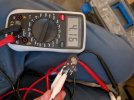
So I unsoldered the Pot, and measured it's resistance, it goes from 0.00 to around 4.16K as you can see here :
The screw moved pretty freely and the numbers changed gradually, I could stop on the 1.00 and 2.00,.. pretty precisely and without big jumps... Is it faulty at 4.16? Should it go all the way to 5k ?
1000063127.jpg

By the way when I disassembled it I saw that the screw on the "user" side had some wax-like material on it as you can see here, same for the 33 pot : do you know why ?

1000063125.jpg

So, have we found the guilty piece ?
Thanks again !
 
Sounds like the trimmer might be OK. Was the solder joints on it in good condition or were they cracked?

You can divide and conquer by swapping trimmers (they are the same) and making sure the 33 side still adjusts properly. I still have not heard did you spray and clean the speed change switch? It could have a flaky/corroded contact on the 45 side. I'm guessing the speed was set at the factory, and a dab of wax applied to lock the setting so it did not drift in shipping. If the speed is still flaky, be sure to check all of the solder joints to make sure none are cracked.
 
Sounds like the trimmer might be OK. Was the solder joints on it in good condition or were they cracked?

You can divide and conquer by swapping trimmers (they are the same) and making sure the 33 side still adjusts properly. I still have not heard did you spray and clean the speed change switch? It could have a flaky/corroded contact on the 45 side. I'm guessing the speed was set at the factory, and a dab of wax applied to lock the setting so it did not drift in shipping. If the speed is still flaky, be sure to check all of the solder joints to make sure none are cracked.
Yes I cleaned the speed switch which looks like this :

1000063208.jpg

You can see in red the 45 side, all contacts seem clean and solid but I wouldn't know how to test if this "component" works properly. Does it just give a binary Go/Stop signal to the servo ?

I will try to swap the 33 and 45 pots later, I'll keep you updated! Thanks again
 
Sounds like the trimmer might be OK. Was the solder joints on it in good condition or were they cracked?

You can divide and conquer by swapping trimmers (they are the same) and making sure the 33 side still adjusts properly. I still have not heard did you spray and clean the speed change switch? It could have a flaky/corroded contact on the 45 side. I'm guessing the speed was set at the factory, and a dab of wax applied to lock the setting so it did not drift in shipping. If the speed is still flaky, be sure to check all of the solder joints to make sure none are cracked.

So I unsoldered the other pot, the one on the 33 side that is working properly, and measured it :

1000063217.jpg

This one goes smoothly up to 5.24
Can they both be "fine" and measure 4.16 (45) and 5.24 (33) ?
 
Ok so I swapped the two pots, and the problem is still on the 45 side ! The 33 runs fine and 45 goes from ~35 to ~80rpm randomly
So the pots are both fine and the problem is somewhere else on the 45 circuit...

I don't know if it can be useful for troubleshooting but I noticed that the 45 speed changes when I stop and start the motor. Let's say that it's spinning at ~40rpm, if I go to the stop position and then to the 45 position again it comes back on at maybe 80rpm...
Then by turning the 45 pot I can maybe bring it back to around 40rpm and the cycle continues if I turn it off and on.

And turning the pot seems to impact the speed pretty randomly, sometimes turning it 90° doesn't change the speed and sometimes turning it 5° can change the speed by +-20rpm...
 
At this point it seems most likely the switches, especially since it happens when turning it on and off, which activates these switches. Almost everything except for the trimmers and the switches is common between the speed that behaves, and the speed that doesn't, except for some very small value ceramic caps and resistors that are far less likely to fail than electrolytic caps, switches, and trimmers. Both S1 and S2 work together to select the speed and both have to work.

Microswitches like those are notorious for breaking or corroding internally- I have replaced at least a dozen in a few short years when I worked on appliances like microwaves. Inside that switch there is one terminal that is the center contact that moves back and forth to connect to one contact and terminal when the button is being pushed, and the other contact and terminal when the button is not being pushed. You could have corrosion or dirt on either of these two contacts in either switch. For a given speed, one switch is closed in the activated position, the other switch is closed in the non-actuated position.

The switch is binary- either constant and solid 0 ohms shorted continuity, or open- there should be no resistance and no flaky intermittent connection. For the 45 speed to work, both switches have to work, so it could be in either of the two- you will have to spray both, and hit the third switch while you are there.

If you can figure out with your continuity meter which two contacts on each switch are supposed to be open or closed when 45 is selected, you can manually short together those two terminals of each switch with an alligator clip or your meter probe, to make a solid contact and see if the problem settles down.


Sony_TTS3000_schematic.jpg
 
Back
Top Bottom