• The move to the new server is done. There are some software and database maintenance updates in process. This has us passing the hat around to help out. We appreciate any donations. Seriously, even a dollar helps. The payment page may be found here - https://www.audiokarma.org/support.html

Vinyl officially outsold CDs (units shipped) in 2021...

I like coffee.
I spend 5 to 10 minutes in the morning, making two, double espresso shots.
When I first wake, I put the vintage Italian coffee machine on. (The one that I strip down & clean, twice a year)
After 10 minutes, it's up to temperature, and so I can weigh 19g of beans.
These are then ground and the resulting powder is pressed down by a force of approximately 10kg/m2.
Then the hot water filters through the 'wall' of compressed coffee powder, and after +/- 25 seconds, I achieve a double shot (30ml).

Every morning I do this twice.
Every time I make one for guests, the remark how lovely it is.
But after explaining that it's only 5 to 10 minutes, every morning, they say they don't have time for that!
Instead, they use those capsules or pads, used in conjunction with that plastic machine that probably has the life expectancy of less than a year.
(My coffee machine is already 50 years old)


I just love the 'theater' of it. And the delicious taste!
It's the same with putting vinyl on. I just love the theater.
Guests also love to visit my 'man-cave' and enjoy some vinyl, whilst drinking a glass of wine.

Again, when I go into what's required, 'behind the scenes', they all think I'm crazy!

I know there are coffee machines that, at the touch of a button, deliver a cup of coffee.

I know I can stream from my phone or computer, having literally a million tracks at my disposal through spotify.

But I like the theater of it.

So when the perennial debate comes around again, I agree that in 2022, streaming is the obvious, mainstream way to go.

In this throw away, get everything delivered yesterday world we live in, I like stepping off of the merry-go-round.
 
There are many good reasons why no recordings made today use the ancient 44/16 standard.
I already explained the reasons why recording studios use higher bit depths and sampling rates. But as for delivering the final, finished product to the consumer, 16/44.1 has indeed turned out to be "Perfect Sound Forever". Blind comparison tests have consistently shown that even among self-selected audiophiles with expensive sound systems, their probability of being able to distinguish "Hi-Res" audio from standard Red Book audio is only as good as flipping a coin.
 
I already explained the reasons why recording studios use higher bit depths and sampling rates.
And left out the most important one. Some folks hear the differences. Others don't.

Here's a dynamic view of "He's Here for Us" from the soundtrack to Rogue One. Can you tell which is the 24 bit master and which is the 16 bit version?

hereforus.jpg


hereforuslow.jpg


Blind comparison tests have consistently shown that even among self-selected audiophiles with expensive sound systems, their probability of being able to distinguish "Hi-Res" audio from standard Red Book audio is only as good as flipping a coin.
Not true. Believe whatever fits your agenda!

http://home.cablelynx.com/~rhw/audio/Pras_Guastavino-AESMay2010.pdf
 
Last edited:
Here's a dynamic view of "He's Here for Us" from the soundtrack to Rogue One. Can you tell which is the 24 bit master and which is the 16 bit version?
I can easily tell which one has more dynamic mastering. But neither one comes anywhere close to making full use of 16-bit digital audio's 96 dB of dynamic range.
Congratulations, you managed to find a tiny group of "expert" listeners who were able to just barely able to exceed the probability of a coin toss. Hardly convincing once you throw in the non-"expert" general public who can't tell the difference between CDs and MP3s.
cointoss.png
 
I can easily tell which one has more dynamic mastering. But neither one comes anywhere close to making full use of 16-bit digital audio's 96 dB of dynamic range.
Back to that irrelevant theory thing. I listen to the real world of commercial recordings. The CD of that music is crippled.

What I find more compelling with my collection of 24 bit recordings is the improved response at the top with lower need for brick wall dithering. Where analog can be superior.

Hardly convincing once you throw in the non-"expert" general public who can't tell the difference between CDs and MP3s.

Believe whatever you will. Let's review the summation:

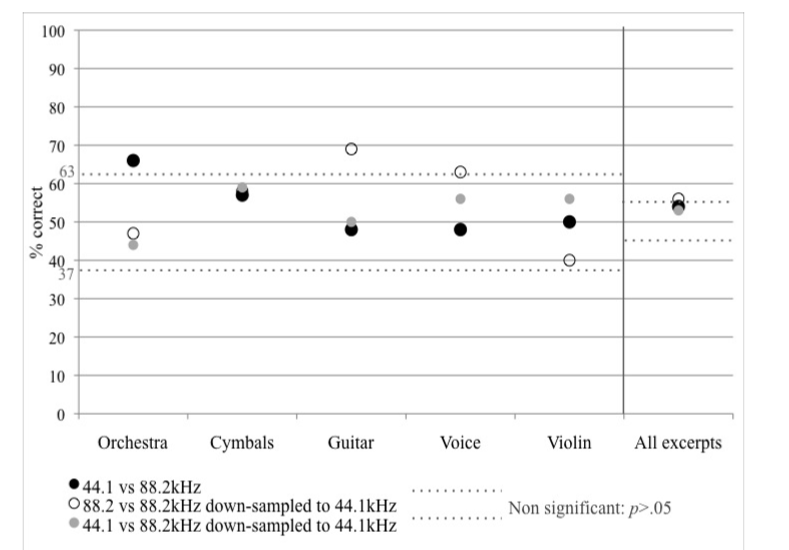
"Findings from the listening tests suggest that expert listeners can detect differences between musical excerpts presented at 88.2 kHz and 44.1 kHz...It should also be noted that all the files used in this study were recorded and presented in 24 bits. Thus, we were not comparing the CD standard ( i.e. 44.1 kHz, 16 bits) with high-resolution formats but restricted our experiment to sample rate discrimination. This choice was based on the fact that limitations of bit-depth of the CD standard at 16 bits have been identified and documented [10]."

How would the general public's limitations have any bearing on my enjoyment?
 
Last edited:
Back to that irrelevant theory thing. I listen to the real world of commercial recordings. The CD of that music is crippled.
Then blame that on bad mastering. You are enjoying 24-bit music for the same reason most people prefer 4K movies: because of better mastering, not necessarily because of any difference they would otherwise be able to distinguish versus an equally well-mastered 16-bit or 1080p source.

The study you cited proves that -- the average result of a direct 44.1 vs. 88.2 kHz comparison was within the range it declares to be "non-significant".
 
Then blame that on bad mastering.
Return to post #9 for answer.

You are enjoying 24-bit music for the same reason most people prefer 4K movies: because of better mastering, not necessarily because of any difference they would otherwise be able to distinguish versus an equally well-mastered 16-bit or 1080p source.
You're welcome to live in your own reality of idle speculation. Matters not to me.

May you enjoy your 16 bit recordings as much as I do my 24 bit collection. :)

edit: As I kid in the 70s, I dreamed of having original studio masters. The concept was largely unheard of then. There were some albums available in open reel, but none in the original 15 or 30ips format.

Today, however, acquiring The Master 24 bit recording - in a range of sample rates - is quite common. Isn't that incredible? Why carve it up? I agree with mastering engineer Brian Lucy on this point:

"Let’s just sell the 24 bit files at the mastering session sample rate, not higher and not lower, and call it a day? Too easy perhaps for the creativity of modern commerce."

http://fairhedon.com/2017/11/05/an-interview-with-mastering-engineer-brian-lucey/
 
Last edited:
As for the sonic of LPs, I definitely feel like there are some limitations with that as well

Yes certainly, and it's been well documented through the years, especially regarding dynamics as well as sound quality differences between the first and last tracks. Still,with a decent LP and a good turntable, it really makes no difference with the vast majority of music IMHO, and is really just a matter of preference.

Physical media of any type is a niche market.

Yes, that's the way it will be from now on, I'm pretty sure, but it could very well remain a significant one.

But for delivering the final, finished product, 16-bit digital audio is still capable of delivering greater dynamic range than any recording can possibly take advantage of without damaging either your speakers or your hearing. Especially with modern pop music which has very limited dynamic range, all 24-bit audio would do is waste storage space and streaming bandwidth.

Yes, I believe that too from everything I've heard and read, as well as personal listening experience. It really all comes down to first the recording production and second the quality of the audio equipment with the most important factor there IMO being the quality of the speakers or headphones, considering the high level of quality inherent in decent audio equipment these days.
 
24-bit (or even 32-bit) digital audio is great for studio use, because it allows many layers of editing and processing effects to be used without any chance of cumulative quantization noise ever becoming audible. But for delivering the final, finished product, 16-bit digital audio is still capable of delivering greater dynamic range than any recording can possibly take advantage of without damaging either your speakers or your hearing. Especially with modern pop music which has very limited dynamic range, all 24-bit audio would do is waste storage space and streaming bandwidth.
Get's even worse when they take an older recording and claim it's "Hi-Res" by surpassing 16-bit it was originally recorded in. Lipstick on a pig at that point.
 
Yes, I believe that too from everything I've heard and read, as well as personal listening experience. It really all comes down to first the recording production and second the quality of the audio equipment with the most important factor there IMO being the quality of the speakers or headphones, considering the high level of quality inherent in decent audio equipment these days.

It seems to me that as you say, the quality of the recording (as well as the mastering) and the quality of the system are going to make far more difference than the whether or not it's either CD or SACD (or other his res format). The differences with mastering and playback gear are things that can be plain as day, even for non experienced listeners, but it seems that there are even experienced listeners who have trouble hearing the difference between CD quality and hi res digital...
 
Is that something that's commonly done? It's not like you can add resolution to digital files that was never there in the first place...
Glad you asked considering a majority of the "Hi-Res" offerings are proposed this way, even the stuff before digital. Though I'm not a digital format person, after a ton of reading I've come to realization that the OG's of digital hit the nail on the head the first time. https://www.realhd-audio.com/?cat=45 is an audio engineer, digital lover, that debunks a ton of misnomers.
 
Which is why many of us transitioned to 24 bit content many years ago. As in how most modern recordings are captured.
Yep, great for recording and editing because it offers more headroom. Pointless for an end user.
Redbook was designed around 1970s media. We've long gone beyond that arbitrary limitation.
It is not arbitrary. It is the best consumer audio format, at least in its physical form. In fact, even 14 bits would be good enough, but 16 bits provides more than enough breathing room if you want to hear jet engine roar from thirty feet in your living room.
There are many good reasons why no recordings made today use the ancient 44/16 standard.
The reasons are mostly marketing, if we are talking about end user product.
I've borrowed a few that do indeed sound very good, though only subtly better than what I heard with regular old CDs and then I have to wonder about how much the improvement is really in the higher resolution or in the remastering process that the SACD reissues tend to go through.
SACD is no better than a dithered CD, it simply stores bitstream that 1-bit DAC would generate. It is especially funny to see how those who say that 1-bit DAC is a cheap solution for the masses, extolling virtues of SACD.
I like coffee.
I spend 5 to 10 minutes in the morning, making two, double espresso shots.
When I first wake, I put the vintage Italian coffee machine on. (The one that I strip down & clean, twice a year)
After 10 minutes, it's up to temperature, and so I can weigh 19g of beans.
These are then ground and the resulting powder is pressed down by a force of approximately 10kg/m2.
Then the hot water filters through the 'wall' of compressed coffee powder, and after +/- 25 seconds, I achieve a double shot (30ml).

Every morning I do this twice.
Meh. Too much tech. I use Turkish pot. I don't time it and don't measure anything. If today it tastes slightly different than yesterday, well, this is what imperfect analog world is about, isn't it?

Anyway, back to the original topic. When I can buy a 128 GB memory card for $20 - this is about 180 CDs in Redbook quality - there is no reason for CD to exist.
 
I'll say this for SACD, I haven't had access to a lot of these things, but with the ones that I have checked out, there wasn't anything like an across the board improvement in the sound quality that I could hear. With some the SACD version was a bit better (but only subtle so) and with others the difference between SACD and regular CD sound was pretty much imperceptible. I have to wonder then if it's differences between the way that the CD and SACD masters are handled that make up much of the difference, not so much the actual format..?
 
Wow. Here we are! 2020 was the year LPs surpassed CDs in sales revenue - now it's both revenue and actual units moved for 2021.

https://www.google.com/amp/s/www.newsweek.com/vinyl-accounts-over-half-physical-albums-sold-2021-surpasses-cds-first-time-1666483?amp=1

- 41.7 million new LPs sold in 2021 (up from 27.5 million in 2020).
- 40.6 million CDs sold in 2021 (up from 40.2 million in 2020).

CD's outsold LP's about 40 to 0 where it matters to me: at my house.

As for the numbers, I look for CD sales to stabilize around to 40 million mark annually. LP sales have peaked. When the nostalgia buzz is over it will be down, down, down.
 
There are two different properties of digital recordings that matter. The bits - they define the dynamic range. And the sampling frequency - this directly infuences the sound. How´s that? Well, when they created the CD standard they relied on Shannons theoreme. The sampling frequency must at least be two times the highest to be recorded signal frequency. So they said: 20 000 Hz is the upper frequency limit we want to record. And what we can today (the 70es!). However: what cannot be clearly defined with this method is the absolute phase of the highest frequencies a sound of an instrument is composed of. If you sample 20 000 Hz with the double frequency it is not clearly defined where you sample it. So even the amplitude of such an harmonic is not clear. Now it is common wisdom that the harmonics with their amplitude and their phase constitute a sound. This effect cannot be heard when the recorded music simply has no real high harmonics. Electric guitar, even my beloved Hammond Organ. But pianos, cymbals, Women´s voices, an Orchestra, ... have those.

Many years ago I was at an dealer´s exhibition here in Germany. On Pioneer´s booth they had a professional DAT (you remember those?). It worked with the normal 44.1/16 format. But it could be switched to double speed then using 88.2/16. They made a simultaneous live recording of a piano using only high-grade Neumann condenser microphones. They played back using a totl Pioneer amp and (German!) high End speakers. We were shocked about the difference in sound! The 88.2 kHz - recording had the clearness and absence of harshness I knew from live recordings with my A77 High Speed. So yes, the CD - properties are outdated. It is possible to clearly hear more with higher resolution. But it depends on the type of music, on the mastering process and a lot of other things.

And so for me a good thing would be an LP produced from a 166,4/24 master tape to which I then can listen with my Astrion-equipped turntable.
 
Back
Top Bottom