
restorer-john
Addicted Member
Just get a Fluke. I promise you, you'll not regret it. You can place 100% trust in the measurements- something you simply cannot do with cheap meters.


I did it... bought a Fluke 117Just get a Fluke. I promise you, you'll not regret it. You can place 100% trust in the measurements- something you simply cannot do with cheap meters.


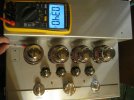

Well, now I'm doing my own research. Looked at Klein multimeters really hard. Passed on those... Now looking at Fluke 17B+
For capacitance testing, here's the specs:
40.00 nF
400.0 nF
4.000 μF
40.00 μF
400.0 μF
1000 μF0.01 nF
0.1 nF
0.001 μF
0.01 μF
0.1 μF
1 μF2% + 5
2% + 5
5% + 5
5% + 5
5% + 5
5% + 5
Good enough?
That post did make me think about testing capacitance and I looked in to tester specifically for capacitors. For a DMM and testing capacitance I was just looking for as wide of a range as possible, even though still being limited.As @whoaru99 mentioned above in post #6, a DMM is great for many things, and a basic check of a capacitor it can often do, but if you truly want to know whether a capacitor is good or failing you need a proper capacitor analyzer that can test all parameters at the rated voltage. With tube gear this is even more difficult because it is unlikely that a tester powered by ~9v of battery can go anywhere near testing a 600V capacitor, and yes it matters.
The same can be said of DMMs with basic transistor test functions; it usually can find good/bad only.

In the beginning... for me... mostly troubleshooting for repairs, later restorations.For small caps, low-voltage applications, you will be able to get what you need from your DMM. You should be able to do all of the troubleshooting that you need with a DMM.
My point (I guess) is that in higher-voltage caps and large (ex: power supply) caps that are expensive enough to warrant testing instead of wholesale replacement, … an analyzer with higher voltage is necessary.
It hinges a bit on whether you’re using it for testing/troubleshooting or for restoration.

 zotektools.com
I did it... bought a Fluke 117
Somehow I overlooked or missed that section at first. I'm usually good about finding my way around a site. I mean it's not my first rodeo, as the saying goes. This is though my first time here to any great extent. First time on any audio based site. Overall happy here and liking the participation.There's all kinds of testers on the DIY section test equipment threads.
It arrived today. It's like I spoiled myself. I can afford to do that, sometimes.It's a great meter for the money. Enjoy.


Good luck! BTW, I suggest a 9V Lithium battery (if that's what the unit takes). Alkaline can spill its guts in old age, ruining the circuit.It arrived today. It's like I spoiled myself. I can afford to do that, sometimes.

For analog VOM, I'm either a Triplett or Simpson 260 guy. For DMM, it's Fluke for me all day long whether portable or bench top.Welcome aboard rick.
Fluke has been in my wheelhouse from day one.
Flukes were standard equipment in the USAF F-15 avionics shops.


