


Four telescopes on Mauna Kea, Hawaii, USA are being used simultaneously to study the center of our Galaxy and so all use a laser to create an artificial star nearby.
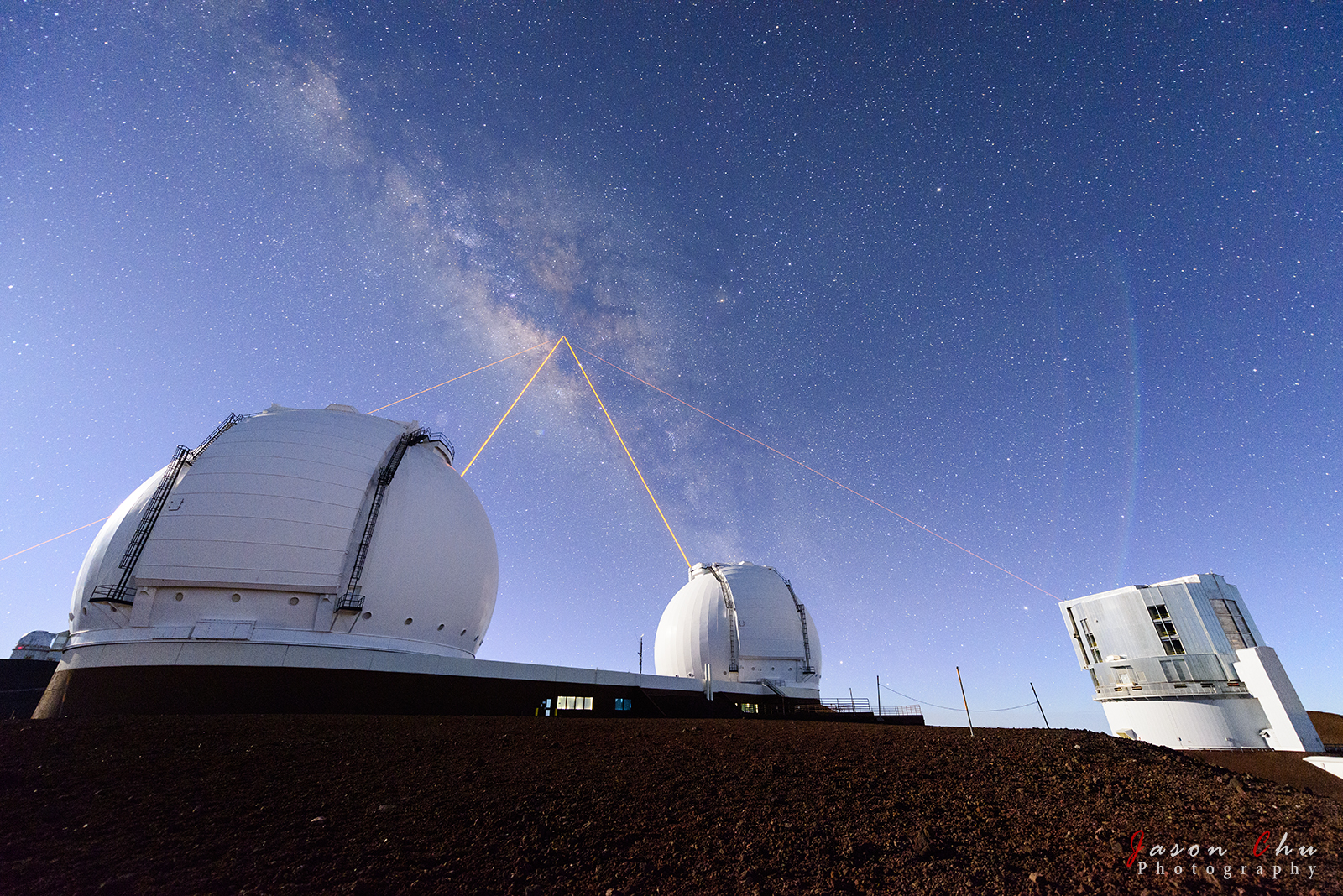
Lasers sent from telescopes are now commonly used to help increase the accuracy of astronomical observations. In some sky locations, Earth atmosphere-induced fluctuations in actual starlight can indicate how the air mass over a telescope is changing so that adaptive optics can be aligned. Sometimes though, no bright star exists in the direction where atmospheric information is needed. In these cases, astronomers create an artificial star where they need it -- with a laser. Subsequent observations of the artificial laser guide star can reveal information so detailed about the blurring effects of the Earth's atmosphere that much of this blurring can be removed by rapidly flexing the mirror.
Lasers sent from telescopes are now commonly used to help increase the accuracy of astronomical observations. In some sky locations, Earth atmosphere-induced fluctuations in actual starlight can indicate how the air mass over a telescope is changing so that adaptive optics can be aligned. Sometimes though, no bright star exists in the direction where atmospheric information is needed. In these cases, astronomers create an artificial star where they need it -- with a laser. Subsequent observations of the artificial laser guide star can reveal information so detailed about the blurring effects of the Earth's atmosphere that much of this blurring can be removed by rapidly flexing the mirror.


