

You are using an out of date browser. It may not display this or other websites correctly.
You should upgrade or use an alternative browser.
You should upgrade or use an alternative browser.
Weird stain or oxidization on silver face knobs (don't use HF ultrasonic cleaner on aluminum knobs)
- Thread starter dlucy
- Start date


The Fuxtor
Addicted Member
I have always just used dishsoap, hot water and a soft nail brush. works well. Sorry about your misfortune...
biscuithead
Me likes the eargasm retroplasm...
I have done this too!
I ended up using Duplicolor High performance Wheel Coating (silver) to paint over them. Turned out alright.
Now I pull the knobs, place them on a plate, soak with windex, let sit for 3 min. spray another spritz of windex and use a q-tip. When I tried the ultasonic cleaner, some of them had paint on them... now to clean paint off of metal, I use Howards neutral, and then clean the oily residue with windex...
I ended up using Duplicolor High performance Wheel Coating (silver) to paint over them. Turned out alright.
Now I pull the knobs, place them on a plate, soak with windex, let sit for 3 min. spray another spritz of windex and use a q-tip. When I tried the ultasonic cleaner, some of them had paint on them... now to clean paint off of metal, I use Howards neutral, and then clean the oily residue with windex...


To clarify, the culprit here was the chemicals used rather than the ultrasonic machine itself, right?. I was planning on trying this with dish detergent or Simply Green.
I have subsequently used the ultrasonic cleaner (device) on the same kind of anodized aluminum knobs and had no problems:
1. I used Simple Green, water and detergent soap
2. Did not use the ultrasonic cleaner powder (from harbor freight)
3. Only left the knobs in the cleaner for 30 seconds

To clarify, the culprit here was the chemicals used rather than the ultrasonic machine itself, right?. I was planning on trying this with dish detergent or Simply Green.
Just use some Palmolive and you will be fine. I would avoid Simple Green because it is rather harsh compared to dish soap.
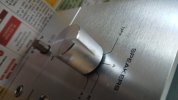
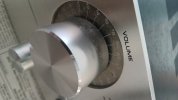
I washed the knobs on my Akai AM 2650 in hot water and a few drops of liquid dish soap. After like 10-15 minutes took them.out and used toothbrush to clean them but I am still left with some marks and have no idea whether these are stains or just usual wear on the knobs. Kindly see attached pics.
Attachments


Old thread, but I'll point out that there is no such thing as "clear anodizing" for aluminum. Anodizing is the process of forming an aluminum oxide layer and then using a dye to color it. Al2O3 forms a layer that seals out oxygen, which it stops the oxidation process and preserves the dyed color.
Anything that is intended to keep the aluminum "shiny" is a clear coat spray of some sort, usually a lacquer, urethane, etc. The only fix if that is damaged (what appears to have happened in the OP) is to strip it all off and reapply.
Ultrasonic cleaner do not attack anodizing nor will it strip a clear coating. You may, however, experience damage to clear coating if it has been damaged by scratching or rubbing through the clear coat as that will give the ultrasonic a corner to work under the clear coating.
Harsh chemicals should not be used in ultrasonic cleaner. Is the cavitation bubbles that do the cleaning, not the chemical. All you need to add to the water is a surfactant to change the surface tension of the water so it will flow over surfaces. A simple soap serves this purpose and you don't need much of it. I use a "vevor" US cleaner for record and a tablespoon of jet dry is more than enough. For my 20L Branson US cleaner that I do things like carburetors in, a tablespoon of something like "Dawn" dish washing soap is all that's needed. The Dawn soap is a surfactant but also deals better than jet dry for holding the petroleum products in suspension once the US cleaner strips them from the parts.
I. personally, just drop my control knobs/levers into a bowl of warm water with some dish washing soap and leave them for a while. Then a wipe and a rinse and they usually come out sparkling clean. It may take a second coat for deeply dirty items. I like to use the least aggressive process possible on face plates and control knows to preserve silk screen lettering and clear coatings.
Anything that is intended to keep the aluminum "shiny" is a clear coat spray of some sort, usually a lacquer, urethane, etc. The only fix if that is damaged (what appears to have happened in the OP) is to strip it all off and reapply.
Ultrasonic cleaner do not attack anodizing nor will it strip a clear coating. You may, however, experience damage to clear coating if it has been damaged by scratching or rubbing through the clear coat as that will give the ultrasonic a corner to work under the clear coating.
Harsh chemicals should not be used in ultrasonic cleaner. Is the cavitation bubbles that do the cleaning, not the chemical. All you need to add to the water is a surfactant to change the surface tension of the water so it will flow over surfaces. A simple soap serves this purpose and you don't need much of it. I use a "vevor" US cleaner for record and a tablespoon of jet dry is more than enough. For my 20L Branson US cleaner that I do things like carburetors in, a tablespoon of something like "Dawn" dish washing soap is all that's needed. The Dawn soap is a surfactant but also deals better than jet dry for holding the petroleum products in suspension once the US cleaner strips them from the parts.
I. personally, just drop my control knobs/levers into a bowl of warm water with some dish washing soap and leave them for a while. Then a wipe and a rinse and they usually come out sparkling clean. It may take a second coat for deeply dirty items. I like to use the least aggressive process possible on face plates and control knows to preserve silk screen lettering and clear coatings.