• The move to the new server is done. There are some software and database maintenance updates in process. This has us passing the hat around to help out. We appreciate any donations. Seriously, even a dollar helps. The payment page may be found here - https://www.audiokarma.org/support.html

We're all in agreement that recapping is good, right? AU-D11

I sure hope not. The lower ESR of film caps will play havoc with sound quality. I used them in my AU717, AU919 and AU7900 restorations. Now those amps are clear and detailed, rather than warm and fuzzy. They are just about ruined. So sad.
This comment bears thinking about, I have recently become aware that putting film capacitors in locations where a low value electrolytic used to be, should not be a hard and fast rule. Sometimes electrolytics are better in some locations if you want to preserve the sound signature of the piece.

Postscript
Sadly we are having the luxury of choosing low value capacitor type taken away from us by the avalanche of capacitor manufacturers ceasing production of low value electrolytics. Meaning that you will be forced to use film capacitors anyway. :(
 
This comment bears thinking about, I have recently become aware that putting film capacitors in locations where a low value electrolytic used to be, should not be a hard and fast rule. Sometimes electrolytics are better in some locations if you want to preserve the sound signature of the piece.

Postscript
Sadly we are having the luxury of choosing low value capacitor type taken away from us by the avalanche of capacitor manufacturers ceasing production of low value electrolytics. Meaning that you will be forced to use film capacitors anyway. :(

What locations would those be?
 
I sure hope not. The lower ESR of film caps will play havoc with sound quality. I used them in my AU717, AU919 and AU7900 restorations. Now those amps are clear and detailed, rather than warm and fuzzy. They are just about ruined. So sad.
I have a strong feeling this comment was meant sarcastic.
Anyway, I do not understand the fuzz about ESR in coupling caps, when wel choosen considering F3, the few tens of mOhms will not matter. What is the bad happening? Especially considering the coupling capacitor is in series with 1 or 2 resistors!
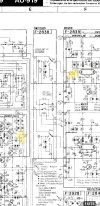
Example of the AU-919, output of the flatamp to the driver board:

Screenshot_20240123-161521_Moon+ Reader.jpg

100 Ohm resistor on the output, a 390 Ohm resistor on the input.
As far as I know the benefit of a film capacitor is lower distortion compared to a electrolytic.
 
An example may be in the Sources of the dual Input FET's of the power amp...

I always wondered why Sansui didn't use film capacitors parallel with the MV103 in the input stages.
In the alpha 607/707 MR models they go up to two 47uF in bipolar config.
For the 907 MR they use two 2,2 uF in bipolar config ( 1,1 uF ) while they have 1 uF film capacitors in the power supply?!
 
An example may be in the Sources of the dual Input FET's of the power amp...
In my opinion it is not worth debating this topic when opinions are very strong, one way or another. The sound quality assessment can only be subjective, measurements of capacitor distortion are too low in numbers to be subjectively audible, of course according to the same crowd that points to measurements as proof of everything.
 
An example may be in the Sources of the dual Input FET's of the power amp...

And why/how will film capacitors there be detrimental to sound quality? Have you A/B'ed these, leaving all other components the same? What was the difference you heard?

Asking so I can learn how to determine for myself where film caps are going to make the amp sound bad.
 
Last edited:
In my opinion it is not worth debating this topic when opinions are very strong, one way or another. The sound quality assessment can only be subjective, measurements of capacitor distortion are too low in numbers to be subjectively audible, of course according to the same crowd that points to measurements as proof of everything.

Comparative listening is a form of measurement. Is this acceptable?

I will not be replacing films with electrolytics in my amplifiers unless someone makes a case for why I should do so (and explains the circuit characteristics and variables that can be used to determine when/where films will degrade performance).

Arguing that I should do so because the manufacturer used electrolytics originally is not compelling.
 
Comparative listening is a form of measurement. Is this acceptable?
Apparently only acceptable when in favour of using film instead of electrolytic.
People even go as far as saying that when you like electrolytic better you probably like "warm and fuzzy" instead of "clear and detailed" :biggrin: !

Arguing that I should do so because the manufacturer used electrolytics originally is not compelling.

Mhh, I trust more in the expertise of a renowned manufacturer as Sansui then someone playing with his amplifiers at home.
There is often said that in the '70s there were no film capacitors large enough in value or they were to expensive. Funny that my Sansui CA-606 and BA-150 have 1 uF film capacitors at the input stages.
This was 1971-72.
 
Apparently only acceptable when in favour of using film instead of electrolytic.
People even go as far as saying that when you like electrolytic better you probably like "warm and fuzzy" instead of "clear and detailed" :biggrin: !


Mhh, I trust more in the expertise of a renowned manufacturer as Sansui then someone playing with his amplifiers at home.
There is often said that in the '70s there were no film capacitors large enough in value or they were to expensive. Funny that my Sansui CA-606 and BA-150 have 1 uF film capacitors at the input stages.
This was 1971-72.

I don't know what "Mnh" means?

So your position is that only like for like component replacement is acceptable?

If so, good for you. I just don't share your opinion. Do you only use NOS transistors and diodes as well? No modern resistors?

And yes, my rebuilt 717 sounds very good to my ears. Much better than the all-original unit sitting here waiting for me to get to it.
 
Last edited:
Comparative listening is a form of measurement. Is this acceptable?

I will not be replacing films with electrolytics in my amplifiers unless someone makes a case for why I should do so (and explains the circuit characteristics and variables that can be used to determine when/where films will degrade performance).

Arguing that I should do so because the manufacturer used electrolytics originally is not compelling.
Comparative listening is acceptable for the individual doing it, not to be conveyed as absolute truth and applicable to other individuals. Unless you are a known reviewer for some hifi publication, then there might be more credence, but even then it is not guaranteed, many people think they hear better than the famous golden eared reviewers.
 
Comparative listening is acceptable for the individual doing it, not to be conveyed as absolute truth and applicable to other individuals. Unless you are a known reviewer for some hifi publication, then there might be more credence, but even then it is not guaranteed, many people think they hear better than the famous golden eared reviewers.

Is anyone here conveying it as absolute truth and applicable to others?

What I am seeing is that some members are claiming that film caps are, or may be, detrimental to sound quality. If they hear the difference, bully for them.

I have not heard this difference, but am open to doing A/B if someone can explain how to determine when/why/where a film cap is going to be better, neutral, or detrimental.

Or is it everyone's view that they are always bad?
 
Is anyone here conveying it as absolute truth and applicable to others?

What I am seeing is that some members are claiming that film caps are, or may be, detrimental to sound quality. If they hear the difference, bully for them.

I have not heard this difference, but am open to doing A/B if someone can explain how to determine when/why/where a film cap is going to be better, neutral, or detrimental.

Or is it everyone's view that they are always bad?
It is highly individual and taste dependent, therefore not worth debating. I tried some WIMA's instead of electrolytics, and very quickly ended up pulling them out and putting back fresh electrolytics. I just did not like the change in sound. Why or how to explain it, does not really matter to me. Somebody else might like the films more. But that is just it, for someone's warm and fuzzy there is other person's natural and realistic, for someone's clear and detailed there is someone else's sharp and edgy. And who has the right to proclaim which is correct?
 
It is highly individual and taste dependent, therefore not worth debating. I tried some WIMA's instead of electrolytics, and very quickly ended up pulling them out and putting back fresh electrolytics. I just did not like the change in sound. Why or how to explain it, does not really matter to me. Somebody else might like the films more. But that is just it, for someone's warm and fuzzy there is other person's natural and realistic, for someone's clear and detailed there is someone else's sharp and edgy. And who has the right to proclaim which is correct?

You seem to think that you do. Or am I misunderstanding?
 
You seem to think that you do.
I assume that people get and bother with vintage equipment because of the sound, not only the looks, so I might have advised sometimes not to put films in. I (maybe wrongly) assumed that people like the vintage sound (the one you call warm and fuzzy). But I do that rarely (not more than once or twice so far), and from now on I will clarify it more, if I recommend that at all any more.
 
It is highly individual and taste dependent, therefore not worth debating.

This is often true, sadly.
Some people on here I can discuss ( debate) the choices in components. Capacitors, resistors, transistors, etc. We share our opinions, our thoughts, without making our opinion more important or more true then the opinion and experience from others.
Just for example: I follow closely the restorations of Hyperion, leestereo, Bumpalump, argou, TupolevFan etc. We do not agree on enough parts of the restoration process. Some change everything to film, some even use foil resistors, change out every transistor they can find a replacement for, some keep everything as original as possible, some decide per case what they like to do, but I see an attitude of listening, sharing thoughts and enjoyment of the equipment. Furthering our combined knowledge and appreciation of the equipment we work on.
What I personally have a little problem with is that some opinions are shared as if they are facts. Like saying that the higher ESR of two electrolytic capacitors in series compared to a film capacitor will make the sound "warm and fuzzy".
 
I'm confused. You love it, but you're parting with it?

In any case, yes, recapping a 50 year old amp is a good thing. Along with other preventive maintenance.
Electrolytic caps have a limited lifespan, so recapping after 10 years in older equipment makes sense. Modern day production caps have much better, longer lasting seals to keep them from drying out, so a longer lifespan can be expected of them. I recapped an integrated amplifier for a buddy and kept all the old caps and measured them for capacitance and leakage current, just to see if they really needed replacement. Only one out of 15 or so needed replacement, a 10uF, 50Vdc unit that read a fraction of a microfarad. Had that cap been good, the recapping would have had no effect on the amplifier's operation at all. The faulty cap bypassed an emitter resistor, resulting in a channel volume imbalance, and replacing that cap fixed that.
 
I don't know what "Mnh" means?

So your position is that only like for like component replacement is acceptable?

If so, good for you. I just don't share your opinion. Do you only use NOS transistors and diodes as well? No modern resistors?

And yes, my rebuilt 717 sounds very good to my ears. Much better than the all-original unit sitting here waiting for me to get to it.

I can not find where I say: "only like for like". It is not my "position". Although I have a fast collection of Sansui amplifiers, starting with monaural tube amplifiers, tube and solid state pre/power/integrated from the '60s/early '70s, the first DC integrated AU-707, through the DD, SFB up to the alpha/X-balanced pre/power/integrated.
So I do consider a lot in how far I want to deviate from the original design, otherwise I can better buy the latest Sansui made ( alpha 907 NRA ) and be done with it.
Or just buy something new.
My interest is in the development of the circuit and amplifier design just as much as the enjoyment of the music.
And I love to be the devil's advocate :biggrin: .
 
And why/how will film capacitors there be detrimental to sound quality? Have you A/B'ed these, leaving all other components the same? What was the difference you heard?
Perhaps I didn't quote a very good example, I freely admit I am rather in the dark about Sansui 'voicing' or characteristic SQ, except that it exists. And also except in the case of capacitor coupled designs where the output capacitors themselves coupled with the supporting electronics hold the key.

And as for the Electrolytic vs Film controversy, I only said in effect that there may be some connection between not using electrolytics, and using films instead, potentially to the detriment of how the amplifier should sound. What I haven't done is months or years of experiments to prove this, nor have I written up a paper for you to read and then discard because you don't like my testing methods.

Nobody knows the answer to this - not chapter and verse anyway, we are all learning, this is a discussion forum, not a one stop shop for the answers to the meaning of life!

Spark old chap - just calm down, take some things with a pinch of salt, file it away as a 'possible' and get on with the rest of your life.
 
Last edited:
Back
Top Bottom