• The move to the new server is done. There are some software and database maintenance updates in process. This has us passing the hat around to help out. We appreciate any donations. Seriously, even a dollar helps. The payment page may be found here - https://www.audiokarma.org/support.html

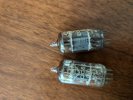
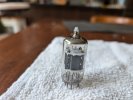
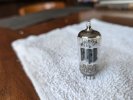
What are these mullard 12au7 tubes?

plagoniste

New Member
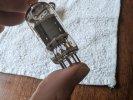
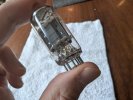
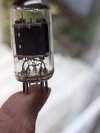
Hi! Calling for your great experience to help me identify these tubes that I came across recently. Mullard old logo "Made in Great Britain" 12AU7 ECC82, but not much more info. The etched code is completely off on 1 tube and the other is suuuuper hard to read. It's definitely yellow paint, I think I see an "E" and then "38" but I might really been imagining this.. I took a lot of pictures of that code area, not sure if it renders it or if these other pictures can help you identify this one? Thanks!
PXL_20241009_152048564.jpgPXL_20241009_152106028.jpgPXL_20241009_152112925.jpgPXL_20241009_152308515.jpgPXL_20241009_152336657.jpg
 
Register to hide this ad
Sorry - I do not recognize these tubes & cannot read the codes.
However:
- the flat dimpled getter should tell us something. This is unique. I probably have 20x Mullard ECC82 tubes; nothing similar to this. Upscale appears to have similar tubes for sale. I would contact them & ask if there are any etch codes (see below).
- You are right to focus in the etch codes. This should tell us tube type & factory. I am not sure what the photos show, but I don't think that is the etch code. Keep looking at the tubes, fog them up with your breath, use a flashlight, etc., to see if you find something else.
 
There are a couple internet references linking flat dimpled disc getters to 'Philips (maybe Holland) 1970's'
 
It is an odd getter design for a tube to have late in the manufacturing cycle. Must have been some reason (cheaper? change to disperse different getter material?) .
The appearance bother me; I have seen it before too, but not mullards. I ended digging through some boxes & found a pair of Amperex (Valvo label, Gf9 ⊿1D1) 12au7 with same getter.
 
It is an odd getter design for a tube to have late in the manufacturing cycle. Must have been some reason (cheaper? change to disperse different getter material?) .
The appearance bother me; I have seen it before too, but not mullards. I ended digging through some boxes & found a pair of Amperex (Valvo label, Gf9 ⊿1D1) 12au7 with same getter.
i have a few myself… u know, i never seen that getter style on mullards.

i often wonder these things as well. between that and the flying saucer, well, are the design engineers just amusing themselves??
 
Wow! So this would NOT be a mullard? It was rebranded or something? It flashes on startup and I think it has wavy glass at the bottom
 
Tough to tell from here, but -
- I don't think it is a 'Mullard' out of the Blackburn or Mitcham factory
- Pretty good chance this is a later production Philips tube, made somewhere w/Mullard label. Philips owned Mullard.
- I have never seen an 'E' factory code tube, but apparently they exist! Hyperlec Brive (Correza, Spain). If you type in the right words, you can see some internet links of Hyperlec/Philips/'Mullard satellite'. However, I am not ready to bet it all on just an 'E'. Let's see if some other members chime in with some info!
 
if BEL aka "the indian mullard" made a dimpled disc getter, that may explain the funny codes.

interesting.
"Early production old logo Mullard" is an odd thing to say about a getter style done in the philips family in the 70s. there may be more to it than i know, but i know upscale DOES mislabel and incorrectly identify tubes.
 
@ceylon you got it. The non-electrical support rods between the spacers and the elongated 'ECC82' printing are correct for the low-microphony version.

Mullard and Philips were intertwined since the 1920s, either name would appear on tubes depending who the contract was for. So its both a 'Mullard' and a 'Philips,' not a later rebranding.
 
Might the "BVA" logo on the glass tell us something about here they were manufactured?

 
BVA = British Radio Valve Manufacturers Association, essentially a cartel, formed in 1926. Mullard was a charter member. Philips wholly owned Mullard after 1927 so became a member.

EDIT: Ooops, correcting my own bad info on the internet. Philips applied for membership in 1929 and became a full member in 1932.

Thank you, "History of the British Radio Valve to 1940" for that useless information.
 
@ceylon you got it. The non-electrical support rods between the spacers and the elongated 'ECC82' printing are correct for the low-microphony version.

Mullard and Philips were intertwined since the 1920s, either name would appear on tubes depending who the contract was for.
thats part of it. if not branded by manufacturer, the
seller who supplies end-user often rebrands and relabels a tube.
that could be another manufacturer or an organ company, broadcaster, auto manufacturer, wholesaler, retailer...

the philips family included many manufacturers, mullard being one.
the different manufacturers rebranded many tubes inside or outisde the philips family.

So its both a 'Mullard' and a 'Philips,' not a later rebranding.
eh, nope.
heres the scoop my friend:

tubes are identified by manufacturer, not parent company or rebrander.
if manufactured by philips at herleen, sittard, copenhagen etc it is philips. if manufacture by mullard at blackburn, mitchum, etc it is mullard.
you can often use manufacture codes or structural idiosynchracies, like the tilted getters of valvo (also in the philips family) and mullard-connected matsushita, the sooth plates of EI yugoslavia and TF, and so on.

 
Last edited:
Back
Top Bottom