

You are using an out of date browser. It may not display this or other websites correctly.
You should upgrade or use an alternative browser.
You should upgrade or use an alternative browser.
What are your favorite vintage speakers?
- Thread starter cubdog
- Start date


SingleAction
Active Member
ESS AMT-3 Rock Monitors

Doctordirt
Silence is Broken
Large advents, circa 1974


FredC
Well-Known Member
can you name any speaker that can top that. I dare you. in it's price range that is.
Isn't that the model they called the "AMPKILLER?" Impedance drops as low as 0.8 Ohm at 30Hz. They've been known to shut down some of the most expensive amps and eat lesser ones for lunch.

wineslob
Wiping out white van
can you name any speaker that can top that. I dare you. in it's price range that is.
Apogee Scintilla, Diva. Nah!


lorne
Sonic Lizard
Well, my Tannoy IIILZ's came from a garbage tip. Does that trump ...?can you name any speaker that can top that. I dare you. in it's price range that is.
:yes:

FredC
Well-Known Member
Well, my Tannoy IIILZ's came from a garbage tip. Does that trump ...?
Your amp will be on the top of that tip if you try to drive those Kappa 9's lol

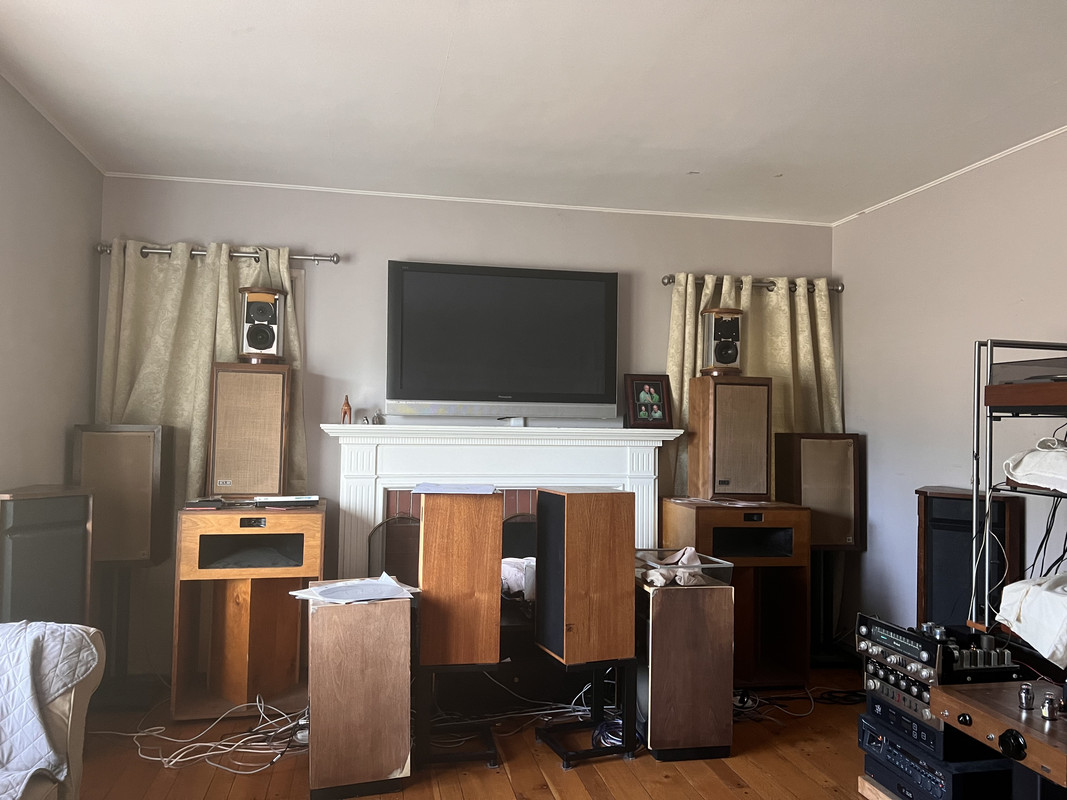
Difficult question for me to answer as I have too many. I've had periods of jamming most of them into my listening space, as my avatar indicates. Lately, I've thinned out that room(although not the collection) and have the following as my "first team":
Allison One
AR3
KLH Five
JR 149
Klipsch La Scala
Bozak 401 Rhapsody
Spendor BC-1
These are the one's that I find myself wanting to listen to the most, so I guess they're my (current) favorites. I have a soft spot for the 3's, the Five's and the One's because of my New England roots(same goes for my EPI M50's which are currently on the sidelines) and those being speakers that as a young man could only drool over but never afford. The La Scala's I love because I can use any amp I want with them and they always sound great. The same goes for the 401's. Finally, the BC-1's and 149's allow me to indulge my love of British gear(as does my Quad 303 amp).
With all of them, there are yet so many others that I would love to try someday, but that's a topic for another page.
Allison One
AR3
KLH Five
JR 149
Klipsch La Scala
Bozak 401 Rhapsody
Spendor BC-1
These are the one's that I find myself wanting to listen to the most, so I guess they're my (current) favorites. I have a soft spot for the 3's, the Five's and the One's because of my New England roots(same goes for my EPI M50's which are currently on the sidelines) and those being speakers that as a young man could only drool over but never afford. The La Scala's I love because I can use any amp I want with them and they always sound great. The same goes for the 401's. Finally, the BC-1's and 149's allow me to indulge my love of British gear(as does my Quad 303 amp).
With all of them, there are yet so many others that I would love to try someday, but that's a topic for another page.
lorne
Sonic Lizard
Sansui SP-G88: C. 1987. Mostly a domestic Japanese speaker, but I believe some got to Germany. And in my opinion, they were Sansui's answer to the Yamaha NS -1000.
I bought these heavy speakers many years ago as used. In 2010 one of the titanium tweeters just went bust. So I took a long train ride to Tokyo's Akihabara. I bought a pair of British-made, silk dome tweeters that matched the output of the originals. For my taste, this improved the sound. In their original configuration, they were a little bright. I also rewired them, installed new capacitors, and built a new board for jacks that accommodate either bananas or spades. I also pulled off the child-proofing screens.
These speakers are quite sophisticated. The 12 inch woofer diaphragms are a combination of carbon weave and fiberglass. The 4 inch squaker diaphragms are made from cross weave carbon. And both units use two magnets that are magnetized in opposite directions. The die cast frames have been carefully engineered for rigidity by using two sorts of structure and varying thicknesses to enhance rigidity.
The proof that all this stuff is not just gimmickry is in the sound. They are balanced and present good detail so you can hear all the instruments. Recently, I found that the preamp section of my renovated 1970’s Pioneer SA-8900 produces more articulate low frequencies than the Melos tube ‘pre’ I have used for years with these speakers. The drum kit and bass guitar sound amazing, and yet are balanced nicely with the rest of the frequency range. The downside is that the Melos GK may make the Sansui’s image better. The power comes from Trio/ Kenwood L-05M mono amps.

I think I’d have to spend a lot of money to replace these with a modern speaker. I’d like smaller units, cuz frankly they’re too big for my small room. I painted the cabinets a sort of baby blue which moderates the dreary monolithic look and keys onto the decor.
I bought these heavy speakers many years ago as used. In 2010 one of the titanium tweeters just went bust. So I took a long train ride to Tokyo's Akihabara. I bought a pair of British-made, silk dome tweeters that matched the output of the originals. For my taste, this improved the sound. In their original configuration, they were a little bright. I also rewired them, installed new capacitors, and built a new board for jacks that accommodate either bananas or spades. I also pulled off the child-proofing screens.
These speakers are quite sophisticated. The 12 inch woofer diaphragms are a combination of carbon weave and fiberglass. The 4 inch squaker diaphragms are made from cross weave carbon. And both units use two magnets that are magnetized in opposite directions. The die cast frames have been carefully engineered for rigidity by using two sorts of structure and varying thicknesses to enhance rigidity.
The proof that all this stuff is not just gimmickry is in the sound. They are balanced and present good detail so you can hear all the instruments. Recently, I found that the preamp section of my renovated 1970’s Pioneer SA-8900 produces more articulate low frequencies than the Melos tube ‘pre’ I have used for years with these speakers. The drum kit and bass guitar sound amazing, and yet are balanced nicely with the rest of the frequency range. The downside is that the Melos GK may make the Sansui’s image better. The power comes from Trio/ Kenwood L-05M mono amps.
I think I’d have to spend a lot of money to replace these with a modern speaker. I’d like smaller units, cuz frankly they’re too big for my small room. I painted the cabinets a sort of baby blue which moderates the dreary monolithic look and keys onto the decor.

Chad Michael
Dissonant Rhino
Of the speakers I have, I would call these two vintage:
- JBL L19
- Boston Acoustics A40 series 2
The JBL's have impressive bass capability, the Boston's just sound great with almost every style of music.
- JBL L19
- Boston Acoustics A40 series 2
The JBL's have impressive bass capability, the Boston's just sound great with almost every style of music.

DesertRatt
All Bark, No Bite!
Another few posts and every speaker ever made will be in the list!


gizzyman47
Addicted Member
Of the speakers I own, I'd say my ESS AMT 1a's. Yamaha NS-1000m's or my ADS L810's.