

You are using an out of date browser. It may not display this or other websites correctly.
You should upgrade or use an alternative browser.
You should upgrade or use an alternative browser.
What can I use to clean really dirty circuit boards?
- Thread starter Buzz
- Start date

Register to hide this ad

Oilmaster
Sonycus Peritum
For PCB, components and chassis cleaning : Isopropanyl alcohol mixed with distilled water to bring concentration around 50/50, then flush with distilled water.
For pots and swithces: DeOxit
Attention: transparent plastic and silk screen printed text on glass don't like isopropanyl alcohol, so keep it away from the dial plate! For the rest it works very well.
For pots and swithces: DeOxit
Attention: transparent plastic and silk screen printed text on glass don't like isopropanyl alcohol, so keep it away from the dial plate! For the rest it works very well.

terra1
Addicted Member
If you are going to use anything water-based, I would make sure it is completely dry before powering on or you can have some smoking and shorting. Keep in mind, water can seep into crevices and holes and take awhile to dry.
Just make sure it is powered off and unplugged before cleaning.
If I use isopropyl alcohol, I just use it straight without adding water. But I will echo the caution of using it on silk-screened lettering especially glass. But you said you were using it on circuit boards and I don't see any problem with that.
I don't see any problem with using electronics cleaner that won't leave a residue. Sometimes I will use a less expensive cleaner than Deoxit like Puretronics Extra Strength for general board cleaning and save Deoxit for the pots, switches and other connections..
I have sprayed electronics cleaner on a 1" paint brush and brushed away soot and grime and also helps to clean contacts at the same time. Tape the metal trim with electrical tape. Even though the unit is unplugged, it can still hold a charge. I have sparked inside speaker terminals by accidentally hitting them with the metal trim. I have also used toothbrushes, q-tips, cut up t-shirt squares swabbing with long tweezers. For tough rust on the chassis, I use cut up dish pads.
There are also specially formulated circuit board cleaners.
Just make sure it is powered off and unplugged before cleaning.
If I use isopropyl alcohol, I just use it straight without adding water. But I will echo the caution of using it on silk-screened lettering especially glass. But you said you were using it on circuit boards and I don't see any problem with that.
I don't see any problem with using electronics cleaner that won't leave a residue. Sometimes I will use a less expensive cleaner than Deoxit like Puretronics Extra Strength for general board cleaning and save Deoxit for the pots, switches and other connections..
I have sprayed electronics cleaner on a 1" paint brush and brushed away soot and grime and also helps to clean contacts at the same time. Tape the metal trim with electrical tape. Even though the unit is unplugged, it can still hold a charge. I have sparked inside speaker terminals by accidentally hitting them with the metal trim. I have also used toothbrushes, q-tips, cut up t-shirt squares swabbing with long tweezers. For tough rust on the chassis, I use cut up dish pads.
There are also specially formulated circuit board cleaners.
terra1
Addicted Member
It's not so much the resistors themselves as the little holes and crevices where water can settle in to. I don't know how saturated you were planning to get them.Thanks. I didn't know if any of the resistors, etc. would absorb any of the cleaning solution.
I feel really confident with electronics cleaners. Because they are really formulated and safe for most electronic contacts.
I have literally basted, all board components like resistors, transistors, IC chips with Deoxit D5 and other electronic cleaners and had no problems. So I know how they perform.
The only time I had problems was when I used water based cleaners and didn't let it completely dry.
The other thing to avoid is getting the fins on the tuning capacitor wet.
And also avoid getting the adjusters on the AM/FM board like the plastic cylinders with hexagon ferrite cores or the metal blocks with slotted cores wet. Those affect reception on tuners.


ChrisMarantz
Super Member
+1 on this link :yes:
The days of solvent based cleaners are over. Water based cleaners and a good drying are they only way to go. :thmbsp:

Buzz
Active Member
Cool. Thanks guys. I was always worried any water no matter the amount or drying time was el bado.
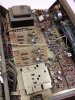
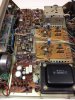
Cleaned it up with a bit of the above mentioned cleaner, will do more thorough cleaning when I get home.
Cleaned it up with a bit of the above mentioned cleaner, will do more thorough cleaning when I get home.
Attachments
Last edited:

Gang-Twanger
Resident Wharfedaliophool
Maybe someone can answer this for me.... Usually, when you ask a question like this, people just say "Deoxit". But what is the difference between say, 'electronics cleaner', 'contact cleaner', and finally the aforementioned 'Deoxit'. I've had trouble understanding this. You go to Radio Shack, and you'll see "electronics cleaner", and then right next to it you'll see a can of "contact cleaner". Which is better, and where does Deoxit fit in here? Is Deoxit an "electronics cleaner", a "contact-cleaner", or something different from either of them? It's time I figure this out once and for all.
Buzz
Active Member
Others will articulate this much better than I can but the contact cleaner I posted a picture of is basically a surface contact cleaner. It will blow out dust and some grime but it won't do much for corrosion that is preventing a good contact. This cleaner can also clean the surface of circuit boards, etc as it leaves no residue and evaporates really fast. Many people use this cleaner to blast out the dust and such of the pots and contacts then treat with Deoxit which has far more better contact cleaning and conditioning properties. It stays with the pot or contact. It deoxidizes the contaminates and really improves the contact surfaces for a long time. It leaves a sort of cleaning residue and wouldn't spray this on a circuit board for cleaning-plus it's expensive.
I used the QD contact solution on a receiver than had scratchy pots. Cleaned them thoroughly with the QD, the channels still dropped out and it was still scratchy. Used Deoxit 5 and within 5 minutes it was perfect-not a single noise or drop out. It's really a miracle product IMO.
I used the QD contact solution on a receiver than had scratchy pots. Cleaned them thoroughly with the QD, the channels still dropped out and it was still scratchy. Used Deoxit 5 and within 5 minutes it was perfect-not a single noise or drop out. It's really a miracle product IMO.
Gang-Twanger
Resident Wharfedaliophool
Others will articulate this much better than I can but the contact cleaner I posted a picture of is basically a surface contact cleaner. It will blow out dust and some grime but it won't do much for corrosion that is preventing a good contact. This cleaner can also clean the surface of circuit boards, etc as it leaves no residue and evaporates really fast. Many people use this cleaner to blast out the dust and such of the pots and contacts then treat with Deoxit which has far more better contact cleaning and conditioning properties. It stays with the pot or contact. It deoxidizes the contaminates and really improves the contact surfaces for a long time. It leaves a sort of cleaning residue and wouldn't spray this on a circuit board for cleaning-plus it's expensive.
I used the QD contact solution on a receiver than had scratchy pots. Cleaned them thoroughly with the QD, the channels still dropped out and it was still scratchy. Used Deoxit 5 and within 5 minutes it was perfect-not a single noise or drop out. It's really a miracle product IMO.
Thanks... I guess part of the confusion is that some companies are vague with labeling. It gets confusing. So Deoxit is a heavy-duty electronics-cleaner for cleaning the innards. I guess what I'm saying is, I like to buy locally, but it's hard to tell what I'm buying sometimes. I wish I could buy Deoxit locally (Shipping can be a PITA where I live because it's on the main drag and I've had a few packages stolen in the past by people as they're walking down the road past my house).
Buzz
Active Member
I would only use Deoxit 5 on contact points-potentiometers or POTS, inside switches, etc. I wouldn't use it for anything else. It's a contact cleaner. When you have noise that is switch or pot related Deoxit is the only answer in my book. I wouldn't even mess with any other brand no matter what it claims. Radio Shack used to sell the small cans of Deoxit. I would look there.
terra1
Addicted Member
I've been confused by the Radio Shack cleaners as well.Maybe someone can answer this for me.... Usually, when you ask a question like this, people just say "Deoxit". But what is the difference between say, 'electronics cleaner', 'contact cleaner', and finally the aforementioned 'Deoxit'. I've had trouble understanding this. You go to Radio Shack, and you'll see "electronics cleaner", and then right next to it you'll see a can of "contact cleaner". Which is better, and where does Deoxit fit in here? Is Deoxit an "electronics cleaner", a "contact-cleaner", or something different from either of them? It's time I figure this out once and for all.
They used to have one of the cans labeled Tuner Cleaner. It sprayed out white and bubbly, then cleared up. The reviews were mixed from ok to made things worse.
I haven't tried their other cleaners, just because, we have Deoxit available locally. And Deoxit is maybe $2-$3 more.
Everybody has their own preference based on their own experiences.
Once they find something that works safely they stick with it because it is confusing to decipher all the labels. That's also why I avoid automotive cleaners. Things I would look for are words like for audio electronics, for potentiometers, circuit board contacts...
A lot of people use different formulations depending on what is available locally. Deoxit is just one of those with a shared common experience.
Here are tips from various threads and even this is not complete --- take from it what you will:
Pots/potentiometers are the rotary knobs. If you use Deoxit D5 recommended with Faderlube F5 to replenish lubrication.
Switches can be toggle levers or buttons. Use Deoxit.
Sliders are fader knobs that slide like on equalizers. Recommended to use Faderlube only on these. "Fader" - lube.
Some will recommend only Faderlube F5 or Deoxit D100 (can may be labeled D100S-2) on rotary knobs so as to play it safe and not lift and damage sensitive membranes or coatings. Although I don't know if it might just be the repeated working back and forth.
Some report damage to Sherwood volume knobs using D5.
Some recommend Deoxit D5, Faderlube, and Gold as a complete regimen for cleaning pots. Deoxit D5 to clean. Faderlube for lube, Gold for longer term preservative. Some just use Deoxit/Gold combintation.
I don't use the Radio Shack twin pack of Deoxit DN5 and Gold GN5 because it's uneconomical. And the 14 gram quick-drying breath sprays seem more suited for cleaning RCA jacks and connections rather than for fully flushing switches, pots and other contact cleaning. In fact the label on the package at RS now identifies it for what it is "Connector Cleaner." Quick dry, no flushing action.
So I prefer the 5 oz (142 gram) Deoxit D5 (which has more solvents and flushing action for cleaning) and/or Faderlube F5 (for more lube) for just about all my cleaning applications. Just my preference. They are more easily available locally.
Radio Shack has the DN5 GN5 twinpack Connector Cleaner. About $15 for 14 grams. They also have other house brand cans labeled electronic cleaner.
Deoxit D5 5oz 142 grams can be found for about $13.99, Faderlube F5 $11.99 at Fry's. You can also find Deoxit at Guitar Center or any musical instrument store. Prices can vary.
14 grams v 142 grams: You get 10 times more product for less than half as much more dollars.
Also do not confuse D100L which is listed as the ingredient in Deoxit D5 with Deoxit D100. If you want 100% Deoxit (no solvents) look for D100 or D100S-2 on the label of the can.
As far as alternatives some people like CRC. There are cheaper electronics cleaners than Deoxit, and for large cleanup to be economical, I will use Puretronics (or any specifically for audio electronics and non-residue) or anhydrous 99.9 alcohol from Fry's for general cleanup of boards/large surface areas and use Deoxit/Faderlube specifically for pots, Deoxit for switches and final contact cleanups or where I deem worthy of the best stuff. Careful of some sprays which spray out freezing cold which can damage solder joints. Or Radio Shack's special contact tuner cleaner which sprays out white bubbly and crackly like pop rocks before it clears up and leaves a greasy petroleum residue.
Tutorial on cleaning with Deoxit (sticky in General Audio):
The Idiot's Guide to Using DeOxit (revisited)
http://www.audiokarma.org/forums/showthread.php?t=207005
Tips on cleaning tuner (sticky in Tuners):
How to clean a tuner (analog)
http://www.audiokarma.org/forums/showthread.php?t=144163
See thread for recommendations on non-residual contact cleaners.
Here's the best summary I have found on the various Deoxits:
DESCRIPTION OF VARIOUS DEOXIT
http://store.caig.com/s.nl/it.I/id.66/.f
A) Standard Spray: Provides flushing action
Products:
DeoxIT® D5 Spray (D5S-6) & DeoxIT® D5 Mini-Spray (D5MS-15)
DeoxIT® GOLD G5 Spray (G5S-6) & DeoxIT® GOLD G5 Mini-Spray (G5MS-15)
DeoxIT® SHIELD S5 Spray (S5S-6) & DeoxIT® SHIELD S5 Mini-Spray (S5MS-15)
Formulation: 5% DeoxIT® (active ingredient), 75% odorless mineral spirits (carrier solvent), 20% propellant
Formulation contains petroleum naphtha (odorless mineral spirits) solvent, and is briefly flammable (until solvent evaporates within 2-3 minutes). It's slower to evaporate, providing flushing action to remove surfaces dirt, grease and other contaminants. Is ideal for connectors and components removed from equipment or those that are easily accessible. It is safe on plastics. When in doubt, always test for compatibility, especially vintage equipment with aging ABS plastic(s).
B) Non drip - Quick Dry Spray: Nonflammable, fast evaporating carrier solvent formula
Products:
DeoxIT® DN5 Spray (DN5S-6) & DeoxIT® DN5 Mini-Spray (DN5MS-15)
DeoxIT® GOLD GN5 Spray (GN5S-6N) & DeoxIT® GOLD GN5 Mini-Spray (GN5MS-15)
DeoxIT® GOLD GX5 Spray (GX5S-6N)
DeoxIT® SHIELD SN5 Spray (SN5S-6N) & DeoxIT® SHIELD SN5 Mini-Spray (SN5MS-15)
Formulation: 5% DeoxIT® (active ingredient), 75% 1,1,1,3,3-PENTAFLUOROPROPANE (carrier solvent), 1-5% isopropyl alcohol, 20% propellant
May be used where fast evaporation and/or non-flammability is required, and no dripping is preferred. It is also safe on plastics.
C) 100% Spray: No solvents, metered one-shot valve
Products:
DeoxIT® D100 Spray (D100S-2)
DeoxIT® GOLD G100 Spray (G100S-2)
Formulation: 20% DeoxIT® (active ingredient), 80% propellant
May be used where maximum lubrication is needed, but solvents are not desired. For example, where cleaning and lubrication is required or over-spray might adversely affect sensitive plastics. DeoxIT® utilizes a metered valve which sprays short bursts of 100% liquid.

and to maybe add more confusion ...
gold v deoxit ....
http://www.audiokarma.org/forums/showpost.php?p=3693359&postcount=117 Gold is recommended as preservative for longer term maintenance. Part of a complete pots regimen consisting of Deoxit D5, Faderlube F5, and Gold G5. You often just see D5 and F5 recommended and it works well. That's because it's a bit of stretch of the budget to add a 3rd additional can of Gold G5 for some. Some just use D5 and G5.
Last edited:

DeOxit is way too expensive to be spraying all over PC boards. I blast off grimy boards with compressed air in the garage, and then douse the boards with Glass Plus and 'scrub' with a cheap unused paintbrush, and then hit it again with compressed air.
Last edited:

I've seen before and after shots of circuit boards that were tossed in an ultrasonic bath to clean. Amazing machines if you have access to one.
For those that don't have one, I've used rubbing alcohol, sometimes mixed with water scrubbed in with an acid brush that I cut the bristles down on to make them stiffer. Rinse with distilled water and dry thoroughly.
For those that don't have one, I've used rubbing alcohol, sometimes mixed with water scrubbed in with an acid brush that I cut the bristles down on to make them stiffer. Rinse with distilled water and dry thoroughly.


4seatPilot
"Broker"
DeOxit is way too expensive to be spraying all over PC boards. I blast off grimy boards with compressed air in the garage, and then douse the boards with Glass Plus and 'scrub' with a cheap unused paintbrush, and then hit it again with compressed air.
???Windex???
It does that too???
4seatPilot
"Broker"
No ammonia. I prefer something more gentle.
ah - that makes sense. I'll have to try that (or the simple green crystal also mentioned) on my 840 boards... the ones a cat was living above... the nice thing is that they are out of the receiver. the not so nice thing is I'm not sure if I'll be able to get the darn thing back together. Fortunately I just picked up another non-working one that can be my guide for re-assembly if nothing else...