Can you explain that tuning eye tube thing? I'm not following what you've said.
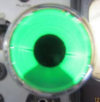
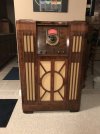
I was showing you pics of the black dial Zenith that has a following so you can compare it with the one you got, which isn't as desirable as a collector piece. The tuning eye (or "Magic eye") is best described by this wiki article;
"A
magic eye tube or
tuning indicator, in technical literature called an
electron-ray indicator tube,
[1] is a
vacuum tube which gives a visual indication of the amplitude of an electronic signal, such as an audio output, radio-frequency signal strength, or other functions.
[1] The magic eye (also called a
cat's eye, or
tuning eye in North America) is a specific type of such a tube with a circular display similar to the EM34 illustrated. Its first broad application was as a tuning indicator in
radio receivers, to give an indication of the relative strength of the received radio signal, to show when a radio station was properly tuned in."
Now, to address this;
"I just don't have any technical knowledge. Would it be safe to mess around with something like this?"
If you don't mind I'm gonna save myself a whole lot of typing here and do a cut & paste of a response I gave a different poster just the other day asking basically the same question, this was in response to a guy asking about a Magnavox that is a family heirloom;
"Although it's never right to make blanket statements like "it's never the ceramic caps" because on rather rare occasions they DO fail, it's just not all that often compared to the two common other types that do fail all too regularly. BTW, ceramic caps were around a lot longer than 1956, in not only Magnavox but in every other manufacturer's equipment as well. The two most failure prone caps are the "paper & foil" type, whether they are covered in carboard/wax or hard plastic, and the "electrolytic" type.
No, you will not be using "NOS" capacitors, as age is as big of a factor in their demise as use is. you will be using all brand new caps.
Now, for the hard part and please don't take this as an attack on your lack of skills, because it's not........
Just from the questions your asking, and your self description as a "Nube", it's plainly obvious your not yet ready to restore this console. Nobody, not a single one of us here, was born with all of the knowledge/skills needed to do expert repairs on complex vintage tube equipment, it just doesn't happen that way. What I believe would be best for you if you want to do this restoration yourself, would be to put this console away for a while, and set out to learn the skills required to not destroy this sentimental piece with failed novice repairs. There are three things that will greatly enhance your chances of success. First & foremost, start watching some of the millions of UTube videos there are on restoring vintage tube equipment. Realize of course that not every UTube video creator is the expert they profess themselves to be, there are a lot of hackjob artists/pretenders out there but the more you watch and learn the more you'll be able to recognize who the real experts are VS who are the ones who should have their soldering irons confiscated & impounded. And that brings us to the next item up, soldering. You are gonna need to be able to make quality solder joints (connections), again with the UTube videos but this also has to be a hands on learning experience, no amount of watching videos of others do it is gonna impart the skill onto you, ya gotta do your "time in the trenches" and there is no better way than (after watching the UTube tutorials) buying a few cheap electronic kits (Yes they do still exist) and build them to gain your soldering experience. Lastly, tying your newly learned knowledge & soldering skills together, you'll bring them into the vacuum tube world by picking up a couple or few cheap "AA5" AM tube radios from someplace like EBay, yard sales, or perhaps consider buying a $25 subscription here at AK and put a wanted to buy ad in "BarterTown" for a few cheap "AA5" radios (unrestored) to learn the nuances of actually replacing things like capacitors & resistors in vacuum tube equipment. (I'm gonna make your first real homework assignment to be a search of "AA5 tube radio" and begin your education there).
I know that sounds like a lot, but if your really interested in restoring this yourself, that's the basics of what it's gonna take. You really WERE lookin for a new hobby, right?

Cause once ya really get into it, , , the restoration of vintage tube equipment is a fine hobby (obsession

) indeed......
PS, STOP plugging the console in, there are several components that can go up in smoke, pricy sometimes not easy to source components, that will live just about forever AFTER the appropriate restoration repairs are made......

"


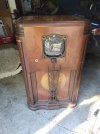

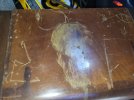
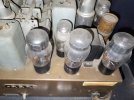
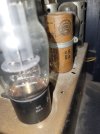


 ), the hole drilled in the front for the toggle switch kludge that's likely covering for the original power switch being bad, the badly scratched, lifted, gouged veneer, and missing knobs, I see a parts set there (or a VERY ambitious restoration that'll likely cost more than it's worth).