• The move to the new server is done. There are some software and database maintenance updates in process. This has us passing the hat around to help out. We appreciate any donations. Seriously, even a dollar helps. The payment page may be found here - https://www.audiokarma.org/support.html

What does this sound mean? Proton Audio Amp

elguapo511

New Member
I have a proton audio D940.

It was working fine last night, and this morning started to make and extremely horrible faded/crackle sound.

I just had this open and cleaned everything out, so I do not believe this is a dirty pot issue.

Any thoughts. I posted a link to the sound its making. Here is the dropbox link
https://www.dropbox.com/s/1jabemgo63l0v39/Amp issue.m4a?dl=0

I un plugged the amp and the pre amp, and the pre amp works, so this is an amp issue.
 
Register to hide this ad
I've had amps sound like that before. Twice it was failing caps, once it was a failing small signal transistor.

Others should be along shortly who know more than me. But in the meantime, I would do the following:
  • Verify it's all inputs that are distorting and work all controls to see if it makes an audible difference even if it doesn't go away.
  • Isolate the preamp section from the amp section (at the jumpers on the rear) to determine where the distortion is.
    • Plug a portable device (with volume control, i.e., an iPod?) into the "main in".
    • Use the "pre-out" to another amp.
    • Visually inspect all electrolytic caps, look for bulging tops (compare with others nearby, often plastic cap is slightly domed but that is not necessarily an indication of failure)
      or goo at base (but learn what the glue looks like too)
Report back on those 1st steps. Once we know if its in the amp or the preamp section we can help you narrow it down.

I don't want to advise too much poking around until we know your skill/knowledge level yet.
 
My skill level is minimal As far as soldering and cap inspection/ replacement.

i checked the amps pre amps inputs etc.

it is a fault of the amp section - confirmed.

i opened it up last week to get to a very scratchy source switch. I had to remove the top board which seemed like the transistor board.

i cleaned the switch/pot and managed to re assemble to working order... for about a week.

now a completely different horrible sound.

so i am familiar with what is inside.

i have a voltometer, and a soldering iron... what now?
 
Normally I would suspect the selector switch. It's not uncommon after cleaning a pot/switch for it to need a follow-up a short time later. But, since you've isolated the distortion to the amp section I think you can rule that out.

After looking at pics of the 940 on the web I think it's safe to say the board you referred to moving to access the selector switch is the tuner board.

So, if I were in your shoes I would be back in there focused on the lower mainboard. If the unit has a removable bottom plate I would remove that and look for cold solder joints and/or lifted solder pads. This will be tedious. If there is not a removable panel under the board this will make life very difficult. From the topside, really inspect all wire connections and caps.

One thing, does the distortion start out from cold? Or, does it come on as the unit warms up? If the latter, you could use freeze spray to cool sections to see if that eliminates distortion. This can lead to finding a faulty component.

Also helpful might be to make use of a non-conductive probe (I have a set of plastic chopsticks for this). Gently poking and pushing on components in the amp section might help find a bad solder joint.

I hope that helps. Like I said, hopefully someone more knowledgable than I will comment. I'm just a tenacious hack with better than average deduction abilities. Or should that be induction abilities?
 
Normally I would suspect the selector switch. It's not uncommon after cleaning a pot/switch for it to need a follow-up a short time later. But, since you've isolated the distortion to the amp section I think you can rule that out.

After looking at pics of the 940 on the web I think it's safe to say the board you referred to moving to access the selector switch is the tuner board.

So, if I were in your shoes I would be back in there focused on the lower mainboard. If the unit has a removable bottom plate I would remove that and look for cold solder joints and/or lifted solder pads. This will be tedious. If there is not a removable panel under the board this will make life very difficult. From the topside, really inspect all wire connections and caps.

One thing, does the distortion start out from cold? Or, does it come on as the unit warms up? If the latter, you could use freeze spray to cool sections to see if that eliminates distortion. This can lead to finding a faulty component.

Also helpful might be to make use of a non-conductive probe (I have a set of plastic chopsticks for this). Gently poking and pushing on components in the amp section might help find a bad solder joint.

I hope that helps. Like I said, hopefully someone more knowledgable than I will comment. I'm just a tenacious hack with better than average deduction abilities. Or should that be induction abilities?

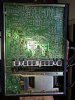
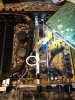
i have the bottom open. Does not appear to have any raised or coldjoints. Maybe the picture will help.

the distortion starts out right away. Not sure if temperature is the issue.
 

Attachments

  • 9B5946F7-C59C-4ADA-97E6-914CE875049E.jpeg
    9B5946F7-C59C-4ADA-97E6-914CE875049E.jpeg
    96.6 KB · Views: 9
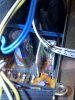
The whole area looks pretty bad. Do i just replace the small thing that definitely looks blown up, or the tall blue cylinder that looks like it leaked everywhere? I look forward to broadening my vocabulary.
 
that leaking is actually glue and might have become conductive .
the R902 is a burned resistor . it appears that it will connect to that green transistor so that may or not be bad too .
 
Yes, I see some charred resistors and some bad electrolytic capacitors. That glue which was used to secure those capacitors often gets conductive with age, and likely caused this problem to happen. And those electrolytic capacitors on this are at the age where they can benefit from replacement.
 
page 14 of the pdf .R902 2.2k ohms ..2200 ohms
its part of a negative regulator
looks there are few possible reasons that caused that resistor to burn up
 
page 14?

page 17 had a resistor part list. i have no idea what is on page 17.

So, from a novice point of view.....

If i track down a 2.2k ohms ..2200 ohms 1/4watt resistor.

De solder the broken one
Re solder the new one.

That might repair the situation?
 
Back
Top Bottom